The hidden hunger crisis: how rising CO2 levels are diminishing the nutritional value of staple crops


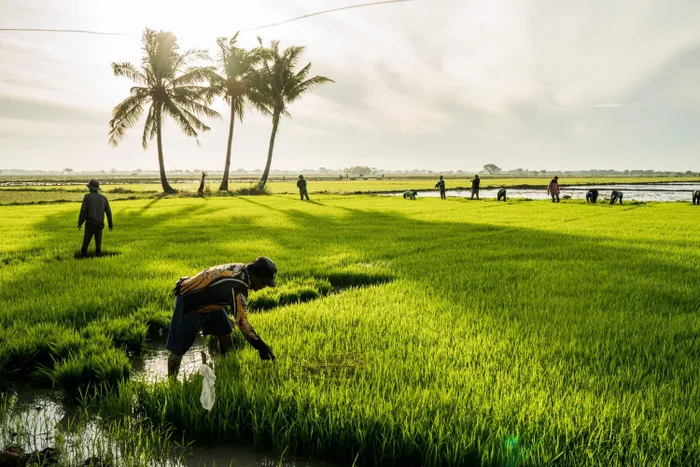
Farmers in a rice field in Nueva Ecija, Philippines. Climate change is projected to diminish the nutritional value of the crop over time, and higher temperatures can lead to a higher concentration of arsenic, a toxic heavy metal.
Image: The Washington Post
In 1988, a simple meal of chickpea and rice curry was a nutritional powerhouse, providing 22% of a person’s daily zinc requirement. Today, that same plate of food meets only 20% of the recommended intake. By 2040, the chickpeas alone will provide just 17%—a decline that threatens to trigger a global epidemic of "hidden hunger."
While the world focuses on the warming effects of carbon dioxide, an invisible chemical shift is happening inside our crops. Surging CO2 concentrations, fueled by fossil fuel combustion, are fundamentally altering the way plants grow, making humanity’s most important staples—wheat, rice, and beans—significantly less nutritious than they were a generation ago.
The phenomenon is driven by a biological trade-off. Plants use CO2 for photosynthesis, and higher concentrations of the gas allow them to grow larger and produce more carbohydrates, such as starch and sugar. However, they do not increase their intake of soil minerals at the same rate. The result is a "dilution effect": crops may yield more, but each bite contains fewer proteins, vitamins, and minerals.
As Kristie Ebi, a professor at the University of Washington, explained, the diets we eat today have less nutritional density than those of our grandparents, even if we eat exactly the same thing. Furthermore, CO2 affects how plants "breathe." With more carbon available, plants open their pores (stomata) less frequently. This conserves water but slows the internal suction that draws mineral-rich water from the roots to the rest of the plant, further starving the crop of essential nutrients like iron and zinc.
For those in wealthy nations, the "great dilution" is an inconvenience that can be countered with supplements or a more diverse diet. But for the billions of people who rely on a single staple crop for half their daily calories, the consequences are life-threatening. Zinc deficiency is already linked to nearly 500,000 child deaths annually from treatable illnesses like pneumonia, yet zinc levels in chickpeas are projected to drop by 40% by 2040.
Additionally, by mid-century, over a billion additional women and children could be at risk of iron-deficiency anemia, a condition that significantly increases the risk of fatal complications during childbirth. In regions like Nigeria, where over half of reproductive-age women are already anemic, the further depletion of iron in staple foods is described by experts like Nike Bello as extremely concerning.
Solving the nutrient crisis requires more than just growing more food. Experts suggest that governments must move away from subsidising a few high-yield staples like rice and wheat and instead promote nutrient-dense crops like millet and sorghum, which are more resilient to CO2 changes.
Ultimately, however, researchers agree that there is no technological "silver bullet" for a degrading atmosphere. While carbon may act as "plant food" in a narrow sense, the broader environmental damage—including intensifying heatwaves and droughts—is expected to cut overall crop yields by 20% by 2050. Samuel Myers, Director of the Johns Hopkins Institute for Planetary Health, warns that there is no silver lining. To protect the nutritional integrity of what we eat, the only true solution is to halt the rise of CO2 at its source.