South Africa's Earth Day 2026: call for sustainable change


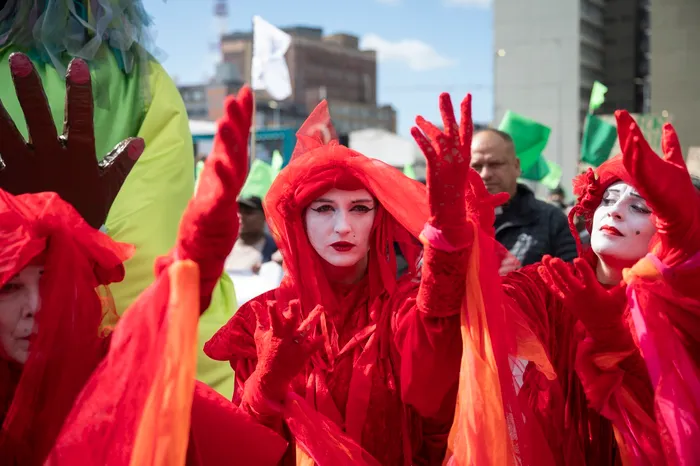
Protesters gathered in Cape Town on Earth Day, calling for a just transition and rejecting what they described as “false solutions” to the climate crisis.
Image: Armand Hough
As the sun rose over Cape Town this Earth Day, the shadow of Table Mountain fell not just on a city in celebration, but on a nation in transition. Under the 2026 theme, "Our Power, Our Planet," South Africa has reached a critical tipping point. The conversation has shifted away from the abstract "green-washing" of the past toward a gritty, practical realism. From the boardroom of global logistics giants to the vegetable gardens of primary schools in KwaZulu-Natal, the message is clear: sustainability is no longer a choice—it is the new currency of survival.
The logistics of change
Africa’s trade ambitions are accelerating, but as the African Continental Free Trade Area (AfCFTA) unlocks economic potential, the industry is rethinking the "how" of growth. Nelson Teixeira, Managing Director of Operations for Sub-Saharan Africa at FedEx, notes that striking a balance between scaling trade and minimizing carbon footprints is an environmental and commercial imperative.
With transport accounting for up to 14% of South Africa’s national carbon emissions, the sector is undergoing a high-tech overhaul. By deploying electric vehicles (EVs) across Johannesburg, Durban, and Cape Town, and leveraging AI-driven fleet management to optimize routes, logistics leaders are proving that efficiency and ecology go hand-in-hand. This isn't just about Earth Day; it is a roadmap to carbon neutrality by 2040.
Rethinking 'natural' disasters
While corporations optimize delivery routes, the engineering community is issuing a sterner warning. For too long, South Africans have categorized floods and droughts as "natural disasters." On this Earth Day, engineers are calling for a reframing: the hazards may be natural, but the disasters are often man-made.
The failure of stormwater systems and the expansion of settlements into high-risk areas result from human choices.
"The future can no longer be predicted by the patterns of the past," experts argue. Designing for "survivability" means building infrastructure that assumes climate volatility is the new baseline. Resilience is no longer an aspiration—it is an immediate operational priority to ensure that energy, water, and transport systems do not collapse under the weight of the next intensifying heatwave or storm.
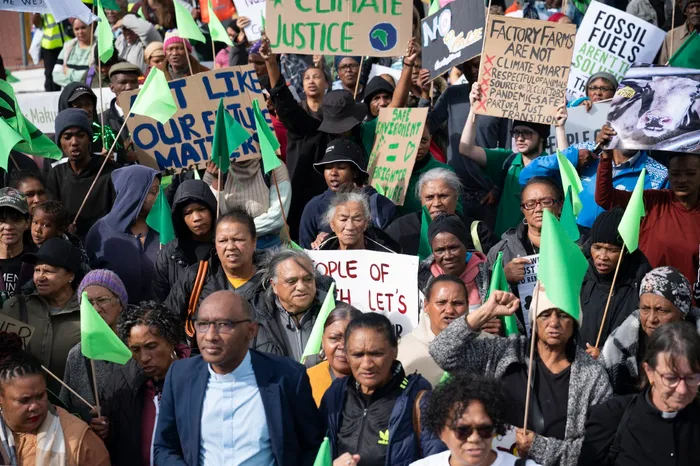
South Africa - Cape Town - 22 April 2026 - Protesters gathered in Cape Town on E Led by groups including SAFCEI, Fossil Free SA, Project 90 by 2030 and Extinction Rebellion, demonstrators opposed industries such as fossil fuels, nuclear energy and industrial agriculture, arguing they harm communities and the environment.
Image: Armand Hough
The grassroots resistance: no to 'false solutions'
The urgency of the climate crisis was perhaps most visible on the streets of Cape Town, where over 500 activists marched to Parliament. Representing a coalition of faith-based groups and environmental alliances, the marchers rejected what they termed "false solutions"—nuclear expansion, "clean coal," and offshore gas drilling.
"37% of South Africans live below the poverty line," said Lisa Makuala of The Green Connection. "It remains unfair for vulnerable communities to have to choose between buying bread and affording electricity." The demand is for a "Just Transition"—one that prioritizes decentralized renewable energy and protects the human rights of those most affected by rising energy costs and food insecurity.
Nurturing the future in the classroom
In KwaZulu-Natal, the focus was local and literal. At Avoca Primary School, Earth Day was marked by the launch of an "Earth Programme Initiative." Supported by the Department of Forestry, Fisheries and the Environment, the school is proving that change starts with the youth.
By implementing food gardens and urban planting projects, the school isn't just teaching biology; it is teaching self-reliance. As learners wash their hands using water from "JoJo" tanks to tend to their vegetable patches, they are learning that the choices made today — how we manage waste and treat our soil — will shape the world they will inherit. These gardens do more than provide nutrition; they act as a "demo" for a community-wide shift toward agroecology.
Tourism: moving from guilt to connection
Even the tourism sector is flipping the script. Often blamed for high carbon footprints, the industry is now positioning itself as a vital guardian of Africa’s carbon sinks. The Kimkim Climate Action Pilot Programme is empowering South African accommodation providers to measure their impact with scientific precision.
Intact African ecosystems, such as the bushveld, store between 30 and 150 tonnes of carbon per hectare. By connecting travelers to these landscapes, tourism provides the financial engine necessary to protect this "climate infrastructure." The goal is to move away from "traveler guilt" and toward a model where every stay contributes to conservation and community resilience.
A provincial mandate
In the Western Cape, Minister Anton Bredell emphasized that environmental protection is now central to the provincial development agenda. A key priority is the systemic diversion of organic waste from landfills to reduce methane emissions. By shifting toward circular economy principles—repurposing food scraps into compost for sustainable agriculture—the province is demonstrating how policy can influence daily household behaviour.
The choice is ours
Earth Day 2026 has revealed a South Africa that is no longer content with being a spectator to climate change. Whether through the mass march of civil society, the technical rigor of engineers, or the digital innovation of logistics providers, the nation is asserting its "power" over the planet’s future.
The gap between knowledge and action is finally closing. As we move forward, the success of these initiatives will depend on accountability. We have the technology, the data, and the community will. What remains is the discipline to apply them. In the words of the activists at Parliament: "Tell the truth. Act now. Decide together."
Protesters gathered in Cape Town on Earth Day, calling for a just transition and rejecting what they described as “false solutions” to the climate crisis.
Image: Armand Hough
South Africa - Cape Town - 22 April 2026 - Protesters gathered in Cape Town on E Led by groups including SAFCEI, Fossil Free SA, Project 90 by 2030 and Extinction Rebellion, demonstrators opposed industries such as fossil fuels, nuclear energy and industrial agriculture, arguing they harm communities and the environment.
Image: Armand Hough