Italy 1990: The defensively drab World Cup that changed football forever
Fifa World Cup 1990


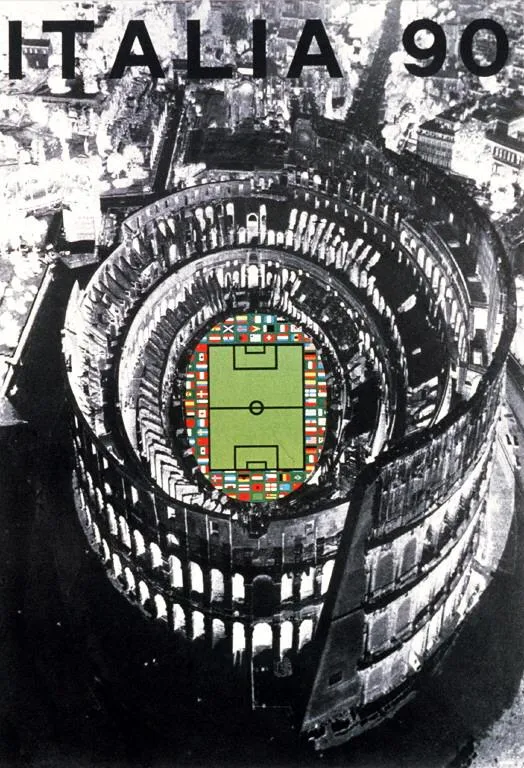
A tournament of cynical defense, historic firsts, and the legendary dance of Roger Milla. Italy 1990 wasn't the highest-scoring World Cup, but it changed the beautiful game forever. Photo: AFP
Image: AFP
Younger Gen-Xers and elder Millennials will arguably look back favourably on the 1990 FIFA World Cup in Italy – after all, for many, it would have been their introduction to the showpiece event.
However, 1990, with its odd Lego-inspired mascot, was characterised by cynical defensive play. It remains the lowest-scoring World Cup still. Indeed, the rules and points scoring system were changed after the event to ensure that it never happens again. Defending champions Argentina, who made the final, were particularly criticised for their tactics during the World Cup, as they scored five goals in six games.
Cameroon captured the imagination of the footballing world, making an unexpected run to the quarter-finals. They were inspired by Roger Milla, who at 38-years old, was convinced to come out of retirement. He would go on to score four goals, dancing his way into the hearts and minds of World Cup lore.
The World Cup also marks the final appearance of a handful of nations. The Cold War was coming to its conclusion and for post-World War II nations such as Czechoslovakia and Yugoslavia, their legacy would be carried forward by successor states, while the Soviet Union would soon break up into Russia and other independent republics.
Who was there?
Africa: Egypt, Cameroon
Asia: South Korea, UAE
Europe: Austria, Belgium, Czechoslovakia, Italy, England, Netherlands, Ireland, Romania, Scotland, Soviet Union, Spain, Sweden, West Germany and Yugoslavia
North America: Costa Rica and the US
South America: Argentina, Brazil, Colombia, Uruguay
Where did they play?
Twelve stadiums were selected across 12 cities, with the Stadio Olimpico selected to host the final.
Due to the rampant hooliganism of the English support base, the British government requested that England play all their group matches on the island of Sardinia. Riots and violence were far too common in English football during this period, and it had spilled over onto the continent in both club and international matches. Such was the severity of the hooliganism, that there was genuine fear that it would increase political tensions between the UK and Italy.
In Cagliari, the Italians increased the police presence, and deployed the special forces of the Italian military. And still, the English rioted several times leading to injuries, arrests and deportations.
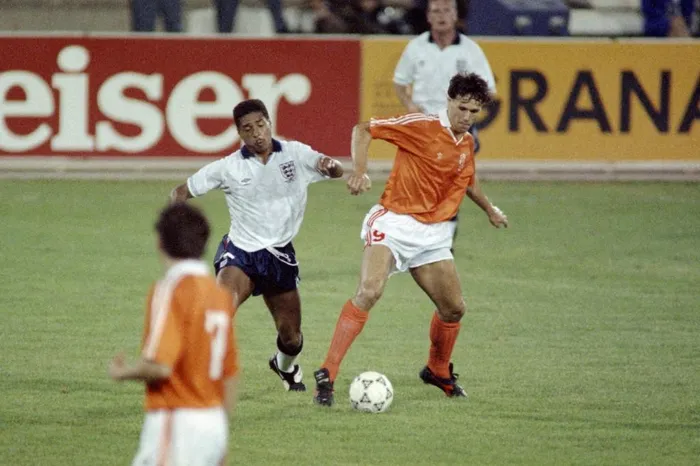
Marco van Basten of The Netherlands. Photo: AFP
Image: AFP
How did it work?
A total of 24 teams were drawn into six groups of four. Group winners and second-placed teams received automatic qualification to the round of 16, while the four best-placed third-place teams – Argentina, Colombia, the Netherlands and Uruguay – also progressed to the next stage of the tournament.
In the beginning
The Dutch were pre-tournament favourites as Euro 1988’s champions. They boasted star players such as Marco van Basten and Ruud Gullit, but the writing was perhaps on the wall when they squeezed through their group to the Round of 16 with three draws, as the third best-placed nation.
Cameroon, meanwhile, topped their group by beating defending champions Argentina with nine men, and then beat Romania 2-1, before losing heavily to the Soviet Union. They would make it all the way to the last eight of the tournament, becoming the first African nation to do so at the World Cup.
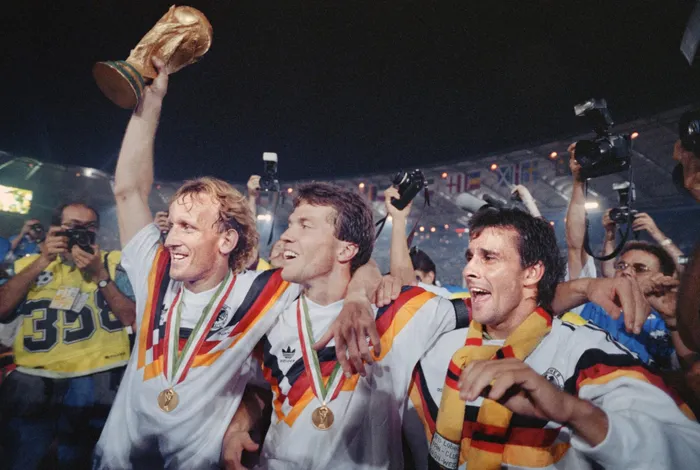
From left, West German defender Andreas Brehme, captain Lothar Matthaeus and Pierre Littbarski celebrate the victory after the Fifa World Cup final between West Germany and Argentina in 1990. Photo: AFP
Image: AFP
The knockouts
Round of 16: Brazil 0, Argentina 1; Spain 1, Yugoslavia 2; Republic of Ireland 0, Romania 0 (5-4 on penalties); Italy 2, Uruguay 0; Czechoslovakia 4, Costa Rica 1; West Germany 2, Netherlands 1; Cameroon 2, Colombia 1 (aet); England 1, Belgium 0 (aet)
Quarter-finals: Argentina 0, Yugoslavia 0 (3-2 on penalties); Republic of Ireland 0, Italy 1; Czechoslovakia 0, West Germany 1; Cameroon 2, England 3 (aet)
Semi-finals: Argentina 1, Italy 1 (4-3 on penalties); West Germany 1, England 1 (4-3 on penalties)
Italy would win the third-place play-off 2-1 against England.
And finally…
The 1990 edition of the World Cup boiled down to a replay of the 1986 final with defending champions Argentina meeting West Germany in Rome. Whereas the 1986 final was the pièce de résistance of Diego Maradona’s masterpiece, the final four years later was a stringent affair by comparison.
Gone was the flair and impetus of the Argentinian team that had won in Mexico, as it was replaced by a drab defensive unit. Argentina had only won two of their five games to get to the final, too; and in the finals had one shot at goal.
The West Germans, coached by Franz Beckenbauer, in comparison, had 23 shots at goal. In the end, the Germans won 1-0 in what has been described as one of the ugliest World Cup finals.
From left field
The Republic of Ireland, making their debut, lived a charmed life in their quarter-final run. They scored only two goals in the tournament – both in the group stages – and did not win a single match to reach the last eight. Instead, they drew all their games and progressed past the Round of 16 on penalties. They were finally kicked out of the tournament 1-0 by Italy.