Sweden 1958: The crucible that forged modern football and crowned a 17-year-old Pelé
2026 FIFA World Cup


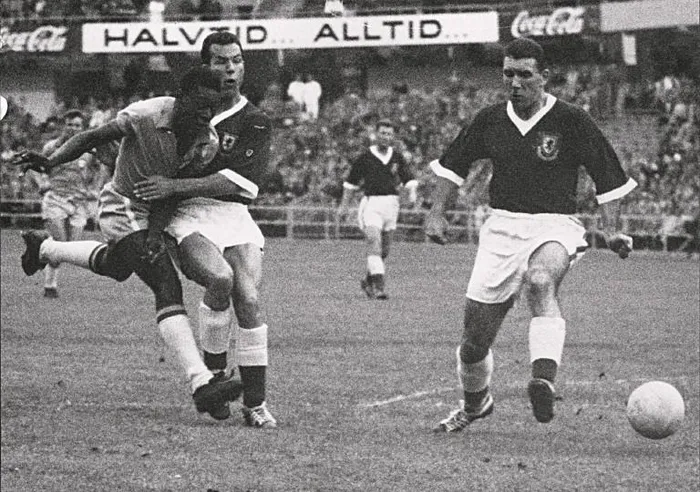
Brazilian forward Pele (L) kicks the ball past two Welsh defenders during the World Cup quarter-final against Wales on 19 June 1958 in Goteborg.
Image: AFP
Football history is fundamentally divided into two distinct eras: before the summer of 1958, and everything that came after.
When the world’s gaze turned to Sweden for the sixth Fifa World Cup, the sport was still largely a regional affair, bound by the limitations of travel and technology. But over the course of three weeks, a tactical revolution, a French goal-scoring machine, and a 17-year-old boy named Edson Arantes do Nascimento — Pele — transformed football from a popular pastime into a truly global, televised spectacle.
The 1958 World Cup was the crucible that forged modern football mythology.
Who was there?
Europe: Austria, Czechoslovakia, England, France, Hungary, Northern Ireland (debut), Scotland, Soviet Union (debut), Sweden (hosts), Wales (debut), West Germany, Yugoslavia
North America: Mexico
South America: Argentina, Brazil, Paragauy
Where did they play?
The tournament matches were played across 12 different venues in 12 cities in Sweden, mostly located in the southern and central parts of the country to minimize travel for the teams.
How did it work?
The format of the competition changed from 1954: 16 teams still competed in four groups of four, but this time each team played each of the other teams in its group at least once, without extra- time in the event of a draw. Two points were awarded for a win and one point for a draw.
In the beginning ...
The tournament marked the debut of Wales, who beat Israel in a play-off. With Northern Ireland, England and Scotland also qualifying, this World Cup was the only one to date to feature all four of the UK’s Home Nations.
This World Cup also included the Soviet Union for the first time, while Argentina returned after a 24-year absence. Two-time champions Uruguay and Italy failed to qualify.
Almost all the matches kicked off simultaneously in each of the three rounds of the group phase, as did the quarter-finals and semi-finals. The exceptions were Sweden's three group matches, all of which were televised by Sveriges Radio; these started at other times so Swedes could attend other matches without missing their own team.
Enter the King
The undeniable fulcrum of the 1958 narrative is Pelé. It is almost impossible to overstate the shockwave caused by a 17-year-old stepping onto the grandest stage and treating it like a kickabout in the streets of Bauru.
Pelé didn't even start the tournament. Sidelined by a knee injury, he was unleashed in the third group game against the Soviet Union, where he provided the assist for Vavá's second goal.
The Goal Machine
While Brazil dominated the narrative, 1958 was not a one-team tournament. It was a festival of attacking football.
It remains the tournament of Just Fontaine. The French striker netted an astonishing 13 goals in just six matches — a record that has stood for nearly seven decades and, in the modern era of hyper-organized defences, is effectively immortal.
The knockouts
Quarter-final 1 (Norrköping): France 4, Northern Ireland 0
Quarter-final 2 (Gothenburg): Brazil 1, Wales 0
Quarter-final 3 (Solna): West Germany 1, Yugoslavia 0
Quarter-final 4 (Malmö): Sweden 2, Soviet Union 0
Semi-final 1 (Solna): Brazil 5, France 2
Semi-final 2 (Gothenburg): Sweden 3, West Germany 1
And finally
The coronation of O Rei (The King) and coronation and the birth of O Jogo Bonito (The Beautiful Game).
After a sequence of goals — the quarter-final winner against Wales and a second-half hat-trick against France in the semi-final — Pele delivered a breathtaking brace against the host nation Sweden in the final that remains one the greatest individual arrivals in the history of sports.
The teenager’s flick of the ball over Swedish defender Bengt Gustavsson in the penalty area before volleying it home in the final is forever etched into the legacy of the Fifa World Cup.
When Brazil captain Bellini lifted the Jules Rimet trophy on June 29, 1958, it was the affirmation that Brazil was indeed a football superpower and helped bury the ghost of the home 1950 final defeat to Uruguay, known as The Maracanazo. It was Brazil's first World Cup triumph.
From left field
The Råsunda Stadium was expanded from 38 000 to 52 400 for the World Cup by building end stands with organising committee chairman Holger Bergérus mortgaging his house to pay for upgrade. It hosted the iconic 1958 final.