Spain 1982: Political tension, global shocks and ultimate Italian redemption at Fifa World Cup
2026 Fifa World Cup


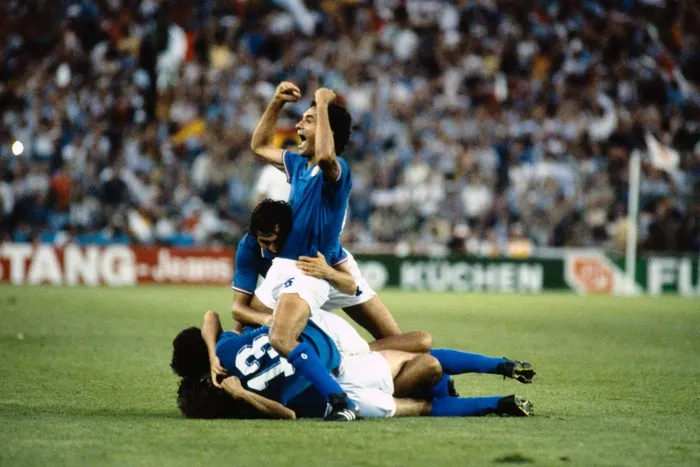
Italian defenders Antonio Cabrini and Claudio Gentile celebrate on top of their teammates after Italy beat West Germany in the 1982 Fifa World Cup in Madrid, Spain.
Image: AFP
The world was navigating a tense and rapidly evolving Cold War landscape, and there were already signs of intense political friction and changing global dynamics at the Fifa World Cup in Spain in 1982.
The tournament was played against the backdrop of the Falklands War, which had concluded just days before the opening match and left the participation of Argentina, England, Scotland, and Northern Ireland shrouded in heavy political tension.
Meanwhile, Eastern European nations competed under the vigilant eyes of their communist regimes, with Poland performing magnificently on the pitch despite the ongoing declaration of martial law back home.
Fifa also expanded the tournament to ensure greater global representation, welcoming debutants from across the globe into a expanded, highly charged competitive atmosphere.
Who was there?
Africa: Algeria, Cameroon
Asia/Oceania: Kuwait, New Zealand
Europe: Austria, Belgium, Czechoslovakia, England, France, Hungary, Italy, Northern Ireland, Poland, San Marino (qualified as part of Italy), Scotland, Soviet Union, Spain, West Germany, Yugoslavia
North America: El Salvador, Honduras
South America: Argentina, Brazil, Chile, Peru
Where did they play?
After winning the right to host, Spain selected an impressive 17 venues across 14 cities, a record at the time. The final was played in Madrid at the iconic Santiago Bernabéu Stadium, the legendary home of Real Madrid. The ground is famous for hosting some of the most prestigious European club matches in history, but in 1982, it became the ultimate stage for international football drama.
How did it work?
Fifa introduced a unique and experimental dual group-stage format for the expanded 24-team tournament. The first round divided the teams into six groups of four, with the top two progressing. The remaining 12 teams were then split into four second-round groups of three. The winners of these exclusive three-team pools advanced directly to the semi-finals, making the second stage an absolute dogfight where any dropped point meant elimination.
In the beginning …
The tournament marked a historic milestone for African football when Algeria produced one of the greatest shocks in World Cup history. On June 16 in Gijón, the Desert Foxes stunned reigning European champions West Germany with a spectacular 2–1 victory.
Tragically, Algeria were later cruelly denied a place in the second round due to the infamous "Disgrace of Gijón" — a match where West Germany and Austria conveniently played out a manufactured 1–0 result that allowed both European nations to qualify at the African team's expense, forcing Fifa to change its rules so that final group games are played simultaneously.
The knockouts
Semi-final 1 (Seville): West Germany 3, France 3 (West Germany won 5–4 on penalties)
Semi-final 2 (Barcelona): Italy 2, Poland 0
Poland beat France 3–2 in Alicante to secure the third-place play-off spot.
And finally …
Italy were heavily unfancied at the start of the tournament after scraping through the first group stage with three uninspiring draws. However, the Azzurri caught fire in the later stages, famously dismantling a magical Brazil side before beating West Germany 3–1 in a fiery final in Madrid.
The triumph solidified the legend of 38-year-old dynamic forward Paolo Rossi, who finished as top scorer, and iconic 40-year-old goalkeeper and captain Dino Zoff, who became the oldest player ever to win the World Cup.
From left field …
The semi-final between West Germany and France in Seville featured the most infamous and unpunished assault in football history. German goalkeeper Harald Schumacher charged out of his box and brutally wiped out French substitute Patrick Battiston, leaving him unconscious, missing three teeth, and with cracked vertebrae.
Remarkably, the referee did not even give a foul — instead awarding a goal kick — and Schumacher went on to be the hero for the Germans in the tournament's first-ever penalty shootout.