Flawed geniuses and winter blankets: How Gazza, Zidane shaped my World Cup romance
2026 Fifa World Cup


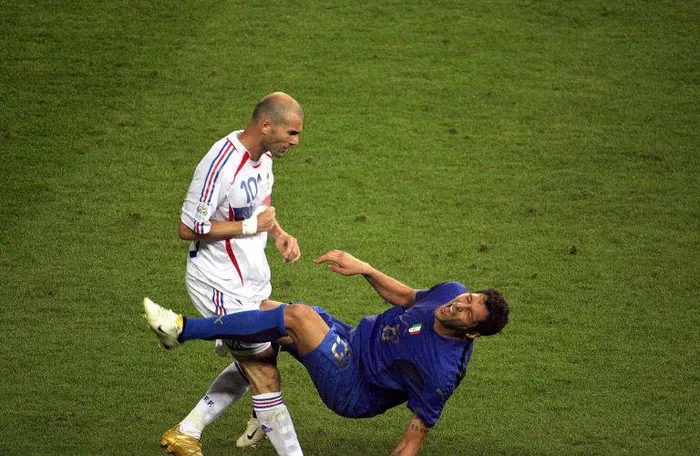
Zinedine Zidane sent Italian defender Marco Materazzi flying with a blow to the chest during the 2006 Fifa World Cup final.
Image: AFP
The Fifa World Cup has always been the ultimate stage for footballing immortality. But for all the icons who have lifted the famous trophy, it is two legends of the game who left me with bittersweet memories of my two favourite World Cups.
They don’t quite make them like Paul Gascoigne and Zinedine Zidane anymore, ridiculously talented showmen who dazzled the football world with their unbelievable skill and grace. But they also had this undeniable mean streak, bringing truth to the adage that all geniuses are flawed.
Gascoigne at Italia '90 and Zidane at Germany 2006 carried their nations on their shoulders, only for their tournaments to end in a visceral, unforgettable tragedy.
My first experience of the Fifa World Cup was as an eight-year-old in the winter of 1990 at my grandparents' house next to the Orange River in Upington. We would watch the matches tucked under blankets with homemade droëwors and biltong.
Gascoigne arrived at Italia 90 as a fiercely talented but unpredictable maverick, and my father’s favourite player as a Tottenham Hotspur fan.
Over the course of four weeks, “Gazza” became the heartbeat of the England team. He played with a breathtaking, childlike freedom that defied the rigid tactical cynicism of the era. Gascoigne didn't just pass opponents; he slalomed through them with a drop of the shoulder and an infectious audacity.
His sublime, chipped assist for David Platt’s late winner against Belgium in the round of 16, followed by his brilliant orchestrations against Cameroon, made my young heart flutter. He was the tournament's undisputed golden boy, playing with a joy that seemed impervious to pressure.
Sixteen years later, Germany witnessed a very different kind of sorcery from a 34-year-old Zidane. Having overturned his international retirement to rescue a struggling France, the ageing virtuoso treated the 2006 World Cup as his grand, operatic swansong.
Where Gascoigne was frenetic energy, Zidane was pure, unhurried elegance. His performance against a star-studded Brazil in the quarter-final remains perhaps the most complete individual football exhibition in modern World Cup history — certainly as far as I’m concerned, especially after leaving Kaká for dead with his famed “Marseille Roulette”.
He converted penalties in both the semi-final and the final with the icy composure of a man who knew he was writing his own script.
Yet, for all their dazzling brilliance, Gascoigne and Zidane were ultimately undone by the volatile emotions that fuelled their genius.
For Gascoigne, the tragedy arrived in the 99th minute of a grueling semi-final against West Germany in Turin. Having already received a yellow card earlier in the tournament, Gazza lunged into a reckless, desperate tackle on Thomas Berthold.
As referee Jose Roberto Wright brandished the yellow card that would rule him out of the final, the realisation hit Gascoigne with a physical force. The boyish bravado vanished, replaced by a devastating vulnerability.
The image of Gazza, lower lip quivering, eyes welling with unstoppable tears as Gary Lineker frantically gestured to the bench, became the defining image of English footballing heartbreak. England would lose on penalties, but the true tragedy was the premature shattering of a young man's ultimate dream.
Zidane’s exit, by contrast, was a tragedy of a dark, almost Shakespearean nature.
Deep into extra time of a tense, deadlocked final against Italy in Berlin, the world watched in stunned disbelief as France's captain turned and delivered a brutal headbutt to the chest of Italian defender Marco Materazzi. It was an act of sudden, inexplicable fury triggered by a verbal provocation. The red card was inevitable.
As Zidane walked off the pitch for the final time in his professional career, he passed agonisingly close to the World Cup trophy, his head bowed, completely isolated in his disgrace. France lost the subsequent shoot-out, leaving Zidane’s legacy permanently intertwined with a moment of madness.
Ultimately, both Gascoigne and Zidane proved that the World Cup's greatest stories are not always written by the victors. Gazza’s tears and Zidane’s red card remain etched in my football memory bank because they reminded us of the fragile, deeply human element behind the superhuman talent.
They dazzled the world, brought their nations to the precipice of glory, and left the stage in tears, ensuring their names would live forever, not just in records, but in the bittersweet romance of the game.