Korea-Japan 2002: Ronaldo’s redemption and Bafana Bafana's goal-difference heartbreak
2026 Fifa World Cup


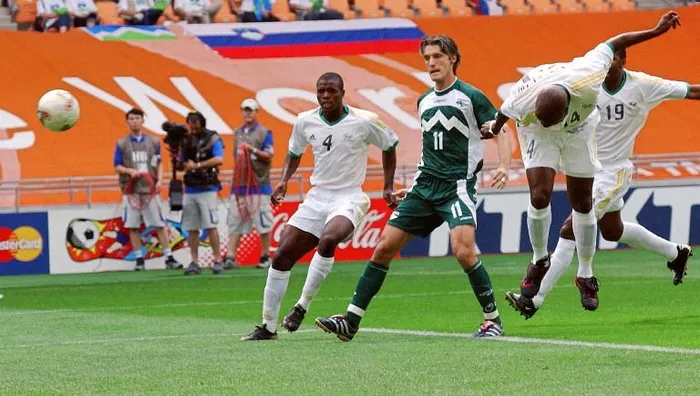
Striker Siyabonga Nomvethe scored the solitary goal in Bafana Bafana's 1-0 win over Slovenia at the 2002 Fifa World Cup. It was South Africa's first ever win at the tournament after they went winless at France 1998.
Image: AFP
The global football landscape was stepping into a bold new frontier, breaking fresh geographic ground as the Fifa World Cup was co-hosted in Asia for the very first time by South Korea and Japan in 2002.
It was a tournament defined by seismic political and sporting shifts. For South Africa, it marked a monumental second consecutive appearance on the global stage, with Jomo Sono’s Bafana Bafana determined to go one step further following their debut in 1998.
Yet, while the tournament celebrated unity and technological advancement, it was also played under the somber, heavy shadow of the September 11 attacks, resulting in unprecedented, iron-clad security protocols across both host nations.
On the pitch, the tournament became synonymous with the "death of the giants." Defending champions France crashed out in the group stage without scoring a single goal, while heavyweights Argentina and Portugal suffered equally shocking early exits, opening the door for an historic mid-tier revolution.
Who was there?
- Africa: Cameroon, Nigeria, Senegal, South Africa, Tunisia
- Asia: China, Japan, Saudi Arabia, South Korea
- Europe: Belgium, Croatia, Denmark, England, France, Germany, Ireland, Italy, Poland, Portugal, Russia, Slovenia, Spain, Sweden, Turkey
- North America: Costa Rica, Mexico, United States
- South America: Argentina, Brazil, Ecuador, Paraguay, Uruguay
Where did they play?
In a massive structural undertaking, a record 20 venues were selected across the two host nations, 10 in South Korea and 10 in Japan.
The spectacular, high-stakes final was played at the International Stadium Yokohama in Japan, a state-of-the-art marvel boasting a capacity of over 70 000 seats. It was the ultimate, ultra-modern stage for a tournament that bridged two distinct cultures.
How did it work?
The tournament featured the established 32-team format, split into eight groups of four. The top two teams from each group progressed to a straight knockout round of 16. It was a format that bred immediate chaos, as unexpected group winners like Denmark, Sweden, and a rampant Spain shook up the traditional bracket, setting up some of the most unpredictable knockout fixtures in modern football history.
In the beginning …
The tournament marked a watershed moment for African football. While Senegal shocked the world by beating France in the opening game and marching all the way to the quarter-finals, South Africa’s Bafana Bafana wore the national colours with immense pride in Group B.
Led by caretaker Sono, who replaced Carlos Queiroz on the eve of the tournament, Bafana secured a thrilling 2-2 draw against Paraguay before claiming their first-ever World Cup victory, a historic 1-0 win over Slovenia in Daegu, courtesy of an early Siyabonga Nomvethe strike.
Needing just a draw against Spain to reach the knockout rounds, South Africa fought valiantly in an absolute thriller, twice coming from behind through Benni McCarthy and Lucas Radebe. Though they eventually succumbed to a narrow 3-2 defeat, their heartbreak was compounded in the cruelest fashion: they missed out on round-of-16 qualification to Paraguay strictly on goal difference, having scored one less goal than the South Americans.
The knockouts
- Round of 16: Germany 1, Paraguay 0; Mexico 0, US 2; Spain 1, Ireland 1 (3-2 on penalties); South Korea 2, Italy 1 (aet); Denmark 0, England 3; Brazil 2, Belgium 0; Sweden 1, Senegal 2 (aet); Japan 0, Turkey 1
- Quarter-finals: Germany 1, US 0; Spain 0, South Korea 0 (5.3 on penalties); England 1, Brazil 2; Senegal 0, Turkey 1 (aet)
- Semi-finals: Brazil 1, Turkey 0; Germany 1, South Korea 0
In the third-place play-off clash, Turkey beat co-hosts South Korea 3-2 in a breathless encounter that featured the fastest goal in World Cup history — Hakan Sukur netting just 11 seconds after kick-off.
And finally …
Brazil were crowned world champions for a record-breaking fifth time, redeeming their painful 1998 final defeat. The Selecao beat a highly disciplined German outfit 2-0 in the final, solidifying the legendary status of the "Phenomenon”, Ronaldo.
The iconic striker scored both goals in the final to claim the Golden Shoe with eight tournament goals, capping off one of the greatest individual comeback stories in the history of world sport.
From left field …
Co-hosts South Korea pulled off one of the most controversial and miraculous runs in sporting history, becoming the first Asian nation to ever reach a World Cup semi-final. Guided by Dutch master tactician Guus Hiddink, the Taeguk Warriors knocked out European royalty in Italy and Spain during successive, highly contentious knockout rounds, matches that remain fiercely debated by football purists to this very day due to several dodgy refereeing decisions.