Unveiling Africa's microbial richness: The African Microbiome Project


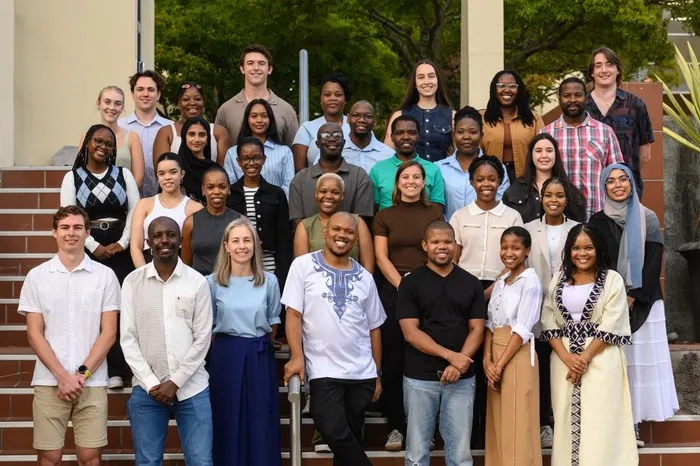
Prof. Thulani Makhalanyane (middle front) leads a large research group in African microbiome research in the Department of Microbiology at Stellenbosch University, consisting of eight postdoctoral fellows, six BScHons, thirteen MSc and nine PhD students. The group is also strategically aligned with SU’s School for Data Science and Computational Thinking, thereby strengthening computational and systems biology skills within microbiome science in Africa.
Image: Peartree Photography
Africa boasts some of the most spectacular, climate-resilient, and biodiverse landscapes on Earth, yet a critical component of this richness remains almost entirely invisible to global science. The microscopic universe of bacteria, fungi, and viruses that populates African soils, waters, and living organisms—collectively known as the microbiome—is conspicuously absent from international datasets. To date, less than three per cent of global microbial diversity has been validly characterised, leaving a staggering knowledge gap that severely limits the scope of modern medicine, agriculture, and environmental conservation.
This profound disparity is finally being confronted by an ambitious pan-African initiative led from South Africa. A newly established South African Research Chair in African Microbiome Innovation at Stellenbosch University, spearheaded by the internationally renowned microbiologist Professor Thulani Makhalanyane, is setting out to radically alter the global scientific landscape. At the heart of this effort is the African Microbiome Project, a monumental endeavour that aims to sequence ten million samples from across the continent, systematically reducing the severe knowledge deficit regarding African microbiota.
Supported by the Department of Science, Innovation and Technology alongside the National Research Foundation, this prestigious research chair aims to attract and retain world-class scientific talent within African public universities. The current concentration of microbiome research in the Global North significantly skews our understanding of biological systems.
Because microbial communities vary drastically on local, regional, and global scales, solutions designed for Western ecosystems or Western demographics are routinely inadequate when applied to African contexts. Professor Makhalanyane argues that this research deficit is particularly perilous given Africa’s acute vulnerability to global challenges, including rapid climate change, infectious diseases, and systemic food insecurity. By generating foundational datasets, this initiative will provide the evidence required to inform local policy, drive regional innovation, and develop context-specific solutions.
The implications of this research stretch far beyond the walls of the laboratory. In human health, science has increasingly shown that the microbiome plays a profound role in regulating everything from disease susceptibility and the immune system to behaviour and food cravings.
In agriculture, soil-dwelling microbial communities are the invisible engines of our ecosystems, controlling nutrient recycling, organic matter decomposition, and carbon sequestration. Unlocking the genetic secrets of African soil microbes could hold the key to developing drought-resistant crops and innovative bio-fertilisers, securing food supplies for millions.
Crucially, the initiative is designed to ensure that African scientists lead these breakthroughs. Historically, global research has suffered from a extraction dynamic, where African samples were shipped abroad for analysis, leaving local institutions without the infrastructure to benefit from their own natural wealth. This new chair explicitly rejects that model.
A primary objective is to build sustainable, long-term computational capacity on the continent by equipping postgraduate students with advanced skills in systems biology, bioinformatics, and machine learning. By creating open-source computational toolkits tailored specifically to African datasets, the project ensures that the continent will actively pioneer microbiome data science rather than merely acting as a data source for others.
As Stellenbosch University rolls out its strategic vision for the coming years, university leadership has noted that the timing could not be more perfect. By leveraging existing local investments in genome sequencing and high-performance computing, the initiative is primed to establish Africa as a global leader in microbial informatics.
True scientific sovereignty requires not just gathering data, but possessing the infrastructure and expertise to interpret it. By bringing Africa’s vast, uncharacterised microbial universe out of the shadows, this project promises to reshape our understanding of the natural world and deliver tailored innovations where they are most urgently required.