Stellenbosch University academics honoured with South Africa's highest civilian awards


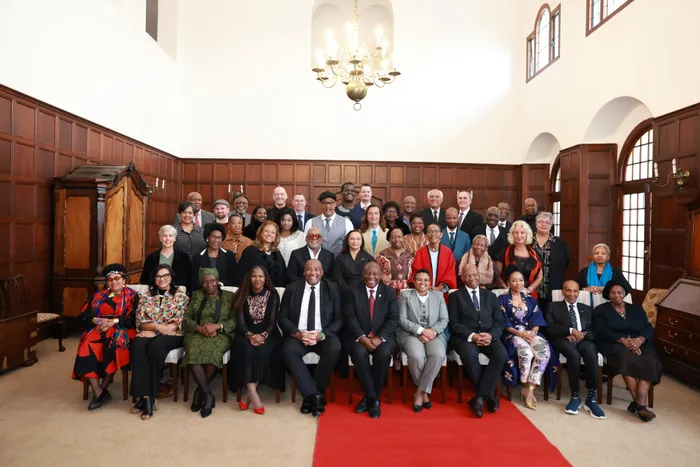
All the recipients who received national orders with President Cyril Ramaphosa in the middle front and the minister of Arts, Culture and Sport Gayton McKenzie to the right of him.
Image: GCIS
Two of Stellenbosch University’s leading academics have been bestowed with South Africa’s highest civilian honours by President Cyril Ramaphosa in a prestigious ceremony today.
Prof Tulio de Oliveira, the bioinformatician who alerted the world to the Omicron variant of Covid-19, and Prof Pumla Gobodo-Madikizela, a globally acclaimed scholar of trauma and reconciliation, received the 2026 National Orders. The accolades recognise citizens who have made exceptional contributions to democracy, society, science, and humanity.
Prof De Oliveira was awarded the Order of Mapungubwe in Gold, the nation's highest scientific accolade, for his groundbreaking achievements in genomic surveillance. As Director of the Centre for Epidemic Response and Innovation, De Oliveira played a pivotal role in identifying both the Beta and Omicron variants of SARS-CoV-2. His rapid detection system placed African science at the very centre of the global pandemic response, earning him a place among the world's ten most influential scientists by the journal Nature in 2021.
The Presidency noted that he was being celebrated "for his contribution in the field of scientific research with a groundbreaking discovery of the Omicron variant of Covid-19." Despite the solo accolade, De Oliveira insisted the honour belonged to a wider network of colleagues.
"I must stress that this was a team effort, and I would like to recognise some of the main contributors... who worked day and night throughout the pandemic to advance science that saves lives," he stated, adding his gratitude for "the dozens of scientists and colleagues from the Network for Genomics Surveillance in South Africa."
Prof Gobodo-Madikizela received the Order of the Baobab in Bronze for her pioneering scholarship on forgiveness, transgenerational trauma, and social cohesion. A former member of the Truth and Reconciliation Commission, she has spent decades examining how societies reckon with the psychological aftermath of state-sanctioned violence, a body of work that previously earned her the prestigious Templeton Prize in 2024.
The Presidency commended her "for her powerful work on conflict resolution and the concept of unsolicited forgiveness," noting that her "corpus of work on the psychology of forgiveness has been recognised internationally."
Reflecting on the award, Gobodo-Madikizela described it as a deeply moving moment for both her and her homeland. "In many ways, this honour recognises not only my scholarship on forgiveness, but also the moments in which South Africa showed its human face to the world – tthe moral imagination to honour humanity and choose truth over denial.To receive this acknowledgement from my own country fills me with a deep sense of gratitude and thanksgiving. It is an honour far beyond anything I could adequately express," she said.
The dual awards mark a significant milestone for Stellenbosch University, demonstrating how local academic research can command immense global influence.
The university's Rector and Vice-Chancellor, Prof Deresh Ramjugernath, praised Gobodo-Madikizela by stating that her work "speaks directly to Stellenbosch University’s commitment to advancing knowledge in service of society and reflects the University’s broader focus on societal impact, meaningful engagement and research that contributes to human dignity, social justice and transformation."
Turning his attention to De Oliveira, Ramjugernath added that "this award not only honours a remarkable scientific contribution to global public health but also affirms the growing impact and leadership of African science on the world stage."
He said by reinforcing the institution's pride in supporting "scholarship that not only advances academic excellence but also helps address some of the most complex human and societal challenges of our time."