Earth Day 2026: South Africa's fight for a sustainable future


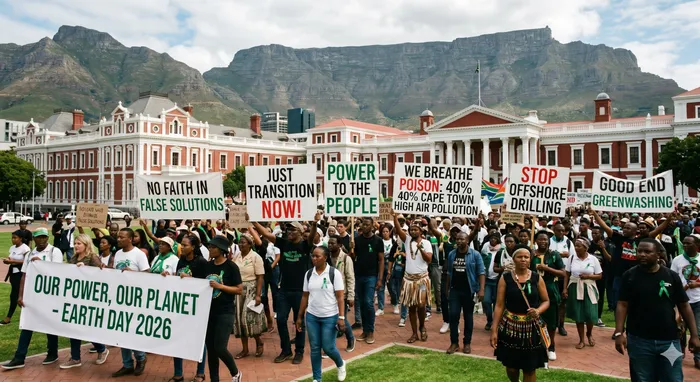
South Africa’s climate goals are anchored in a 2030 deadline, yet several metrics suggest the country is struggling to meet its "green" milestones.
Image: AI Generated/Gemini
As the global community reflects on Earth Day 2026, South Africa finds itself at a volatile crossroads. While President Cyril Ramaphosa stands on international stages pledging a “Just Transition” away from fossil fuels, the reality on the ground tells a story of systemic contradiction. From the smog-choked streets of Cape Town to the contested waters of the Indian Ocean, the gap between political rhetoric and environmental stability has sparked a national outcry.
The theme for this year, "Our Power, Our Planet," was met with defiant energy outside Parliament in Cape Town this week. Over 500 activists, led by the GOOD Party, Extinction Rebellion, and various faith-based organisations, gathered to hand over a memorandum of demands. Their message was blunt: South Africa is not merely missing its green milestones; it is actively running in the wrong direction.
The statistics are sobering. A recent scientific report revealed that over 40% of Capetonians—roughly 1.9 million people—now live in high-pollution zones. This air quality crisis, stretching from the Western Cape to Limpopo, threatens to overwhelm an already fragile healthcare system. Despite this, the government recently approved the expansion of experimental offshore oil and gas drilling, a move activists label as "eco-terrorism" against the country’s marine heritage.
"We cannot claim to love this country when we so eagerly poison it," said a representative from the GOOD Party. The party’s Environmental Manifesto calls for an immediate end to “greenwashing” — the practice of using media events to mask continued fossil fuel expansion. They argue that the $11.6 billion (R215 billion) in international climate loans South Africa has accepted will become a "debt trap" if the funds are not used to protect the communities most dependent on the coal value chain.
However, amid the high-level friction, pockets of practical hope emerge. At Avoca Primary School in KwaZulu-Natal, the launch of the Earth Programme Initiative demonstrated that grassroots action is bypassing sluggish policy. By integrating urban vegetable gardens and "JoJo" water tanks into the curriculum, educators are fostering a generation that views sustainability as a tool for self-reliance rather than a corporate buzzword.
Similarly, the logistics and tourism sectors are attempting to pivot. Industry giants like FedEx are finally rolling out electric vehicle fleets in major hubs, while the Kimkim Climate Action Pilot Programme is reframing the African bushveld as "climate infrastructure." By quantifying the carbon stored in the savanna, tourism is being repositioned as a guardian of the environment rather than a contributor to its decline.
For South Africa, the "Power" in this year's theme is being reclaimed by the people. The demand is no longer just for a "green" future, but a "just" one—where renewable energy is decentralised, oceans are defended by a functional coastguard, and the economy is built on restoration rather than extraction. As the 2030 deadlines loom, the executive must decide if short-term fossil fuel gains are worth the price of international condemnation and a poisoned legacy.