Migrants not to blame for SA’s unemployment crisis, says Malema at SACP conference


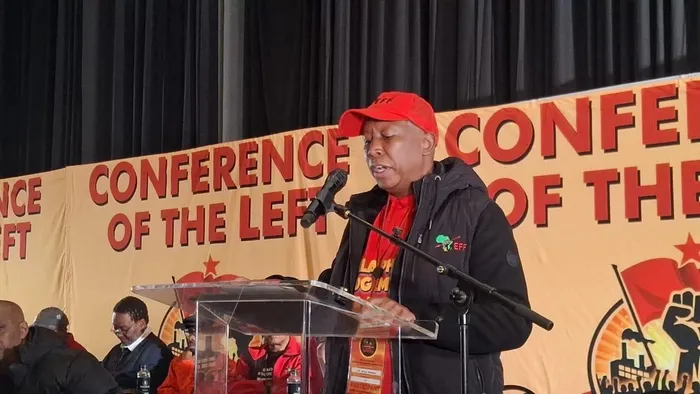
EFF leader Julius Malema says African migrants are being unfairly blamed for South Africa’s unemployment, and failing public services.
Image: Timothy Bernard/Independent Newspapers
EFF leader Julius Malema has labelled the ongoing anti-illegal immigration marches as “Afrophobia” targeting foreign nationals, saying poor African migrants are not responsible for South Africa’s unemployment crisis and service delivery problems.
“Poor Africans from Zimbabwe, Mozambique, Nigeria, Somalia, or elsewhere on the continent are not responsible for unemployment, inequality, or collapsing public services,” Malema said.
He was speaking at the South African Communist Party’s (SACP) Conference of the Left in Boksburg, Ekurhuleni, on Friday.
The three-day conference aims to strengthen coordination, unity in action, political education, and organised struggle among leftist and working-class formations, according to the SACP.
Although the ANC confirmed it had been invited to the conference, the party rejected the gathering, saying there was “nothing leftist” about it.
Malema said the conference convened at a decisive historical moment characterised by economic instability, political uncertainty and what he described as the visible collapse of the global capitalist order.
“We gather in a world defined by obscene concentration of wealth alongside unprecedented levels of poverty, technological advancement alongside expanding human misery, and enormous productive capacity alongside deepening unemployment, hunger and social collapse,” he said.
“Humanity has never had better scientific knowledge, greater productive potential or greater technological sophistication than it does today, yet billions of people continue to exist in conditions of insecurity, deprivation, violence and despair because society remains controlled by the private accumulation of profit rather than the fulfilment of basic human needs.”
According to Malema, global capitalism no longer attempts to justify itself morally or philosophically.
“It has abandoned the language of justice and embraced the language of markets, competition and permanent inequality,” he said.
“It conditions the entire population to accept mere survival as normal and to internalise hopelessness as a permanent feature.”
He argued that societies organised around commodification reduce people to “mere cogs” in the pursuit of profit, leading to ecological destruction, racism, misogyny, militarisation, xenophobia and authoritarianism.
Malema said millions of workers remained trapped in debt despite being employed, while young people obtained education only to face unemployment.
“Women enter workplaces while still carrying the burden of patriarchal violence and unpaid labour,” he said.
“Communities become sites of addiction, criminality and despair because capitalism destroys economic security and weakens collective social consciousness.”
He described the global crisis as capitalism functioning “exactly as it was designed to function”.
“It produces abundance for a minority through the organised deprivation of the majority,” he said.
Turning to South Africa, Malema argued that while political apartheid had ended, “economic apartheid” remained intact through unequal land ownership, financial concentration and white control of strategic sectors of the economy.
“The majority acquired political rights without corresponding economic power,” he said.
He said the economy remained structured around exclusion, citing unemployment levels as evidence.
“Official unemployment exceeds 32%, while expanded unemployment exceeds 43%, meaning millions of people exist outside meaningful economic participation altogether,” he said.
“Youth unemployment remains a serious crisis at more than 60%, condemning an entire generation to social marginalisation despite their aspirations, education and capabilities.”
Malema said crime, gender-based violence, drug abuse, gangsterism and social decay could not be separated from unemployment and economic insecurity.
“When millions of people are denied meaningful participation in society, the result is not merely poverty but the breakdown of social cohesion itself,” he said.
He criticised what he described as superficial analysis that blamed migrants for South Africa’s problems.
His remarks comes amid ongoing protests targeting undocumented immigrants.
“The growing phenomenon of Afrophobia within South Africa must be confronted with absolute political clarity because it represents one of the most dangerous expressions of false consciousness within the working class,” he said.
“Migrants did not privatise state capacity. Migrants did not concentrate ownership of land and industry. Migrants did not construct an economy incapable of absorbing labour.”
Malema argued that directing anger towards vulnerable African communities protected the structures responsible for inequality and suffering.
“A left that cannot defend African solidarity has abandoned its historical mission,” he said.
He added that the future of African liberation depended on continental solidarity, regional industrialisation and coordinated resistance against global systems of extraction and dependency.
Malema also addressed tensions between the ANC and the SACP following the formation of the Government of National Unity after the 2024 general election.
Relations between the alliance partners have deteriorated sharply since the SACP criticised President Cyril Ramaphosa and the ANC leadership for including the DA and FF Plus in the GNU.
The SACP has also announced plans to contest the upcoming local government elections independently, while maintaining it is not leaving the tripartite alliance.
Malema argued that the ANC increasingly viewed independent political organisations as hostile.
“This reflects political insecurity produced by the erosion of historical legitimacy and organisational dominance,” he said.
“For decades, the ANC occupied such a central position within South African political life that sections of its leadership began confusing the organisation itself with the entirety of liberation politics.”
“No political formation possesses permanent ownership over history, revolutionary legitimacy or the aspirations of the working class,” he added.
Among those attending the conference were representatives of the MK Party, Pan Africanist Congress, AZAPO, United Africans Transformation, NUMSA and SANCO.
IOL Politics