Political leaders gather at the SACP 'Conference of the Left' in Boksburg


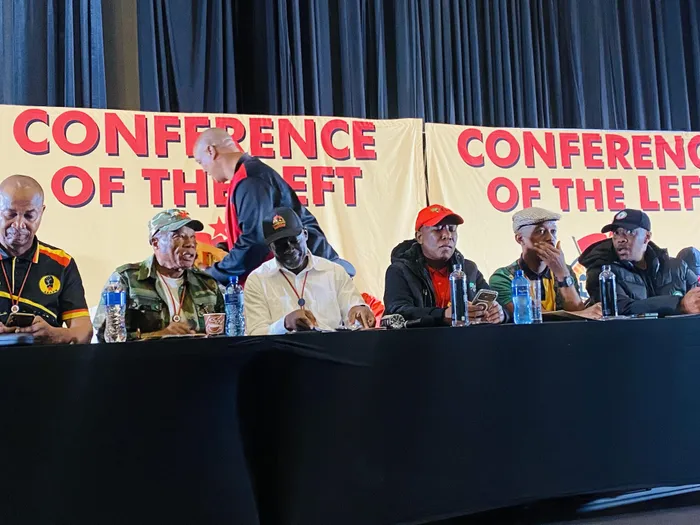
EFF leader Julius Malema, MK Party second deputy president Tony Yangeni, SACP’s general secretary Solly Mapaila attends the communist party’s conference of the left.
Image: Simon Majadibodu/IOL
Political leaders including Julius Malema, Tony Yengeni and UAT leader Dr Bantu Wonder Mahlatsi have gathered at the South African Communist Party’s three-day Conference of the Left.
The conference is taking place in Boksburg, Ekurhuleni.
Political analysts argue that the conference could still yield positive results in building coordinated working-class politics, despite the ANC saying there was nothing leftist about it.
The South African Communist Party said the conference is aimed at strengthening coordination, unity in action, political education, and organised struggle among leftist and working-class formations.
Although the ANC confirmed it had been invited to the conference, it rejected the gathering, saying there was nothing leftist about it.
Speaking to IOL News, political analyst Dr Bernard Sebake, dean of students at the Central University of Technology (CUT) in the Free State, said the conference was intended to solidify the political position of leftist organisations.
“I think the left has made its own decision to go independent because of the nature of the relationship in the tripartite alliance,” Sebake said.
“The expectation of this conference is to solidify the political ground and prepare the machinery to work with civil society, and to put together an agenda of the left that they believe is relevant in the current political epoch in South Africa.”
Sebake said leftist organisations believed “the revolution has been diluted” by those who do not represent the interests of the working class and the poor.
“They want to solidify their political ground, their presence and what they stand for in the broader political and economic development of South Africa,” he said.
On Tuesday, tensions between the ANC and the SACP intensified after ANC secretary-general Fikile Mbalula confirmed that the party would not attend the conference.
Mbalula dismissed the gathering, saying it was not genuinely leftist.
“On the so-called Conference of the Left, ideologically we do not think it is a forum of the left,” Mbalula said.
“We think it is merely a project of people coming together to discuss various issues in general.
“Beyond that, this Conference of the Left, outside the ANC and the alliance, is not left in our view. If you look at the composition of those attending, we do not believe it constitutes the left.”
The communist party has since hit back at the ANC for refusing to attend the conference, accusing the governing party of being arrogant, isolating itself and acting in a divisive way.
Relations between the two parties have deteriorated since the formation of the Government of National Unity (GNU).
The SACP, an alliance partner in the tripartite alliance with the ANC and Cosatu, has sharply criticised President Cyril Ramaphosa and the ANC leadership over the decision to form the GNU after the 2024 general election.
The party opposes the inclusion of the DA and FF Plus in the GNU.
The SACP has long opposed coalition government at national level, arguing that it does not represent the interests of black people or the working class.
The party has since announced that it will contest the upcoming local government elections independently, while insisting it is not leaving the alliance. The ANC has strongly opposed the decision.
Sebake said the ANC’s refusal to attend the conference pointed to deeper tensions between the two parties.
“For me, it is a signal that the relationship has been punished by the SACP’s decision to contest elections outside the tripartite alliance,” he said.
“However, the fact that the SACP says it is still part of the alliance means it wants to force a political or revolutionary agenda that is no longer about a multi-class alliance, but a leftist revolutionary agenda.”
He said the ANC’s declining electoral support and the failure to redefine the alliance had contributed to the growing tensions.
“Perhaps an internal revolution in the tripartite alliance could emerge from the conference, where organisations involved in the alliance redefine how it must function and what political ideology should dominate,” Sebake said.
Cosatu has confirmed that it will attend the conference, while Saftu said it would not participate.
The EFF, MK Party, Afrika Mayibuye Movement, Pan Africanist Congress (PAC), Azanian People’s Organisation (Azapo), United Africans Transformation (UAT), Numsa, NGOs and leftist activists have attended the conference.
Despite the ANC’s absence, Sebake said the conference could still produce significant political outcomes.
“They will probably yield broader political results because parties such as the EFF and MK Party have an objective of weakening the ANC’s dominance,” he said.
He added that Cosatu viewed the conference as an opportunity to champion workers’ interests at a time when government wage negotiations and bargaining forums had repeatedly collapsed.
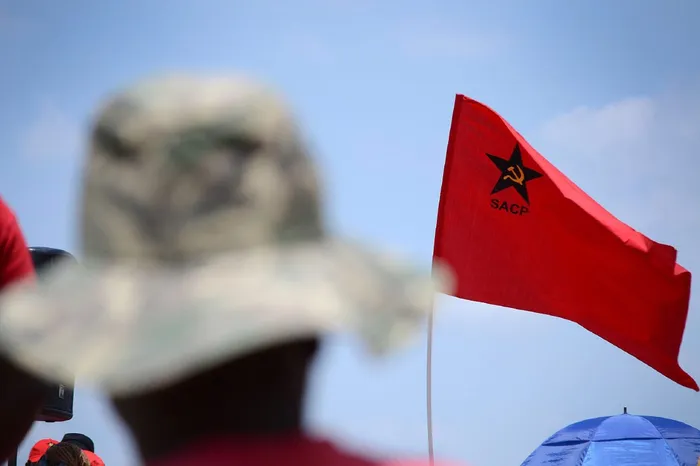
The SACP’s three-day “Conference of the Left” in Boksburg is being viewed as a key test of left-wing cooperation amid growing tensions with the ANC over the Government of National Unity and future electoral strategies.
Image: Independent Newspapers Archives
“The ANC’s current role in the GNU may not necessarily be rooted in improving conditions of service for employees,” Sebake said.
“The working class sees a worrying picture, and Cosatu sees the conference as an ideal platform to champion its interests.”
Sebake said the involvement of the EFF and MK Party represented a push to pressure the ANC into changing its political direction.
“The SACP wants to wage this as an internal revolution for the ANC to change its narrative in society,” he said.
“They are saying they are not leaving the alliance, but they want to address the class narratives of the GNU and the ANC government.”
He said ideological differences within the alliance had been ignored for too long.
“What is required is to address the state of the South African economy and explore approaches that benefit the poor and the working class,” Sebake said.
“If this is not done, it places the alliance on a path towards collapse, and the current debates and stance taken by the SACP are a signal of that.”
Another political analyst Solly Rashilo said the ANC’s rejection of the conference showed that trust within the tripartite alliance had reached a low point.
“The ANC’s refusal to attend the Conference of the Left, coupled with its dismissal of the event as an anti-ANC ‘coalition of negation’, indicates that trust within the tripartite alliance has hit an all-time low,” Rashilo said.
“While the conference risks deepening divisions between the ANC and its traditional allies, it aims to establish a structured, extra-parliamentary ‘left popular front’.”
He said the gathering could build coordinated opposition focused on anti-austerity measures and the cost-of-living crisis by bringing together the SACP, EFF, MK Party and civic groups.
Rashilo said the SACP’s opposition to the GNU, which includes “centrist and right-leaning parties such as the DA”, was driving a long-term political realignment.
He said the conference also served as a testing ground for the SACP ahead of the local government elections scheduled for November 4, 2026.
According to Rashilo, the ANC and SACP are increasingly divided by structural and economic disagreements.
“The ANC is pivoting toward market stability and centrist coalition politics, while the SACP accuses it of a rightward neoliberal drift,” he said.
“Their public dispute over which social classes belong at a ‘left’ conference highlights that the historical ideological glue holding the alliance together has severely degraded.”
IOL Politics