Tensions rise as civic movements confront Nigerian Embassy over ‘Igbo King’ coronation


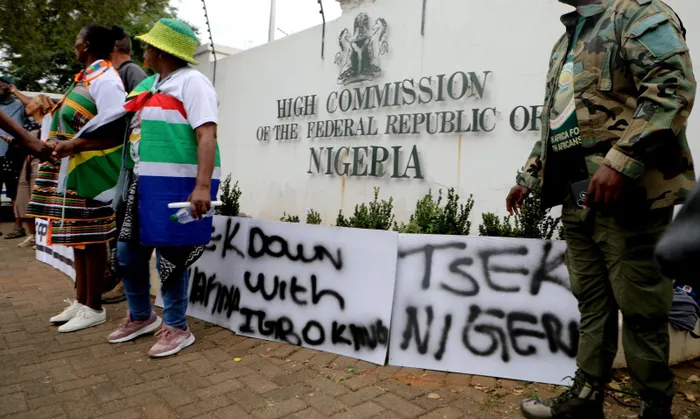
A Collective of Civic Movements pickets outside the High Commission of Nigeria in Arcadia, seeking clarity and accountability following the coronation of the so-called Igbo King of East London in KuGompo, Eastern Cape.
Image: Oupa Mokoena / Independent Newspapers
Diplomatic tensions are rising between South Africa and Nigeria after a coalition of civic organisations formally lodged a memorandum of grievances with the Nigerian Embassy, demanding urgent clarity over the controversial “coronation” of an alleged Igbo king in the Eastern Cape.
The memorandum was delivered by Progressive Forces – United for Change alongside other civic movements on Tuesday and comes amid growing public concern and recent unrest in parts of the Eastern Cape linked to the incident.
Framing the issue as one of national importance, the group said the matter touches on “issues of sovereignty, respect for local governance systems, and the rule of law”, warning that conflicting accounts surrounding the event have already fuelled tensions.
“It has come to our attention that an event was publicly communicated and promoted as the installation or coronation of an ‘Igbo King’ in KuGompo (East London), Eastern Cape,” the memorandum states. “Subsequent to public concern, conflicting statements have emerged attempting to downplay the nature of this event.”
The group argues that these inconsistencies have “heightened tensions and raised serious questions among South Africans”, particularly in communities where traditional leadership structures remain deeply embedded.
At the core of the dispute is the perceived establishment of parallel authority structures. The memorandum stresses that South Africa’s system of recognised traditional leadership, especially within the Eastern Cape, must be respected.
“Any parallel or perceived competing leadership structures, especially those framed in terms of kingship, are viewed as deeply inappropriate and potentially destabilising,” the document reads.
The group also questioned the legitimacy of the titles being used, noting that even within Nigeria, traditional titles such as “Igwe” or “Eze” are governed by strict cultural and territorial frameworks.
“We question the legitimacy of individuals claiming titles such as ‘Igwe’ or ‘Eze’ within South African territory,” the group said.
Beyond cultural concerns, the memorandum raises legal questions, calling for transparency around the immigration and legal status of those involved in organising and participating in the event.
“There is a lack of clarity regarding the legal and immigration status of individuals involved,” it states. “South Africans have a right to know whether all applicable laws and regulations have been complied with.”
The group further warned that the way the issue has unfolded risks undermining already fragile social cohesion.
“The manner in which this matter has unfolded has contributed to rising tensions within communities. Lack of transparency risks further destabilising social cohesion,” the memorandum notes.
In response, the coalition has outlined a set of demands directed at the Nigerian mission. These include a “full disclosure of a clear account of the event”, identification of those involved, and confirmation of their legal status in cooperation with the Department of Home Affairs.
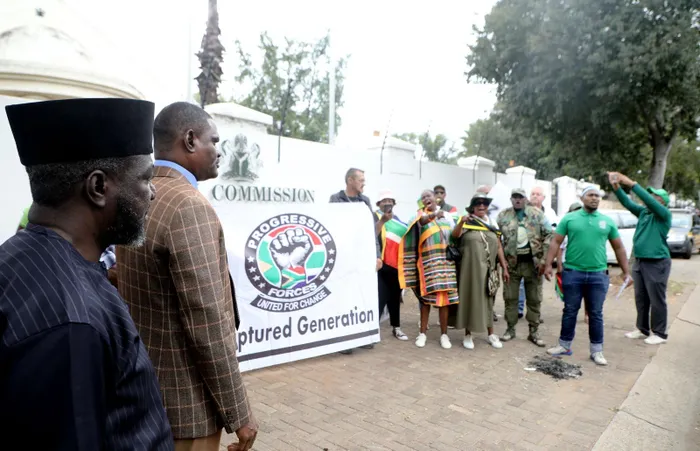
The marchers also made demands that they explicitly directed the embassy to respond to.
Image: Oupa Mokoena / Independent Newspapers
They are also seeking assurances that members of the Nigerian community in South Africa will “operate within the legal, cultural, and governance frameworks of the Republic”.
While the tone of the memorandum is firm, the organisations emphasised that their intervention is not intended to inflame tensions but to seek accountability.
“We reiterate that this memorandum is not an act of hostility, but one that calls for accountability, transparency, and mutual respect between nations and communities,” the statement reads.
The march followed a circular from the Nigerian Embassy calling on its nationals to lay low amid the heightened situation. The advisory, issued by the High Commission of Nigeria in Pretoria, comes after protests in KuGompo, formerly known as East London, turned violent on Monday.
This comes amid controversy over the reported installation of a Nigerian traditional leader. In a circular titled “Advisory to All Nigerians Living in the Republic of South Africa”, the mission cited rising tensions and urged immediate caution.
Protests were triggered by the alleged coronation of Chief Solomon Ogbonna Eziko as “Igwe Ndigbo”, a development that has drawn sharp opposition from local political groups and traditional leaders.
What started as a planned demonstration quickly escalated into violence, resulting in property damage and reported clashes.
The group on Tuesday, during its march, warned that failure to respond adequately could trigger further action.
“Failure to provide adequate responses will necessitate further lawful civic action,” it said.