Nigerians in South Africa urged to prioritise safety amid rising violence


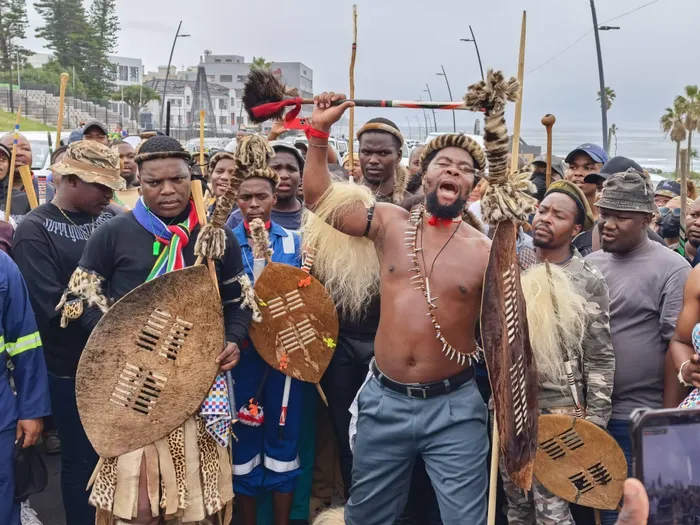
Protests turned violent in the Eastern Cape, with reports of violence torching of vehicles.
Image: Pedro Mapelo / I'solezwe lesiXhosa
Nigeria has issued an urgent safety advisory to its citizens living in South Africa, warning them to scale back public activity and prioritise personal security following violent unrest in parts of the Eastern Cape.
The advisory, issued by the High Commission of Nigeria in Pretoria, comes after protests in KuGompo, formerly known as East London, turned violent on Monday amid controversy over the reported installation of a Nigerian traditional leader.
In a circular titled “Advisory to All Nigerians Living in the Republic of South Africa”, the mission cited rising tensions and urged immediate caution.
“In view of the recent developments in Eastern Cape Province and the current palpable tension in the country, the High Commission of the Federal Republic of Nigeria in Pretoria, would like to issue the following advisory and enjoin all Nigerian nationals living and working in the Republic of South Africa to observe the following safety protocols,” the statement reads.
The advisory calls on Nigerians to limit movement, avoid unfamiliar individuals, and “maintain a low profile at all times”. It further instructs citizens to “suspend any form of socio-cultural activities forthwith” and to avoid “inflammatory statements on social or mainstream media capable of heightening the current tensions”.
They were also urged to steer clear of demonstrations, report threats to authorities, and refrain from “unnecessary ostentation and flamboyance”, reflecting concerns that foreign nationals could be targeted.
“All nationals are enjoined to consult… if in doubt of any of the safety measures,” the statement adds.
The warning follows escalating unrest in KuGompo, where protests were triggered by the alleged coronation of Chief Solomon Ogbonna Eziko as “Igwe Ndigbo”, a development that has drawn sharp opposition from local political groups and traditional leaders.
What began as a planned demonstration quickly descended into violence, with property damage and clashes reported.
According to South African Police Service spokesperson Brigadier Nobuntu Gantana, authorities were deployed to manage the situation as it deteriorated.
“The protest began as a planned peaceful demonstration by various traditional leaders over the alleged coronation of an Igbo king,” she said.
“Violence broke out when some participants moved away from the city hall, where a petition was being handed over. Twelve vehicles have been damaged, and several buildings have been torched. Emergency services, including the fire department, remain on the scene, along with the Public Order Policing Unit,” she said.
“This is an active scene, and updates information will be shared in due course.”
Police also confirmed a stabbing incident during the unrest.

Cars were burnt during the march.
Image: Pedro Mapelo / I'solezwe lesiXhosa
“The stabbed person is not linked to the march,” Gantana said.
However, Jacinta Ngobese-Zuma, leader of the March and March Movement, claimed on social media that the victim was one of her members.
The controversy has also drawn a strong response from traditional leadership structures. The AbaThembu Kingdom distanced itself from the protests while raising concerns about governance failures and the handling of the situation.
“We wish to unequivocally distance ourselves from the acts of violence, looting, and destruction of property that occurred during the recent march in East London, KuGompo,” the statement said.
The kingdom emphasised its support for lawful protest while rejecting criminal conduct.
“The AbaThembu Kingdom supports the constitutional right to peaceful protest, but rejects any form of lawlessness and criminal conduct.”
It also made clear that its leadership was not involved.
“His Majesty, King Buyelekhaya Zwelibanzi Dalindyebo, and no member of the AbaThembu Royal Council deployed to or participated in this march. Those who attended did so in their personal capacity and do not represent the AbaThembu Kingdom in any official form.”
Beyond distancing itself, the kingdom raised pointed questions about the role of authorities in preventing the violence.
“What steps were taken when the call for this march was first announced?” the statement asked.
“If the country has intelligence capabilities, why were early warnings not acted upon to prevent the violence and looting?”
It further questioned whether failures within law enforcement had enabled the unrest.
“Did failures within the police and intelligence community effectively give space and power to hooligans to terrorise communities?”
The kingdom also criticised the broader implications of the alleged coronation.
“The Eastern Cape is not an annexure or colony of any foreign nation. There must be accountability and clarity on how such a situation was allowed to arise.”
The developments have once again highlighted underlying tensions around migration, identity, and economic pressure in South Africa.
In recent years, outbreaks of violence targeting foreign nationals have been recorded across several provinces, often linked to competition over jobs, housing and small businesses. Nigerian nationals have at times been among those affected, prompting diplomatic engagement between Pretoria and Abuja.