What 100 Days of the Madlanga Commission reveals about corruption in South Africa
CRIMINAL JUSTICE SYSTEM TURMOIL


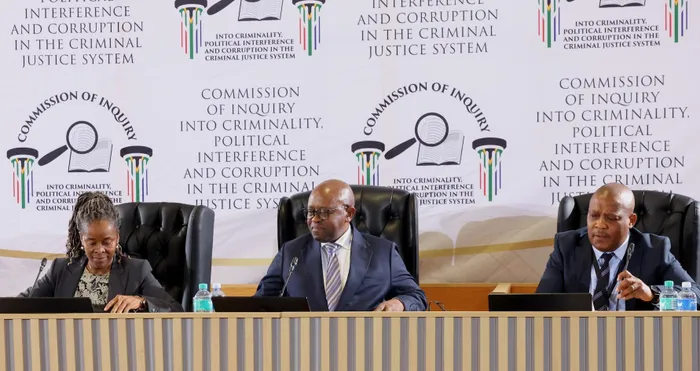
JUSTICE Mbuyiseli Madlanga (centre) flanked by Adv. Sesi Baloyi, SC (left) and Adv. Sandile Khumalo, SC at the commencement of the Judicial Commission of Inquiry into Criminality, Political Interference and Corruption in the Criminal Justice System hearings on September 17, 2025. | GCIS
Image: GCIS
Prof Dirk Kotzé
The Madlanga Commission has now reached the symbolic milestone of 100 days in operation.
Its original terms of reference determined that mid-March would be the end date of its work, but it was extended until the end of August. For a commission of inquiry, it is a very short timeframe, especially if one takes into account its extensive terms of reference.
The public does not have a positive outlook towards such commissions, not because of their reports, but because of the lack of consequences and implementation of their recommendations.
In the case of the Madlanga Commission, inevitably, it will be compared with the Farlam Commission on the Marikana massacre and the Zondo Commission on state capture. All three focused on the South African Police Service (SAPS).
The catalyst for the Commission was the revelations made by the KZN provincial commissioner, Lieutenant General Nhanhla Mkhwanazi, on 6 July 2025. One can present it as an example of whistleblowing par excellence, given his seniority in SAPS as a former acting National Commissioner.
Much of Mkhwanazi’s focus was on the Political Killings Task Team (PKTT), managed by the Crime Intelligence head, Lieutenant General Khumalo. The task team’s decommissioning by the Police Minister, the role of his chief of staff and several senior SAPS generals, was one of the Commission’s first focal points.
President Ramaphosa’s proclamation to establish the commission, however, included a much broader scope, including the judiciary, the National Prosecuting Authority, the State Security Agency, the Department of Correctional Services and the police services of several metropolitan authorities.
Some of these components of the terms of reference have been intensively investigated, such as the Ministry, the SAPS top structure, the Ekhurhuleni and Tshwane metro police departments, and several persons who are most probably part of the “Top 5” criminal syndicates. Kat Matlala and TK Molefe were in the centre of some of these hearings, while senior SAPS officials were linked to them.
The Commission structured their hearings into three phases: first was the testimonies Mkhwanazi and persons whose evidence related to his; second were the testimonies of persons whose names emerged from evidence presented to the Commission, or who were implicated in the evidence.
In response, they were allowed to present their case to the Commission. The Commission is at this point. The third phase is when Mkhwanazi and others will give their final response to the Commission.
What can be said now already about the significance of the Madlanga Commission?
Justice Madlanga and his two commissioners – both senior advocates – created an impression of the criminal justice system which is impressive and creates more confidence in the judiciary, in particular.
Their fair and unbiased approach, but bulldog attitude many times, sends the message that persons who are suspected of malfeasance will have a fair opportunity to defend themselves, but they cannot expect any lenience from the commissioners. It is important in restoring the public image of commissions of inquiry, which are generally regarded as toothless instruments with little consequences.
The second important point is that the Madlanga Commission takes place in public, is broadcast on a daily basis and is a public display of how an inquiry can expose secrets and lies. This public exposure increases the public’s knowledge of how SAPS functions, what its problems are, and who the main personalities are. In future, it would not be able to hide a problematic situation behind the excuse that “it must first be investigated”.
Almost unique for such commissions is the speed of response to the current hearings. Now it is no longer unusual if a witness appears before the Commission and is arrested very soon, followed by an appearance in court.
Several factors contribute to it: firstly, that detailed evidence becomes available as a result of the witnesses’ testimonies; secondly, the presence of the Investigative Directorate against Corruption (IDAC), which has both investigative and prosecutorial powers (almost similar to the former Scorpions).
It is important to emphasise that in the past, any response to the work of such a commission would become possible only after its final report was presented to the President. Now the prosecutors don’t wait for the final report anymore.
It should not be ignored that Parliament also constituted an ad hoc committee to engage in a process similar to those of the Madlanga Commission. On the one hand, it complemented the Commission’s work, and for some of the witnesses, it was a preparatory experience before appearing before the Commission.
The parliamentary committee had fewer resources and less time available for its work. It also included, in some instances, political posturing by some committee members, but it increased the belief that parliamentary members are also able to play their oversight role with more vigour and tenacity.
Early in the hearings of both the parliamentary committee and the Commission, a matter arose with significant constitutional and administrative law implications. It was about who has the authority to dissolve the PKTT: the Minister of Police or the SAPS National Commissioner?
It has a wider implication for the relationship between a minister and a department’s director-general. More broadly speaking, it is about the relationship between the executive and the administration in public affairs. The Minister’s actions created serious suspicions and contributed towards being put on extended special leave.
An implication of similar magnitude was the recent appearance of the National Commissioner, Gen Fannie Masemola, in court on charges related to the Public Finance Management Act, and his lack of oversight over decisions regarding departmental contracts.
That could have implications for the Directors-General of all the departments in which contractual fraud or corruption has been detected without the DG’s consequence management.
Finally, the Commission is an amazing demonstration of how the nature of evidence in criminal justice procedures has changed towards electronic evidence. Especially, the evidence in WhatsApp messages has changed the way in which evidence is led.
By the end of the next 100 days, the Commission will be close to its conclusion. Then it will be possible to have a more careful consideration of what its legacy might be.
* Kotzé, Department of Political Sciences, Unisa.