A breakthrough for South African healthcare: UCT's BMERC gains manufacturing licence


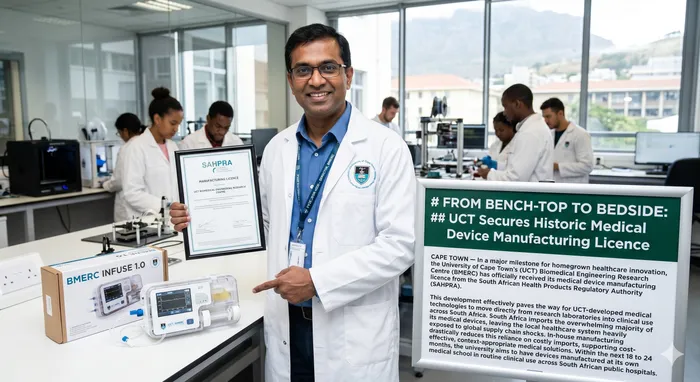
The University of Cape Town’s (UCT) Biomedical Engineering Research Centre (BMERC) has officially received its medical device manufacturing licence from the South African Health Products Regulatory Authority (SAHPRA).
Image: AI generated/Gemini
In a major milestone for homegrown healthcare innovation, the University of Cape Town’s (UCT) Biomedical Engineering Research Centre (BMERC) has officially received its medical device manufacturing licence from the South African Health Products Regulatory Authority (SAHPRA).
The licence formally authorises the research centre to conduct manufacturing, distribution, and wholesale operations for medical devices for which it holds a registration certificate. This development effectively paves the way for UCT-developed medical technologies to move directly from research laboratories into clinical use across South Africa.
While UCT MedTech and BMERC have spent over a decade building one of the most productive academic medical device pipelines on the continent—boasting 23 patent families, five spinout companies, and more than 100,000 devices distributed globally—every promising design previously hit a regulatory wall. Without a certified manufacturing pathway under their own roof, these locally designed devices could not legally or ethically be deployed in local clinical care.
"In practical terms, it means the devices we design and develop here, for African patients in an African context, can now be produced and brought to market with the full weight of regulatory recognition behind them," said Professor Sudesh Sivarasu, Director of UCT’s BMERC. "In the medical device sector, quality is synonymous with patient safety... This licence serves as our solution to that barrier."
The acquisition of the SAHPRA licence transforms UCT's capabilities across several key areas. BMERC can now formally produce and distribute innovative devices specifically engineered for the African healthcare context, backed by quality management systems that have been independently assessed and certified against rigorous international standards.
Furthermore, in-house manufacturing drastically reduces reliance on costly imports, supporting cost-effective, context-appropriate medical solutions while strengthening UCT's ability to train the next generation of biomedical engineers within a real-world, regulatory-compliant environment fluent in ISO 13485 and SAHPRA requirements.
Professor Sivarasu emphasized that this milestone was a massive collaborative effort, relying on years of partnership with SAHPRA, the national Department of Science, Technology and Innovation (DSTI), the National Research Foundation (NRF), clinical collaborators across the Western Cape Department of Health, and global peers.
What began as a quiet compliance project has evolved into a robust institutional capability that aligns deeply with multiple United Nations Sustainable Development Goals (SDGs), including SDG 3 (Good Health and Well-being), SDG 9 (Industry, Innovation, and Infrastructure), SDG 10 (Reduced Inequalities), and SDGs 4 and 17 (Quality Education and Partnerships).
With the regulatory framework now firmly in place, BMERC’s immediate focus is to convert its pipeline of late-stage prototypes into clinically validated, locally manufactured products. The ultimate goal is to transition flagship devices from the lab to the patient's bedside under UCT's own quality system.
Within the next 18 to 24 months, the university aims to have devices manufactured at its own medical school in routine clinical use across South African public hospitals, fundamentally improving the quality and dignity of local patient care.