Uncovering the hidden dangers: UCLA's research on Los Angeles fires


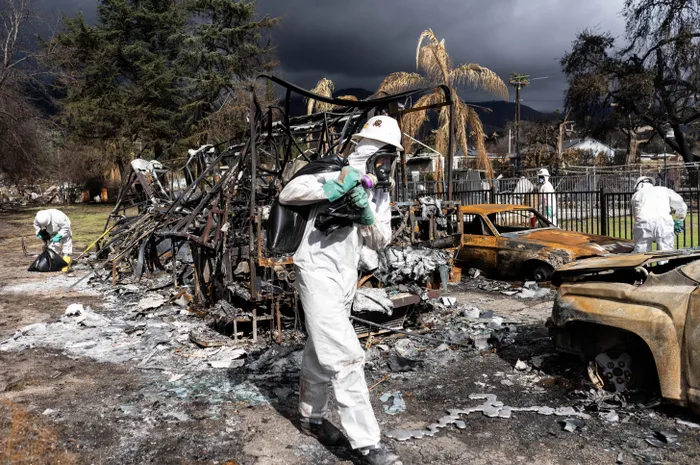
Environmental Protection Agency crews remove hazardous materials from a property where the Eaton Fire swept through Altadena, California, on Jan. 7, 2025.
Image: Melina Mara/The Washington Post
By some grim coincidence, a team of scientists was already prepared to deploy into the hills of Los Angeles for another study when the city’s firestorm sparked.
It was Jan. 7, 2025. The UCLA researchers, equipped with expensive monitoring devices and contacts in the area, pivoted. They were meant to assess air quality at the site of a decade-old gas leak, but committed instead to conducting a real-time analysis of the disaster unfolding in front of them. It felt like a rare opportunity - an obligation, almost - to sample the air during an active fire.
A year later, those samples served as the bedrock of a peer-reviewed analysis published this month that found harmful carcinogens were still present after the blazes were extinguished. Levels continued to increase in people’s homes for weeks.
It’s one of many new discoveries - from cancerous nanoparticles, to unexpected reactions within the human body - that have come out of what scientists say is an extraordinary research effort to understand the long-term health and environmental effects of the massive blazes, which killed 31 people and displaced tens of thousands more.
“The unprecedented nature of such disasters often reveals previously unknown information,” said Yifang Zhu, a professor in the Department of Environmental Health Sciences at the UCLA Fielding School of Public Health, who is one of the authors on the air quality study.

Air quality machines used by the EPA.
Image: Barbara Davidson/For The Washington Post
Given the scale of the tragedy, it felt important to “make something good out of it,” she said of the large-scale research efforts.
It helped that the fires happened in one of the country’s largest and wealthiest cities. Millions of dollars were eventually poured in to the endeavors, from foundations including the Spiegel Family Fund, which was started by the billionaire founder of Snapchat.
Researchers from more than 10 universities across the country - from Harvard to the University of Texas at Austin - descended on the burn zones as part of the LA Fire Health Study, hoping to answer the difficult questions of what is in the air, water, soil and dust - and what effect is it having on residents?
As the fires tore through Los Angeles, they burned homes, car batteries, paint and cleaning products, unleashing untold contaminants into the air.
Soon after the blazes sparked and before the philanthropic funding rolled in, scientists launched a frenzied effort.
“I’ve never seen the scientific community mobilize so fast just behind the scenes,” said Joseph G. Allen, a professor of exposure assessment at the Harvard T.H. Chan School of Public Health and one of the LA Fire Health Study leads. “People were borrowing equipment. We were asking, ‘What’s the best lab that does this? Who can get a truck out and sample the air?"
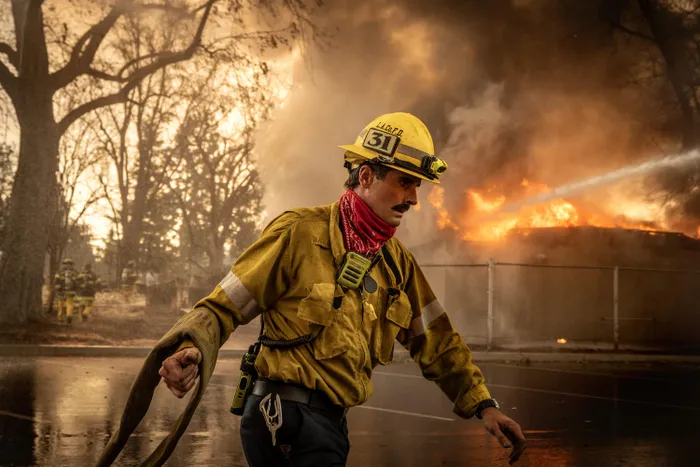
Firefighters work to put out a fire that broke out at the Altadena Golf Course in January 2025.
Image: Barbara Davidson/The Washington Post
Researchers set up air monitoring networks to find out what was concentrated in the massive plumes of smoke that wafted above the city - and settled in people’s homes. They tested the water supply to see when it would be safe to drink. They drew blood from firefighters and emergency room patients to document the effects exposure to the fires were having on people’s health.
The preliminary findings confirmed these fires were not your average conflagration, Allen said.
For example, separate research from the University of California at Davis in partnership with LA Fire Health, found that Chromium-6, a cancer-causing chemical made famous in “Erin Brockovich,” was present in the Eaton and Palisades fire burn zones in March and April. It was in the form of nanoparticles, Allen said, meaning the substance could be absorbed almost instantly by the human body.
He added that the chemical had been found in the soil after past wildfires, but not in the air.
“I guarantee everyone will look for this after the next fire,” he said, adding that, thankfully, the threat posed by the particles diminished over time.
Zhu and her team at UCLA measured Volatile Organic Compounds inside and outside of people’s homes. They took samples while the fires were burning, once they were halfway contained and then after they were extinguished.
These compounds can be produced in small amounts from cooking, cleaning or smoking - but the scientists were surprised to find that their levels were increasing in unoccupied homes after the fires. It suggests material continued off-gassing contaminants after the blazes were extinguished.
“That is the sort of information that will not just benefit the survivors from this particular fire,” Zhu said. “For many, many future fires I think we can generate information that will be helpful for those people to recover.”
Perhaps the more challenging task is investigating the effects these contaminants could have on human health.
Research has yielded concerning and surprising results, said Kari C. Nadeau, a professor of climate and population studies at the Harvard T.H. Chan School of Public Health.
“You would hope as a member of the public that a lot of this would have been known,” she said. “But unfortunately, it is not.”
Nadeau said there have been studies looking at wildfires’ effects on human health, but the amount of toxins in the air and the number of people affected by the Los Angeles fires were unprecedented. “We were very worried about the extent of damage to people’s bodies,” she said.
There were concerning, but expected, findings: Lead and mercury levels in the bloodstreams of the firefighters spiked. But then there were more puzzling results. People’s bloodwork was shifting in strange ways, according to research that came out of Cedars-Sinai Medical Center in December. In the wake of the fires, abnormalities emerged in sugar and potassium levels, Nadeau said.
“The changes occurring in people's bodies,” she said.
It was also a new finding, “not described previously after major wildfires,” the researchers wrote.
“It makes us humble and very curious as to why that is. And that’s the next step,” Nadeau said.
Scientists say there are still more questions than answers.
The consortium is running out of funding to continue its exposure research, Allen said, but scientists still meet weekly to discuss how they can carry on. For example, he wonders how groundwater will be affected by the fires as materials settle into the soil over the next few years. Nadeau wants to continue researching the effects the fires had on pregnant women, on ocean swimmers.
“My concern is that, like any disaster, after a year, people stop paying attention,” Allen said. “But there’s a lot more to do. A lot more to learn.”