How Merla the Beagle discovered 100 illegal sandwiches at the airport


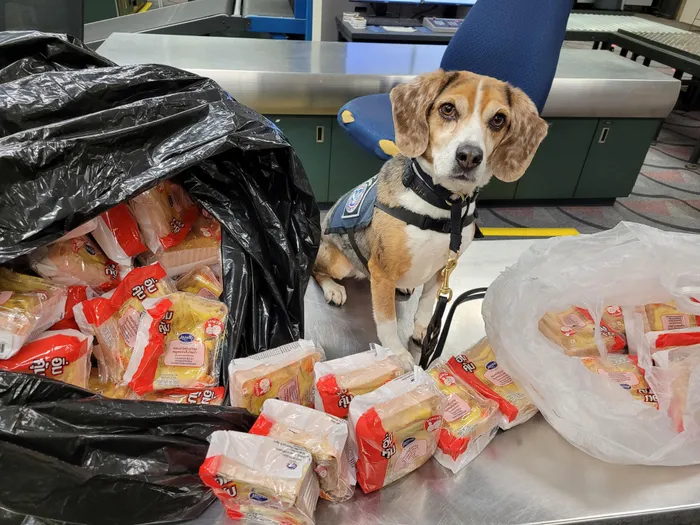
Merla with the 100 illegal sandwiches she discovered at the Minneapolis airport.
Image: The Washington Post
Two unremarkable duffel bags on a baggage carousel at Minneapolis-St. Paul International Airport looked like any other luggage arriving on a flight from Seoul. But Merla, a federal employee with the Beagle Brigade, knew differently. During her shift on February 24, the little hound caught a whiff of the bags and immediately sat on the floor, alerting her handler to potential contraband inside.
A secondary hand search by Customs and Border Protection (CBP) officers confirmed Merla’s hunch: two passengers were smuggling 100 illegal pork sandwiches from Thailand. For this massive bust, Merla earned the "Jackpot Award"—multiples of her favorite treats all at once.
Despite the big win, Merla’s snout was still on the clock. With a belly full of treats, she trotted back to work for the remainder of her 10-hour shift, which includes several naps and water breaks. By day’s end, she had successfully ferreted out beef sausages from Kenya, pork from Serbia, milk products and hamburgers from Japan, plant roots from Tanzania, beef sandwiches from Lebanon, and millet from India. So far this year, her scavenger hunt has also turned up 100 pounds of cowskin, star fruit, dried cucumber seeds, and exotic akuamma fruit. Alongside her canine colleagues, Steelor and Boone, she has even detected minced camel meat, a delicacy from Somalia.
Merla, who is 7½ years old and has been on the force for roughly half her life, joined the Minneapolis team after a stint at Dallas/Fort Worth International Airport. She comes from a long line of detector dogs managed by the U.S. Department of Agriculture (USDA) and enforced by CBP. The USDA created the Beagle Brigade in 1984 with just one dog and trainer at Los Angeles International Airport to safeguard the nation's agricultural industry from devastating foreign pests and pathogens.to safeguard the nation's agricultural industry from devastating foreign pests and pathogens. Today, the pack has grown to about 120 beagles across 21 of the busiest international airports.
Donated by private owners, breeders, or rescue shelters, these dogs learn their trade through a 10- to 13-week program at the National Detector Dog Training Center near Atlanta. Beagles are uniquely suited for the job due to their high food drive, gentle disposition, and compact size. More importantly, their noses contain about 220 million scent receptors, which is at least 40 times more than a human's. While a physical inspection or X-ray machine can take a human officer five minutes, a beagle can locate contraband instantly.
During formal training, the dogs learn to identify five core scents: apple, citrus, mango, beef, and pork. However, because they sniff day in and day out, experienced members of the brigade can naturally expand their olfactory menu to nearly 50 odors, alerting to unfamiliar items like bush meat or medicines simply because they smell "off." Their accuracy rates are remarkably high, rising to 80 percent after their first year and reaching 90 percent after two years on the job.
Travelers who fail to declare agricultural goods face civil penalties of up to $1,000. Fortunately for the passengers carrying the 100 pork sandwiches, they admitted to officers that they might have food in their bags after Merla flagged them. Officers accepted this statement as a legal declaration, sparing them the hefty fine. The decision didn't bother Merla, who still enjoyed her well-earned jackpot rewards before heading back out to police the baggage claim.