Cow trip: a heartwarming rescue of calves and a father's transformation


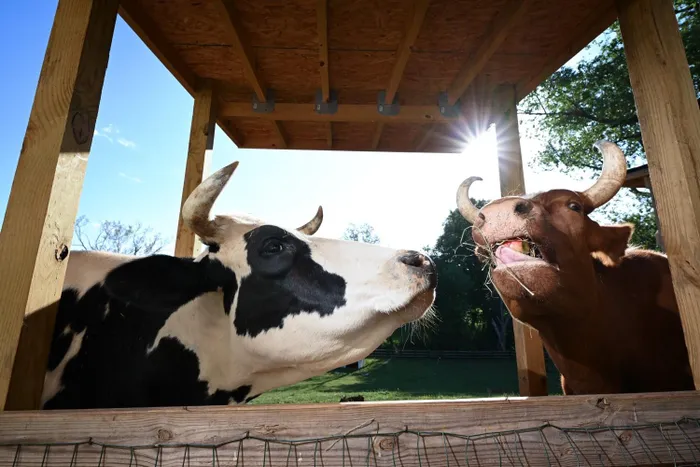
Mickey and Moose eat at Rosie’s Farm Sanctuary in Potomac, Maryland.
Image: The Washington Post
The proposition for my dad in June 2022 was simple yet absurd: "Want to come with me to a dairy farm in Vermont, rescue a calf, and drive him to a sanctuary in Maryland in the back of our car?"
My burger-loving father, Jared, a 77-year-old retired physician, didn’t hesitate. "Sure, let’s do it." When I asked if he had ever interacted with cows before, he admitted, "Well, not close. I mean, I’ve mooed at them." Good enough. The trip was on, fueled by trust, parental love, and a mutual love of laughter.
As we prepared to leave, we received a call from Michele Waldman, a psychotherapist and activist who had recently founded Rosie’s Farm Sanctuary—a five-acre refuge in Potomac, Maryland. Michele was thrilled we were bringing a calf, but she had a surprise request. A second calf at another Vermont dairy farm needed saving. Could we take him too?
We happily agreed. Within hours, Mickey, a black-and-white Holstein, and Moose, a days-old caramel Ayrshire, were lying side-by-side in the tarp-lined, straw-covered back of our borrowed SUV. Our 27-minute documentary, Cow Trip, captures the chaos that followed: medical crises, a lost phone, navigation debates, my dad’s first taste of Red Bull, and an unexpected discovery. Ultimately, it’s a story with a happy ending, watching Mickey and Moose settle into their new lives.
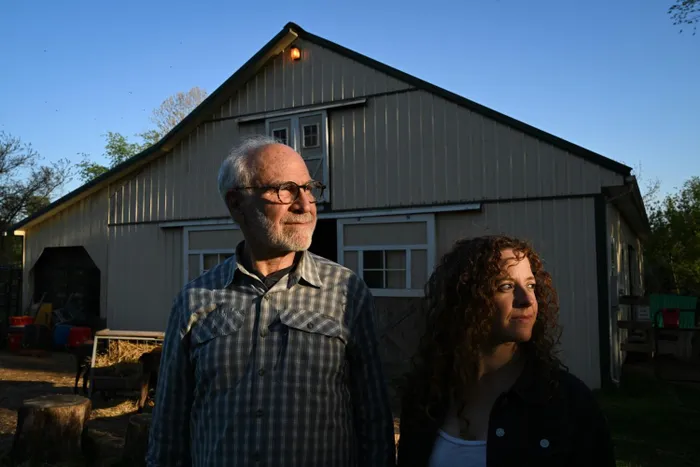
Jared Zelman and his daughter, Joanna Zelman, visit Rosie’s Farm Sanctuary.
Image: The Washington Post
As a vegan and lifelong animal lover, part of my motivation for the film was uncovering a reality that surprises many: the fate of male calves in the dairy industry. To maintain milk production, dairy cows must give birth. However, their calves are separated from them almost immediately so the milk can be harvested for commercial sale. Because male calves cannot produce milk, they are viewed as commercial byproducts. Most are sold to veal farms and slaughtered at just a few months old.
I wanted a different outcome for Mickey and Moose. While saving two calves is a drop in the bucket, my hope is that the film inspires viewers to rethink their relationship with farm animals. Animals are capable of forming friendships, feeling pain, and experiencing joy.They deserve a good life.
While Cow Trip is a love note to these animals, it is equally a tribute to my father. Seeing him approach these vulnerable creatures with the same compassion and openness he practiced as a doctor was profoundly moving.
The experience changed him in ways neither of us expected. Through the road trip and subsequent visits to Rosie's, he bonded deeply with Mickey and Moose. While he hasn't gone fully vegan, he has completely given up milk and dairy, and rarely eats meat. "I just don’t have the taste for it anymore," he says.
Today, Mickey and Moose are thriving, towering behemoths weighing roughly 1,700 pounds each. Visiting them recently, they craned their necks over the fence, loudly lowing in appreciation as they inhaled apples and celery from my dad's hands. Looking at them, my dad just laughed. "I don’t know," he said, "they look pretty happy."