Join the fight: 700 000 signatures for a ban on dog and cat meat in Indonesia


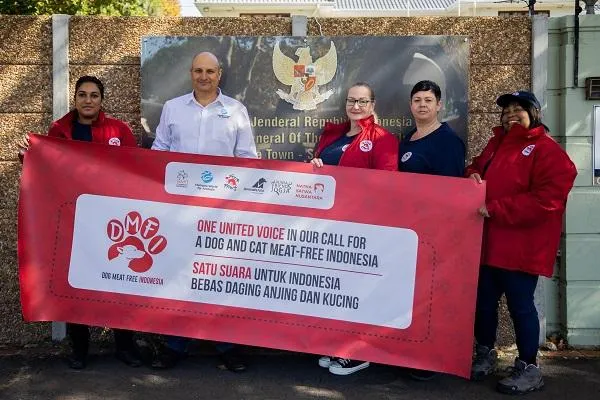
Sasha Forbes, Tony Gerrans, Executive Director of Humane World for Animals South Africa, Fiona Miles, Director of FOUR PAWS South Africa, Yvonne Niewenhuis, Deidre Daniels at the Consulate General of the Republic of Indonesia in Kenilworth.
Image: FOUR PAWS
Animal campaigners across six continents have submitted a 700,000-signature petition to the Indonesian Consulate, demanding an end to Indonesia’s brutal dog and cat meat trade. The global action demonstrates solidarity with efforts to pass the Animal Protection and Welfare Bill currently being debated in Indonesia.
The petition urges Indonesian President Prabowo Subianto to support the Bill's passage. If passed into law, Indonesia would become the sixth nation or territory in Asia to explicitly ban the cruel practice.
A critical legal loophole
The trade sees more than a million dogs and countless cats stolen, trafficked, and brutally slaughtered for human consumption every year. Campaigners from global animal welfare organisations FOUR PAWS and Humane World for Animals, members of the Dog Meat Free Indonesia (DMFI) coalition, submitted the petition at Indonesian embassies and consulates in a dozen countries, including Australia, the United Kingdom, Brazil, and South Africa.
Rebecca Dharmpaul, a Dog and Cat Meat Trade specialist from FOUR PAWS, highlighted the urgent need for legislative action, noting that most existing animal welfare laws in Indonesia exclude companion animals. "Dogs and cats are companions, not commodities. Yet in Indonesia, their legal protection remains dangerously weak... This legal loophole leaves millions of dogs and cats vulnerable to cruelty of the trade," Dharmpaul said.

The meeting and petition handover were held in support of the Dog Meat Free Indonesia (DMFI) campaign.
Image: FOUR PAWS
Public health and rabies risk
The trade is not only an animal welfare catastrophe but also a major human health concern. The mass movement of dogs of unknown disease or vaccination status is facilitating the spread of deadly diseases, including rabies, which directly undermines the country's pledge to eliminate the disease by 2030. Lola Webber, international director of DMFI, confirmed that investigations have revealed hundreds of markets and slaughterhouses across Indonesia are still selling dogs and cats for meat, making the trade a "catastrophic threat to animal welfare and rabies elimination efforts". Dog thieves further jeopardise public health by removing vaccinated dogs from communities, breaking down the "herd" immunity necessary for rabies eradication.
Domestic support for a ban
Campaigners emphasised that the move is supported by the vast majority of Indonesia’s own population. Opinion polls nationwide reveal that 93% of Indonesians support a ban on the trade, with just 5.4% having ever consumed dog meat and less than 1% cat meat. Julie Sanders, Humane World for Animals’ End Dog and Cat Meat director, stated that the ban is "urgently needed to protect public health from zoonotic disease risks and prevent animal cruelty". The campaign takes place as South Korea prepares for its own nationwide ban on the dog meat industry to come into full force in February 2027, a landmark victory that campaigners hope Indonesia will follow.