Cape Town's Bree Street: a pioneering ‘living’ street experiment in urban planning


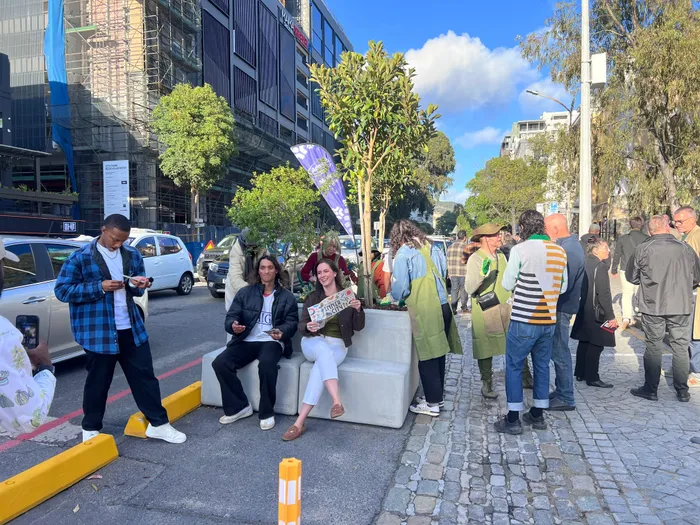
Launched as part of the Safe Passage Programme, the new Safe Passage Precinct pilot will run over the next six months, testing ways to make the popular inner-city street safer, greener and more accessible for pedestrians, cyclists and businesses
Image: Sinazo Mkoko
In a move that signals a bold departure from car-centric urban planning, Cape Town Mayor Geordin Hill-Lewis officially opened the Safe Passage Precinct on Bree Street. The launch marks the beginning of South Africa’s first inner-city street experiment, transforming a high-traffic stretch of Bree Street into a greener, safer, and more people-focused corridor.
For the next six months, the section of Bree Street between Wale and Shortmarket Streets will serve as a high-stakes "living laboratory." Led by the Young Urbanists NPC in partnership with the SDI Development Trust, the project seeks to prove that city streets can function as vibrant public spaces rather than mere conduits for motorized traffic.
The experiment utilizes "tactical urbanism"—the use of temporary, adaptable interventions to test urban design theories in real-time. By narrowing the road to a single mixed-traffic lane in each direction, the project has reclaimed significant asphalt for the city’s pedestrians and cyclists. The transformation is immediate and tactile.
Visitors to the precinct are greeted by traffic calmed to a human-friendly 30km/h, complemented by over 40 lush planters, removable seating, and artistic bollards. Crucially, the design addresses the complexities of inner-city logistics. Four formalized commercial loading bays and a dedicated protected motor bicycle bay for last-mile delivery riders have been installed, a move designed to eliminate the illegal double-parking that has long plagued the CBD.
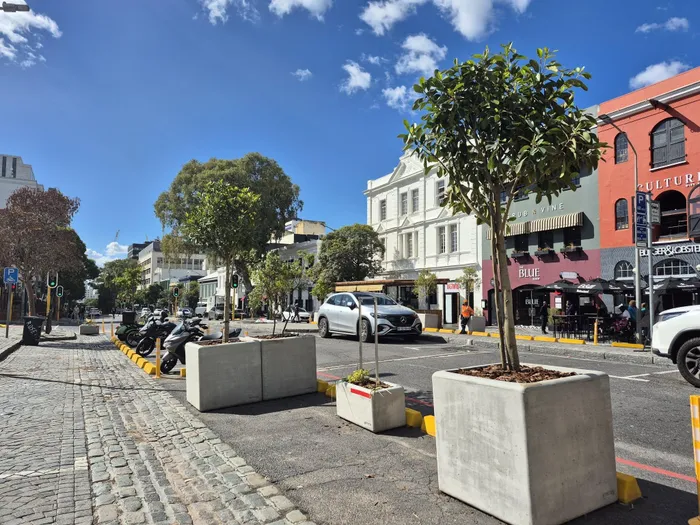
The CBD’s popular hospitality hub is now at the centre of a precinct-wide street experiment linked to the City of Cape Town’s CBD Mobility and Accessibility Plan, which identified Bree Street as a Special Activity Street.
Image: CCID/Facebook
"Today’s launch is an exciting step forward in making our streets more friendly for their actual users—people and pedestrians, not just cars," said Hill-Lewis. He emphasized that the project builds on the popularity of "Car-Free Sundays," but takes it a step further by testing how the street functions during the grueling mid-week rush.
The "experiment" label is intentional. Unlike traditional infrastructure projects that require years of permanent construction, the Safe Passage Precinct uses reversible elements like temporary kerbs and delineators. This allows the City to monitor traffic flow, pedestrian safety, and local business impact before making permanent, capital-intensive decisions.
A unique facet of the project is its funding model. Through a concept dubbed "Brand Urbanism," the Adreach Group has enabled private brands to invest directly in the urban fabric. From local artwork on 1.4km of cycle lane bollards to the zero-emission "Safe Passage Mellow Van," private capital is being channeled into public goods. Brad Armitage, co-founder of The Mission for Inner City Cape Town, noted that private investment is critical when aligned with the public good. "Cities are complex systems," he said. "Meaningful change only happens when stakeholders work together."
While the focus is currently on the CBD, the implications of the Bree Street experiment extend far beyond the city centre. This pilot constitutes Phase 1 of a broader vision to link Cape Town’s economic hubs with townships and informal areas through inclusive mobility corridors. Phase 2 is already set to extend the route along Albert Road toward Langa.
As the six-month pilot progresses, data on pedestrian movement and business activity will be meticulously collected. If successful, the Bree Street model will be scaled across Woodstock, Salt River, and Dunoon, providing a replicable blueprint for human-centered cities across South Africa. For now, the message from the City is clear: the era of the car-first street is under review. On Bree Street, the people are finally given the right of way.