Innovation keeps them powering ahead
|Published
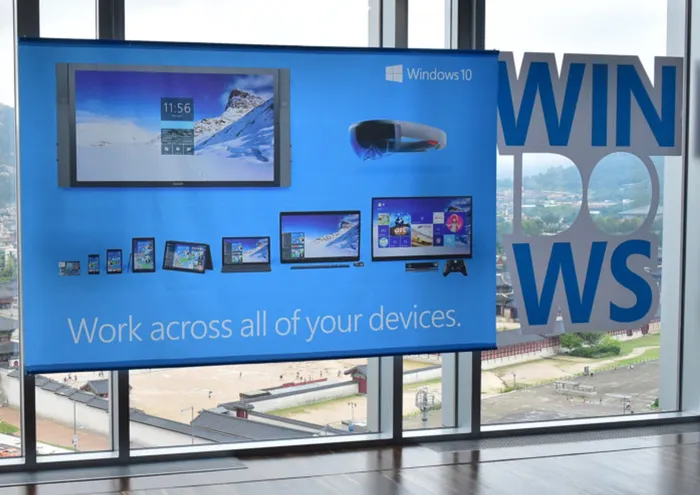
The head of Microsoft " Satya Natella " took his Windows 10 international roadshow to Nairobi, one of the 13 cities in the world to form part of the much-anticipated global launch. Picture: Jung Yeon-Je The head of Microsoft " Satya Natella " took his Windows 10 international roadshow to Nairobi, one of the 13 cities in the world to form part of the much-anticipated global launch. Picture: Jung Yeon-Je
Something about East Africa’s largest and most sophisticated economy keeps on attracting more international attention, writes Victor Kgomoeswana.
About 70 percent of Kenyans now have access to the Internet. This represents an 11.4 percentage rise to 29.15 million, according to statistics by the Communications Authority of Kenya. As a result of 2.5 million new data subscriptions between January and March, Kenya can claim to be one the leading innovator in Africa; an example from which all of us could learn.
And I am talking more about the private sector – not government – learning from this example.
Something about East Africa’s largest and most sophisticated economy keeps on attracting more international attention. Within a week of the visit by US President Barack Obama to the Global Entrepreneurship Summit, the head of Microsoft – Satya Natella – took his Windows 10 international roadshow to Nairobi, one of the 13 cities in the world to form part of the much-anticipated global launch. With our eager expectation that Windows 10 would live up to the hype and make us forget the operational gimmickry that is Windows 8, I found myself asking why Kenya seems to attract more international visitors and investors than most eastern and southern African countries.
As a South African, I am jealous because I grew up basking in the country considered to be the gateway to Africa. Now, I cannot go anywhere without a story about Kenya in my face. However, because no single country can have it all, I strongly believe South Africa has to start structured relations to exchange information with others on the continent. I see no reason why there should be no study trips to countries such as Kenya on what has been called the green (reduced carbon footprint) and blue (innovation-led) economies. They would offer us a lot more than going to Russia, the US or China, even. After all, if a delegation of the US led by Obama himself prioritises Kenya and Ethiopia as partners, followed by the man at the helm of Microsoft in seven days, who are we to ignore them?
Since I first became aware of M-Pesa, the mobile money solution that has now grown into many other facets of daily transactions, this simple innovation has added another accolade to the breakthrough. So big is an innovation that even President Obama made a stop to see for himself. It is called M-Kopa.
Nnamdi Oranye – a regular guest on my radio show – shared a CNBC report about it by Anmar Frangoul with me this week. It was called “Pay-as-you-go solar power takes off in Africa”. The specific country in question? Kenya.
The gist of this innovation is a clever confluence of prepaid subscription, commonly used in cellphone deals and clean energy: solar in this case.
What M-Kopa does, according to Jesse Moore, co-founder and MD of the company involved, is allow users to secure a solar system for $35 (R442). The unit gets installed in the user’s home and with the help of a GSM sensor inside the system, the company is able to monitor consumption and regulate payments.
The mobile payment system on the user’s cellphone is then employed to make payments – which should be easy, considering the resounding success of mobile technology in the region. From this point on, the user buys solar power according to their needs and means; with top-up costing about R6 a day. The incentive, though, is that they get to own the solar system after 12 months of regular payments. How is that for affordability, creative financing of infrastructure and adaptation of mobile telecommunications technology to improve the lives of the masses?
We are talking a system that delivers clean energy, which Africa has in abundance, without the hassle of bureaucracy and high capital outlay.
M-Kopa Solar figured the obvious to devise this solution: electricity supply is not sufficient in most African countries. In other cases, it is erratic due to power outages.
The cost of installing solar technology is prohibitive for an average African family; regular banks do not have creative funding solutions to meet these needs and power utilities are not resourceful enough either. In the meantime, Africa loses – by not using its abundant sun energy – while low-income communities suffer poor lighting, which could lead to higher crime rates.
In South Africa, lower-income communities have rightfully benefited from solar geysers provided by the government. This indicates that in keeping with its quest for cleaner energy and less dependence on the national grid, the Energy Department is on the right track, with the help of municipalities.
The problem is that these geysers have to be subsidised. In the M-Kopa case, this funding is dropped to the bare minimum as the company bets on what drives prepaid solutions everywhere: users cannot afford huge capital outlays to buy equipment, resulting in a slower uptake of what should be a logical solution. This is why most households are not using solar geysers, even with the Eskom rebates.
Would something along the lines of M-KOPA not help us overcome the barrier and encourage more households to use solar geysers and other appliances – while relieving the national grid of domestic demand? How about the use of cellphone technology to monitor payments and consumption? Is that not what drove metros such as Joburg to introduce smart meters (but at a high cost to the municipality)?
It could; on condition the private sector assumes a greater responsibility to find solutions, especially funding, to relieve the pressure of the government to do everything.
This does not mean the government has no role, but it is important for private investors not to disempower themselves.
This is exactly what we have to understand; that the solutions such as M-Pesa and M-Kopa are using technology from developed markets to devise solutions for emerging economies, for example, M-Pesa used British technology to design mobile payment for Kenya.
Therein lies the answer: an eclectic approach to solving problems of inclusivity for the majority.
Waiting for the government to build power stations to supply every household with electricity deprives individuals of their power to act and their dignity.
With a little innovation, private initiative and intermittent study trips to countries such as Kenya, we might be all inspired to solve problems that affect us.
The rest is up to us; and the examples we need are right here in Africa. The sooner we realise that, the better. In the meantime, the likes of Kenya will leave us all behind.
*Kgomoeswana is anchor of Power Hour on PowerFM, Africa Business News on CNBC Africa and author of Africa is Open for Business. He writes in his personal capacity.
** The views expressed here are not necessarily those of Independent Media.
Sunday Independent