The politics of memory: DA's opposition to Mandela and Tambo statues in Durban


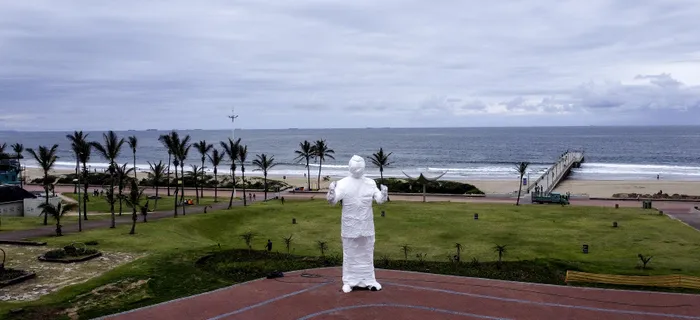
Residents in North Beach have been left wondering about the towering statue located along O.R. Tambo Parade (formerly Snell Parade) on the beachfront. Covered in plastic, the eThekwini Municipality is yet to announce its unveiling. The DA's opposition to the statue betrays selective fiscal concern and a desire to erase black heroes from public spaces, argues the writer.
Image: LEON LESTRADE Independent Newspapers
There is a strange and lingering malaise haunting South African liberal politics. It presents itself as concern for public finance, yet beneath its carefully rehearsed vocabulary lies something far more troubling: a cultivated amnesia, a persistent unease with African dignity, and a deep-seated discomfort with Black pride when it dares to occupy public space.
It speaks fluently of budgets and balance sheets, yet grows visibly agitated when history rises in bronze and stone. It wraps itself in the language of accountability while quietly waging war against memory itself.
The Democratic Alliance is currently in the grip of this affliction.
Its latest episode was provoked not by corruption, not by maladministration, not by looting or collapse of governance but by eThekwini Municipality’s decision to erect monumental statues of Nelson Rolihlahla Mandela and Oliver Reginald Tambo along Durban’s historic promenade. Suddenly, the DA’s mayoral hopeful has discovered a tender affection for municipal finances, anointing himself the solitary guardian of “taxpayers’ money”, as though the rest of Durban’s residents were mere tenants in a city their ancestors built with their hands and their hunger.
Let us speak plainly. EThekwini does not belong to the DA. It does not belong to their benefactors. It does not belong to their suburban salons and gated conversations. It belongs to the people. And the people of this city pay rates. They pay taxes. They carry the weight of the municipality not selectively, not opportunistically, not only when it flatters a political narrative but faithfully and without fanfare.
The DA’s newly discovered concern for public expenditure would command greater respect if it were not so conspicuously reserved for moments when African history is being honoured. It is a remarkable irony that statues of colonial generals, imperial governors and apartheid architects towered over our cities for generations without stirring so much as a murmur of fiscal anxiety. Their presence was accepted as heritage. Their domination of public space was treated as natural order. Yet the moment a Black liberator rises in bronze, suddenly the ledger is summoned and the calculator unsheathed.
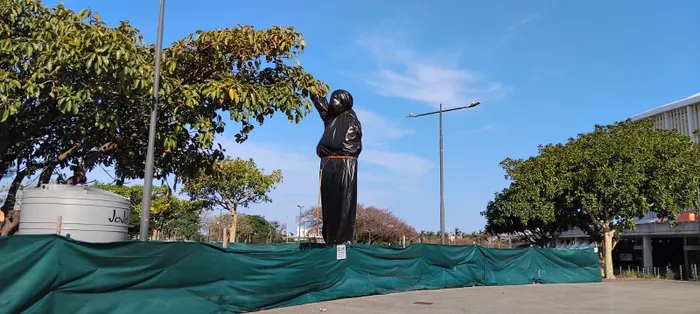
The Democratic Alliance's opposition to new statues of Nelson Mandela and Oliver Tambo in Durban reveals a troubling pattern of selective fiscal concern that only emerges when African history is commemorated in public spaces, argues the writer. Awaiting to be unveiled is the statue of Mandela outside the Moses Mabhida Stadium in Durban.
Image: ZAINUL DAWOOD
One would imagine, listening to the DA’s mayoral candidate, who got excited by the social media likes and misguided commentaries as if he alone bankrolls the municipality. That he pays a superior tax, a sovereign levy from which ordinary citizens are exempt. The manner in which he lectures Durbanites about “taxpayers’ money” implies that the rest of us are unwelcome beneficiaries in a city built by our parents’ labour and sustained by their sacrifice.
This is not stewardship. It is performance. Statues are not indulgences. They are acts of remembrance. They are public classrooms. They are declarations of belonging in a country that spent centuries teaching Black people that they belonged only on the margins of their own land.
Great cities honour those who shaped them.
London does it. Paris does it. Washington does it. Rome lives and breathes through its monuments. These cities understand that memory is not a luxury. It is a civic necessity. But when eThekwini chooses to remember, it is accused of recklessness. The discomfort is not about money. It is about visibility. It is about whose story is permitted to stand tall in the landscape. It is about whether African leadership is allowed to be monumental.
The truth, however delicately one may try to avoid it, is that the DA remains unsettled by African pride in public spaces. It disturbs a nostalgia for an era in which power was inherited and history was carefully curated. They would prefer silence to celebration. They would prefer amnesia to acknowledgement. They would prefer a city stripped of its soul.
But eThekwini is not a relic of empire. It is a living African city, shaped by struggle, sacrifice and stubborn hope. It carries a revolutionary inheritance and a future that refuses to bow its head.
Every city of consequence honours its giants.
London honours Mandela in Parliament Square. Washington honours Lincoln and Martin Luther King Jr. Paris honours De Gaulle. Rome honours its emperors and its rebels. Memory is not treated as a burden in these cities. It is treated as a foundation.
Durban has the same right. Indeed, it has a deeper obligation.
It was in this city, at Kings Park Stadium in 1990, that Nelson Mandela called on South Africans to “throw their weapons into the sea”. In that moment, he offered a nation bruised by centuries of cruelty a moral horizon. To place his statue in that very precinct is not extravagance. It is fidelity to history.
Oliver Tambo carried the liberation movement through its longest night. When leaders were jailed, hanged, banned or exiled, it was Tambo who kept the flame alive across continents. He persuaded the world to see South Africa’s pain and to side with its people. He ensured that freedom was not forgotten.
To honour OR Tambo is to remind future generations that democracy did not arrive by accident. It was negotiated in exile, defended in prisons, and paid for with lives. The suggestion that these statues are erected at the expense of service
delivery is a false dilemma. eThekwini governs a R70-billion budget. The statues were budgeted for long before the current administration and not at the expense of water, sanitation, electricity or refuse collection.
A city can mend pipes and honour heroes. It can pave roads and preserve memory.It can illuminate streets and illuminate history. The real question is not whether we can afford to remember. It is whether we can afford to forget. A society that forgets its liberators soon forgets its obligations.
What is most distressing about the campaign against these statues is not the debate about priorities that is legitimate in any democracy but the tone of derision with which it has been conducted. To dismiss statues of Mandela and Tambo as “mummies” is not critique. It is desecration.
It betrays a profound discomfort with African history and African authority. It echoes a colonial reflex that mocks African self-expression while venerating European monuments as civilisation. This is not the language of democratic contestation.
It is the language of erasure.
Durban does not need leaders who trade in ridicule. It needs leaders who understand that development without dignity is empty, and progress without memory is blind.
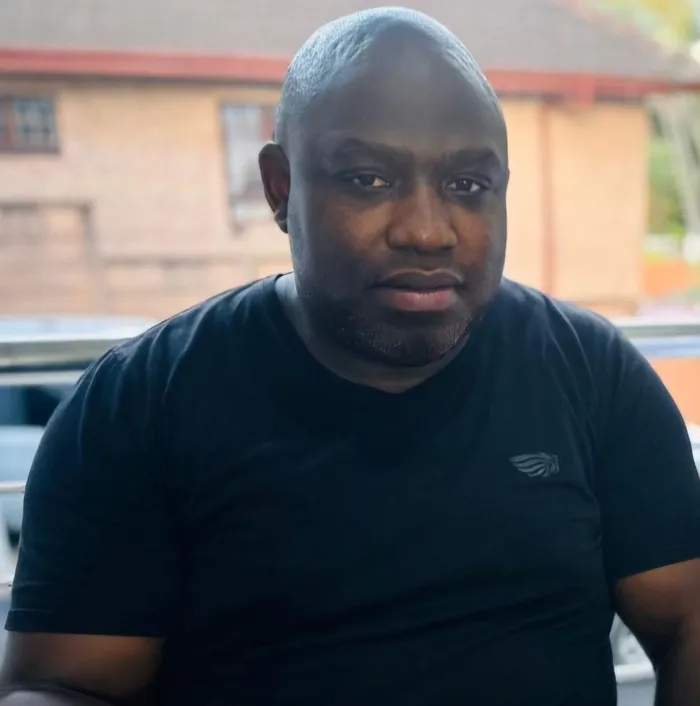
MHLABUNZIMA MEMELA
Image: SUPPLIED
In the end, the choice before the city is not complicated. Do we wish to be a people embarrassed by our freedom? Or a people who stand upright in the knowledge of who liberated us? The statues of Mandela and Tambo are not ornaments. They are declarations. Declarations that Durban remembers. Declarations that Durban honours its giants. Declarations that freedom is sacred.
Those who cannot grasp the meaning of these declarations may harvest applause on social media. But they will never prevail against the verdict of history. And history, unlike political campaigns, does not forget.
(Memela is an award-winning journalist who has written for various newspapers and a former government communications specialist. He writes in his personal capacity. His views don't necessarily represent those of the Sunday Tribune, or IOL)