The Zen of Manie: Why Japan has given Libbok a chance to reset his mind
SPRINGBOKS


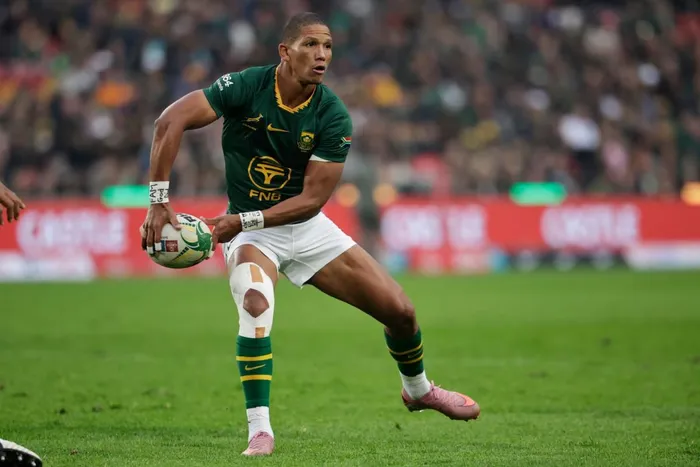
Springbok flyhalf Manie Libbok has having a ball playing in Japan
Image: AFP
It's been a case of out of sight, out of mind as far as far as Springbok flyhalf Manie Libbok playing rugby in Japan is concerned. But it may have been the best for his own mind.
For a player who lived under the relentless microscope of South African rugby, the move to the Far East has proven to be less of a sabbatical and more of a strategic mental reset.
No player has come under more scrutiny than the Springbok flyhalf, with couch critics analysing his every move, especially his goalkicking. This intensity exists purely because Libbok is a different breed of flyhalf to what South Africans are used to. He is skilful, sharp, fast, able to kick with both feet, and plays what is in front of him; he is a proper maverick.
He has served up many moments of magic over the last few years that have left fans breathless, with his pin-point cross-kicks, high-class distribution, and an ability to spot a gap and leave defenders for dead. But amongst the great moments, there have been many bad ones too, and those moments often seem to be highlighted far more than the good.
However, Libbok has always been able to pick himself up and get back on the bike after a difficult match. Mentally, he has shown that he is made of stern stuff, which is to be admired. Still, playing in the second tier in Japan has definitely given him a chance to reset his mind away from the spotlight.
Japan is a wonderful place, but it is not a traditional rugby heartland in the same sense as South Africa. The sport is not a "life or death" matter there, and the quality of life is ideal for a young man and his wife building a life together. In Japan, the cultural emphasis on attacking flair and speed has helped him rediscover the joy of the game. He is cooking in a league that prioritises his greatest strength: playing with eyes-up intuition.
Physically, the Japanese season offers a reprieve from the attritional nature of the United Rugby Championship. While the games are exceptionally fast, they lack the sheer brutality of the set-piece-heavy European and South African circuits.
This has allowed Libbok to arrive at the mid-point of the 2026 season without the usual "rugby mileage" that hampers long-term performance. He looks sharper, and his decision-making appears unburdened by the fear of failure.
Despite the rise of clinical pragmatists such as Chris Smith or the multifaceted brilliance of Sacha Feinberg-Mngomezulu, Libbok remains a non-negotiable asset for the Springboks as they look toward the 2027 Rugby World Cup.
Rassie Erasmus has always valued "point of difference" players, and Libbok is the ultimate outlier. He remains the only flyhalf in South Africa capable of manipulating a defensive line through pure lateral vision and deceptive passing.
The Springboks’ tactical evolution under Tony Brown is built on the premise of stress-testing an opponent's defensive spacing. To execute this, you need a pivot who is comfortable playing in chaos.
Libbok does not just survive in broken play; he thrives in it. His ability to launch the Springboks’ world-class outside backs into space is a weapon that a legend such as Handré Pollard simply does not offer in 2026.
Critics will always point to his goal-kicking, but the Springbok coaching staff has shown a willingness to outsource that duty. What they cannot outsource is Libbok’s genius for unlocking a game.
By refreshing his mind and body in Japan, Manie Libbok has not just escaped the noise; he has prepared himself to be the creative engine that could once again lead South Africa to global glory.