A lame horse: How the once-mighty Super Rugby lost its mojo after 30 years
COMMENT


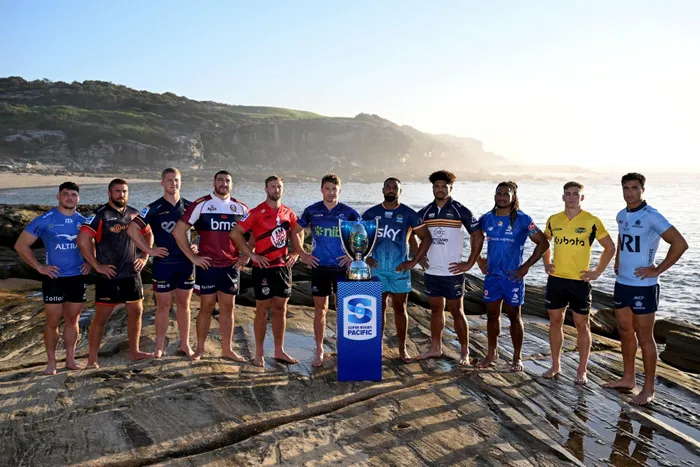
Super Rugby, the sprawling Southern Hemisphere empire we once knew feels further away than ever.
Image: AFP
Three years ago, a prominent English rugby writer proclaimed on social media that the United Rugby Championship would be “dead” in three years.
Three years have gone by, and the Sunday Times writer would have been far closer to the mark had he had another competition in mind — Super Rugby, which currently reminds one of a lame horse waiting to be put out of its misery.
The final shot may yet ring out, according to legendary All Black Sir John Kirwan, who recently said on The Rivals podcast: “I think it’s over.” Kirwan has come to this conclusion based on the inescapable reality of half-empty stadiums, dwindling television audiences, and teams on the brink of insolvency.
It is deeply tragic that this has come to pass on the 30th anniversary of Super Rugby. When it kicked off in 1996 — the year after the 1995 World Cup signalled the dawn of the professional era — the Super 12 was red hot.
The original teams three decades ago were the Auckland Blues, Canterbury Crusaders, Wellington Hurricanes, Waikato Chiefs, and Otago Highlanders from New Zealand; the ACT Brumbies, Queensland Reds, and New South Wales Waratahs from Australia; and the Natal Sharks, Western Province, Transvaal, and Northern Transvaal from South Africa.
Auckland beat Natal in the inaugural final at Eden Park. The type of rugby played that year, and for a significant time to come, was explosive and highly entertaining — although the aforementioned English writer and many of his northern hemisphere colleagues routinely dismissed it as “basketball”.
Well, that unique blend of rugby produced by the enterprising New Zealanders, wily Australians, and physical South Africans was responsible for Super Rugby — and the Tri-Nations — producing every single World Cup winner bar one in 2003, right up until 2023 when the Springboks won the tournament while playing in the United Rugby Championship era.
Super Rugby lost its way because the organisers forgot the oldest adage in the book: “If it ain’t broke, don’t fix it.” There seemed to be an internal feeling that continual tinkering with the format was required to prevent the tournament from going stale. The Super 12 became the Super 14 in 2006 with two additional sides. That expansion was still manageable, but in 2011 a further team was added and the tournament was rebranded simply as Super Rugby.
The plot was completely lost in 2016 when the Sunwolves (Japan) and the Jaguares (Argentina) were introduced. The competition ballooned from 12 teams to 18, and the introduction of complex pools and conferences made it messy and incredibly difficult for casual fans to follow.
In 2022, the fallout from the Covid-19 pandemic ultimately forced the South African sides to migrate to the northern hemisphere — with a firm push from New Zealand. Super Rugby went back down to 12 teams, featuring five from Australia, five from New Zealand, plus a team each from Fiji and Samoa. The problem was that the competition had completely lost its mojo. With revenue declining, some teams went belly up, including the Melbourne Rebels and Moana Pasifika.
Kirwan, sounding very much like an undertaker, said: “Super Rugby has been amazing for us for the last 30 years, but I think it’s over. We need to redefine it, we need to understand what it is, and I believe we need to get back to tribalism and traditionalism with more Kiwi derbies. I would bring in another three New Zealand sides.”
Kirwan insisted that Super Rugby has to find its lost soul and simplify the format, or risk falling permanently behind Europe and South Africa.
“In the northern hemisphere, France is going great, and the English game is really buoyant with big crowds,” he said. “In the southern hemisphere, we’re getting smaller crowds, and I think we need to have some courage to make a change.”
It is a case of adapt wisely or die for Super Rugby. How ironic would it be if the South African franchises were eventually asked to return to save the day?