From impostors to participants: Bafana Bafana finally ended South Africa's 'borrowed jerseys' era
TACKLING GOLIATH


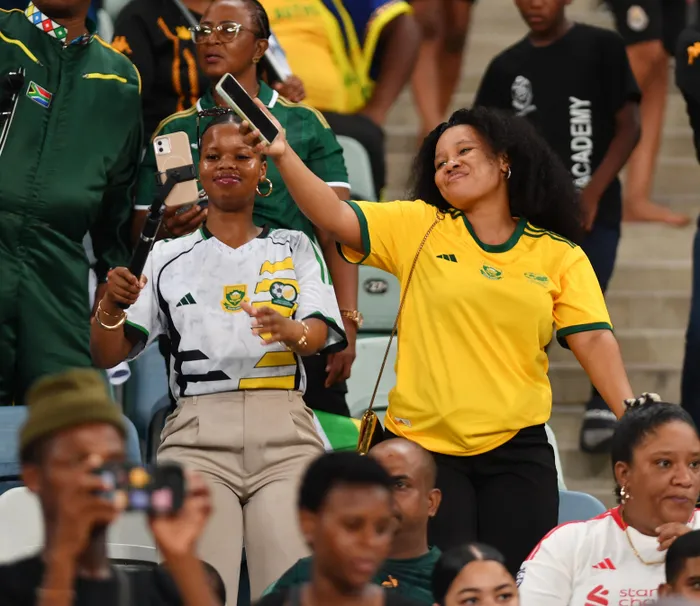
Bafana Bafana supporters will be able to wear their jerseys with pride during the 2026 Fifa World Cup in North America.
Image: Backpagepix
There is a quiet indignity in being a football fan from a country that failed to qualify for the Fifa World Cup. It hits you hardest when you are actually there, standing in a stadium halfway across the globe, surrounded by fans from 32 other nations.
At Qatar 2022, I found myself walking into the posh Lusail Stadium wearing a Brazil shirt for their match against Serbia.
Without South Africa in the mix, I was a nomad, searching for a second team to borrow some passion from, trying to convince myself that a Selecao goal mattered to me as much as a Bafana Bafana strike. I specifically chose the shirt because of Tottenham striker Richarlison, who ended up scoring a cracking bicycle-kick goal to win the match.
Outside the stadium, the Brazilian supporters were celebrating and having a good time following their 2-0 win. We joined in the celebrations and partied with Brazilians without understanding a word of Portuguese. It felt a bit like 2010, except that I wasn’t as eager to pay for rounds that included R250 beers.
But while the hangover was familiar, the gees just didn’t feel the same. I felt like a bit of an impostor. It was a lekker experience, don’t get me wrong, but it lacked the visceral, heart-in-throat anxiety that only comes with watching your own team in the stands.
For 16 years, South African fans have been forced into this role of the neutral observer at the Fifa World Cup, politely applauding the success of others while our own team remained an afterthought.
Thankfully, as we look toward the World Cup in North America, those days of "borrowed jerseys" are officially over. All this will change in June and July, when we will be able to cheer on Hugo Broos and his Bafana Bafana team. South Africans won't have to scan the groups to see which underdog is worth supporting ... we have our own horse in the race.
The most remarkable part of this journey wasn’t just the qualification itself; it was the erasure of the so-called “calculator era”.
For years, being a Bafana Bafana supporter required a degree in advanced mathematics. Every qualification cycle followed a depressing, predictable script, which ended in a final day where we needed a win, two draws elsewhere, and a specific solar eclipse to occur just to stand a chance.
We became the laughing stock of African football, a nation with world-class infrastructure and a top-tier domestic league that somehow couldn't figure out how to beat minnows without needing a slide rule.
The man who finally threw the calculators in the bin is Broos.
Broos did something his predecessors refused to do: he prioritised mentality over reputation. He stopped selecting players based on their star power and started building a well-oiled machine of soldiers who understood his tactical blueprint.
Under Broos, the transformation has also been psychological. The team that used to shrink under pressure has been replaced by a disciplined, fearless unit. We saw the first real fruits of this labour during the 2023 Africa Cup of Nations bronze-medal run, and the momentum has only snowballed.
Despite the Teboho Mokoena saga, the 2026 World Cup qualification campaign wasn't a desperate scramble; it was a statement. By securing the top spot in a group that included Nigeria, Bafana Bafana proved that they no longer need favours from other teams to succeed. They are masters of their own destiny.
Walking into a stadium in the United States or Mexico — for those who can afford it, of course (I will be watching on TV) — will feel fundamentally different. There won’t be a need to buy a Brazil shirt to blend in; people from Mzansi will be wearing the green and gold, partying in their own language.
Broos hasn't just qualified us for a tournament; he has restored a sense of pride that had been missing for 16 years. The calculators are gone, the second teams are retired, and for the first time in a generation, the world will see South Africa exactly where we should be: on the pitch, not in the stands wearing someone else's colours.