A day to celebrate Turkey, Ali and brave decisions
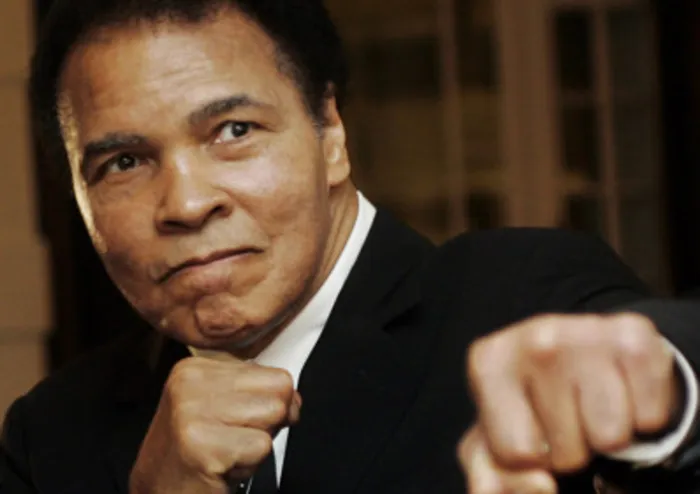
U.S. boxing great Muhammad Ali poses during the Crystal Award ceremony at the World Economic Forum (WEF) in Davos, Switzerland in this January 28, 2006 file photo. Ali, one of the best-known U.S. Muslims, appeared December 9, 2015 to join the chorus condemning the proposal by Republican presidential front-runner Donald Trump to temporarily stop Muslims from entering the country. REUTERS/Andreas Meier/Files U.S. boxing great Muhammad Ali poses during the Crystal Award ceremony at the World Economic Forum (WEF) in Davos, Switzerland in this January 28, 2006 file photo. Ali, one of the best-known U.S. Muslims, appeared December 9, 2015 to join the chorus condemning the proposal by Republican presidential front-runner Donald Trump to temporarily stop Muslims from entering the country. REUTERS/Andreas Meier/Files
On February 25 1945, as World War II was winding down, the leaders of Turkey looked left, then right, then crossed the road. Why did the Turkey cross the road? To declare war on Germany and Japan.
As Graeme Donald’s “On this Day in History” noted, they placed themselves on “the winning side without firing a shot”. It is, though, not that simple.
Turkey had suffered during WWI, it was broke and its people suffering. Through the war, it is estimated Turkey, a predominantly Muslim nation, saved some 100 000 from death in the Holocaust.
On February 25, 1964, Cassius Clay went to war on Sonny Liston. Clay baited Liston, he goaded him, he wrote him poems. This was read on CBS the night before the fight:
Clay comes out to meet Liston and Liston starts to retreat,
If Liston goes back an inch farther he’ll end up in a ringside seat.
Clay swings with a left, Clay swings with a right, Just look at young Cassius carry the fight.
Liston keeps backing but there’s not enough room, It’s a matter of time until Clay lowers the boom.
Then Clay lands with a right, what a beautiful swing, And the punch raised the bear clear out of the ring.
Liston still rising and the ref wears a frown,
But he can’t start counting until Sonny comes down.
Now Liston disappears from view, the crowd is getting frantic
But our radar stations have picked him up somewhere over the Atlantic.
Who on Earth thought, when they came to the fight, that they would witness the launching of a human satellite?
Hence the crowd did not dream, when they laid down their money, That they would see a total eclipse of Sonny.
Clay was in his transition to becoming Muhammad Ali, and this almost derailed the fight. Clay had been an all-American hero after the Olympics. Converting to Islam did not sit well with the promoter, Bill McDonald. It also did not sit well with Angelo Dundee, his trainer.
In “The Greatest: My Own Story”, written in the first person with Ali by journalist Richard Durham, who spent six years living with the Champ, he remembers the day Dundee burst into the change-room during pre-fight training.
Malcolm X of the Black Muslims was in the gym. “Do you know what will happen if the newspapers pick that up? They’ll denounce you! They’ll condemn you! Please! Please! We’ve got to get him out of here! If the newspapers know you’re associated with Muslims like Malcom X your career is over,” Dundee told Ali.
“I’ve been as close to Angelo as I’ve ever been to a white man up to now,” wrote Ali. “The only thing he doesn’t know is that Malcolm is not the only ‘X’ in the gym. I am Cassius X.”
The promoter panicked. Ali let them. He went to Liston’s house, which was in a white neighbourhood and baited the big bear some more. White police arrived and chased him away, one telling him, “Boy, if you’re not out of town in the next hour, you’re going to jail.” Ali left. His promoter finally came around. He had to. Ali would not fight if he was going to be forced to lie about his religion.
February 25 should be a day of celebration, not just for Turkey and Ali, but for all who make brave decisions. Turkey played a role in a war they wanted no part of, and saved 100 000 people from evil. Ali fought barriers of race and religion against a society that was as twisted and evil as apartheid South Africa. He won some those fights, though they left their mark on him. They left their mark on all of us.
Johan van Wyk, the Rapport sports writer who passed away this week, was the sort of journalist who often broke stories that had many of us scrambling to play catch up. As Bokkie Gerber wrote in Rapport yesterday, Van Wyk dedicated his entire life to sports journalism and most of it to the newspaper where he spent most of his career.
He coined the headline: “Naas 24, Transvaal 18”, after the 1987 Currie Cup final. Condolences to his family, friends and colleagues.
The Star