Why there has been little power bill relief despite prolonged load shedding
and |Published
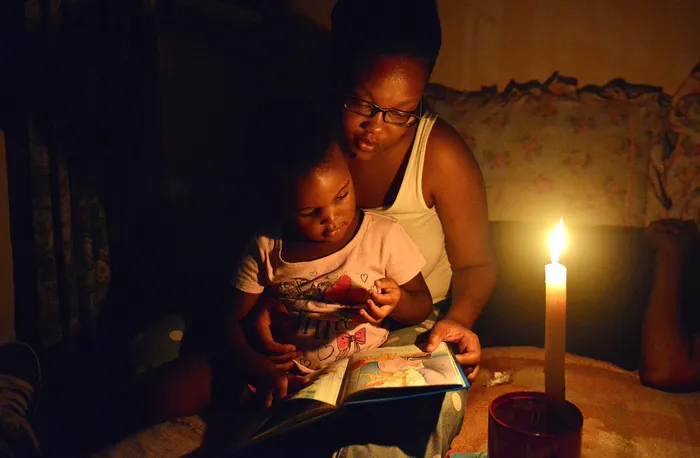
Sanelisiwe reads a bedtime story to her daughter Nandi, 2, as Eskom load shedding hits the area in Newlands East, Durban. Picture: Bongiwe Mchunu.
Johannesburg - A month of load shedding and hours spent in the dark should see reductions in electricity usage and cost on bills, but it doesn’t work like that… Instead South Africans are paying more.
So far load shedding has blighted South Africa for 86 of the 281 days of 2022.
It works out to about a third of the year spent dealing with blackouts. No electricity should mean relief in back pockets, but to understand why this is not so, The Saturday Star turned to the experts.
“You have to remember that electricity for people who live in municipalities went up in July, so you are not going to see a decrease in how much you pay.”
“In fact, there is a 9.6% relative increase in terms of what you paid in June to what you are paying now,” explained energy expert Lungile Mashele.
He added that people assume that because there is load shedding they are saving on electricity. The problem is that it is deferred to a different time. South Africans are bathing and cooking at different times to avoid load shedding and often this falls into the expensive peak periods of electricity use.
“The other biggest reason why people do not see a reduction is that they forget that during load shedding, especially during long periods or long bouts of load shedding, your electrical appliances such as your freezer, which may have been on -20°C for instance, drops to -10°C,” said Mashele
“Then when you are back up again, it has to go back up to -20°C and you experience a surge. The surge comes back during peak tariff time, so not only do you have a surge, but you are now almost paying double for electricity in some cases.”
Professor Hartmut Winkler of the Department of Physics at the University of Johannesburg said while reduced power consumption should see electricity bills going down slightly, it would not be as much as people would hope for.
“There are various reasons why the reduction in electricity use is not in proportion to the reduction in load shedding-free hours,” said Winkler. The biggest culprit in most houses is the hot-water geyser.
During load shedding the geyser cools. “The moment load shedding comes back, the geyser immediately draws power, and it will stay on for longer than usual until it finally reaches the desired heat,” said Winkler.
“In effect, this means that the daily average use of power to heat geysers stays roughly constant, even when it is a day with high load shedding. Note that geysers are one of the largest consumers of power in a typical household.”
City Power spokesperson Isaac Mangena said there are valid reasons why people’s electricity bills have not decreased, despite continuous load shedding for the past year.
“What most of those who question the bills now during load shedding ignore is the fact that consumption of electricity is higher than what it was last year at the same period of the year.
“The electricity bill is a factor of usage by the consumer, and the applicable tariff. So as you know the applicable tariff was increased in line with NERSA-approved tariff increases, and the same consumption you paid for past year won’t be the same as this year.”
Mangena did admit that the overall demand for electricity and the revenue from its sale over the past few months was lower when compared to the previous financial year.
Spokesperson Zweli Dlamini of the City of Ekurhuleni said that their consumers are billed for actual electricity consumption.
“In respect of conventional meters – not pre-paid – actual consumption is only billed in the month following consumption, with the result that any reduced consumption due to load shedding will only be reflected on the following month’s statement,” he said.