Legal hurdles plague Khampepe Commission Inquiry


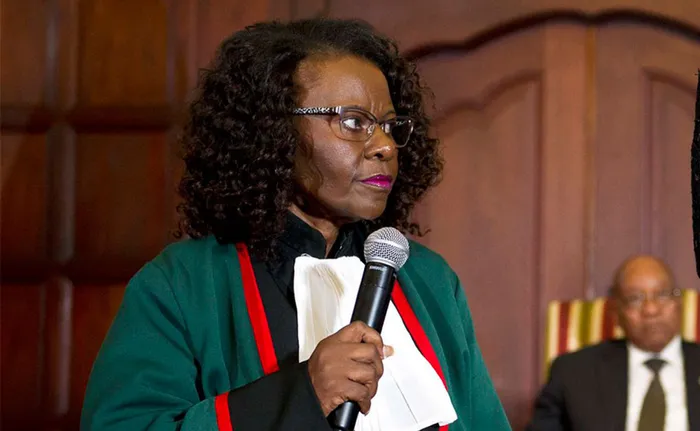
Retired Justice Sisi Khampepe.
Image: File
The Khampepe Commission, chaired by retired Justice Sisi Khampepe, was set up in May last year as an inquiry into delayed apartheid-era prosecutions.
Ramaphosa established the Khampepe Commission after litigation by the families of apartheid-era victims and the Foundation for Human Rights. In January 2025, 25 families and survivors brought an application to compel President Cyril Ramaphosa to establish a commission of inquiry into the interference in the investigation and prosecution of TRC cases, together with a claim for constitutional damages.
Its mandate was to determine whether political interference or other efforts were made to halt and prosecutions related to Truth and Reconciliation Commission (TRC) cases. The present chairs are retired Constitutional Court Judge Khampepe, along with retired Judge President Frans Kgomo and Advocate Andrea Gabriel.
Now 10 months later, it is being fraught with a series of legal challenges. Mbeki and Zuma unsuccessfully approached the Gauteng High Court to remove Khampepe on the basis of her past role within the TRC Amnesty Committee and subsequently the NPA. I suspect the real reason is that both Mbeki and Zuma previously had amnesty applications refused by a panel that included Khampepe during the initial TRC process.
The legislation that spearheaded the TRC was the Promotion of National Unity and Reconciliation Act, was tabled by then Minister of Justice, Dullah Omar, in 1995. The Act explicitly stated that, if not granted amnesty, perpetrators of politically motivated human rights violations faced prosecution by the State. The ANC Presidents changed their minds. At some juncture the TRC’s refusal to grant a blanket amnesty to 37 ANC leaders who did not want to apply in their individual capacities and just wanted a free pass. This situation created the potential jeopardy of prosecution of ANC leaders.
But the impasse into what happened with the TRC goes even deeper.
The Truth and Reconciliation Commission in South Africa, which operated between 1996 and 1998 (with the Amnesty Committee continuing until 2001), processed thousands of cases regarding gross human rights violations committed between 1960 and 1994. The TRC received more than 21,000 statements from victims or their families, which identified over 37,000 gross human rights violations, including killings, torture, and disappearances.
The TRC received 7,112 amnesty applications. Of those a total of 849 amnesty applications were granted, while over 5,000 were refused. Upon closing, more than 300 cases of gross human rights violations, where amnesty was denied or not applied for, were handed over to the National Prosecuting Authority (NPA) for investigation and prosecution. No major figure of apartheid or individuals who committed gross human rights violations were ever prosecuted or convicted. This is why after 32 years since the advent of democracy, South Africa still lives in a perpetual unresolved crisis of despair.
Professor Patrick Bond, a prominent political economist and critic of post-apartheid South Africa, is known for arguing that the TRC was a structural failure, primarily because it prioritized political reconciliation over economic justice. He made the argument that by focusing on individualized gross human rights violations, the TRC neglected the systemic and structural economic violence of apartheid, which continued into the new democratic era.
He suggests that the ANC politicians adopted “progressive rhetoric while implementing neoliberal policies”, with the TRC representing a "reconciliation" that allowed the existing economic elite to maintain their position. The late Cosmas Desmond a prominent human rights activist and former Catholic priest, was a vocal critic of the TRC during its inception. He famously challenged the overtly religious and Christian nature of the TRC. The thrust of his challenge was whether the commission was functioning as an "arm of the state or the church," suggesting that the involvement of an overtly “religious” element compromised the secular nature of the state. Like many critics, he was skeptical of the restorative justice model, which prioritized amnesty over traditional prosecution for perpetrators who fully disclosed their crimes.
We can thus see that the TRC was successful at storytelling and exposing the horrors of the past but was a dismal failure because it prioritized the oppressors (who didn’t have to apologise), over accountability, allowing many perpetrators to walk free and their crimes to lay buried in the past.
In his 1997 documentary, Apartheid did not die, the remarkable late war correspondent John Pilger highlighted that while legal apartheid ended, "economic apartheid" remained intact. He argued that the TRC failed to address the systemic theft of land and the ongoing economic control by a small minority, both white and newly affluent black elites. In his book “Freedom-Next Time” he notes that the "freedom" promised was limited by the adoption of neoliberal economic policies, which he believed continued to oppress the black majority despite the political “transition”.
The lack of any exposure of the involvement of major corporations—both in South Africa and internationally in sustaining the apartheid system was never addressed.
The judiciary which enabled such an evil system were never brought to book. These were dominated by white men who brutally engaged in the judicial imposition of state sanctioned murder.
Under Chief Justice CJ Rabie, the Appellate Division was dominated by an "emergency team" of five judges—Rabie, Hefer, Viljoen, Joubert, and JJA Vivier—who were seen as upholding state security laws over human rights.
The TRC requested that judges appear to account for their actions, but they shamelessly and arrogantly ignored the request, opting not to take part in hearings. Its final report stated that the judiciary's failure to appear displayed a lack of accountability and that "History will judge the judiciary harshly".
The legal system was used to legitimise apartheid. People could be arrested, torture for confessions, and then convicted on the basis of those confessions. The judiciary did not question it. And 32 years later, the legal establishment never had a true purge. While South Africa formally dismantled the legal framework of apartheid, replacing it with one of the most progressive constitutional frameworks in the world, this is in theory only.
If the Khampepe commission can, some 32 years (too) late, establish the truth behind delayed justice, investigate political interference and eventually address the culture of impunity for serious crimes that both state operatives and former activists who did not receive amnesty are properly investigated; this will provide closure for victims and may also restore the integrity of the criminal justice system.
If not, it will be another wasted commission set up by Ramaphosa and 70 years from now, future generations may look back on this era not as a successful transition, but as a period where shallow reconciliation was prioritized over justice, leaving them to inherit deep socio-economic inequality.
* Ismail is criminal Defence Lawyer & Founder of the South African Debate Initiative