From Grassy Park to the World: When Talent Runs Ahead of Justice


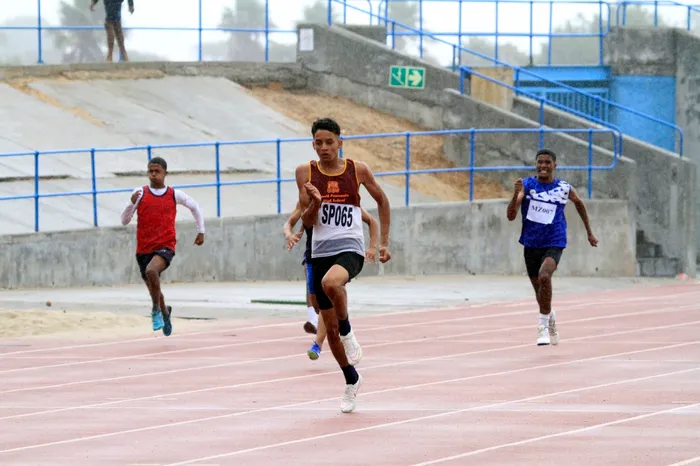
Ubay Arend's triumph at the South African Age Group Championships serves as a powerful reminder of the untapped potential within Grassy Park, highlighting the urgent need for better sports infrastructure and support for young athletes.
Image: Supplied
There are moments in community life when sport does more than produce a result sheet; it exposes a nation’s conscience.
On Saturday, March 28, at Germiston Stadium during the South African Age Group Championships, news travelled back to Grassy Park that one of its own, Ubay Arend, had produced the fastest time in the world for his age this year.
For many in the community, that news carried the weight of something larger than sport. It was the kind of moment that could easily bring tears to the eyes of those who understand what it means for a child from the Cape Flats to outrun circumstance.
For those of us who have lived in Grassy Park all our lives, this was not simply another athletics statistic. Grassy Park has long been known as the gateway to the Cape Flats.
A place layered with history, struggle, and resilience. It is home to E.C. Primary School, the first school built on the Cape Flats, a symbolic marker of how deeply education and community are rooted here. It is also a place where talent repeatedly emerges despite conditions designed to suppress possibility.
Ubay’s journey began at Sid G Rule Primary School and now continues at South Peninsula High School. Yet even as his feet move at world-class speed, the structures around him remain painfully slow.
His school is currently fighting to protect the MN Moerat Sports Field from private development through a public petition because even basic sporting space has become contested land.
That struggle is not isolated. It reflects a broader and deeper political truth: the poor remain conspicuously marginalized, even in democracy, even in spaces where talent has repeatedly proven itself.
For years, many of us have argued for a proper athletics track in the deep South. The logic is obvious. Athletics remains one of the most accessible sporting codes in working-class communities.It requires discipline more than privilege, commitment more than capital. Yet a child from Grassy Park who wishes to train seriously must travel approximately 35 kilometres to the University of the Western Cape Athletics Club or 26 kilometres to Vygieskraal Stadium just to access suitable facilities.
This is not an inconvenience. It is structural exclusion.
And still, despite that exclusion, the area has produced extraordinary athletes: Caval Marthinussen, Shaun Vester, Terrence Smith, and many others who, during the apartheid sports isolation era, ran times that would have commanded international respect.
They emerged without tartan tracks, without modern facilities, without the state making meaningful investment in their development. Thirty-five years into democracy, the pattern remains painfully familiar: talent flourishes, infrastructure does not.
Nothing illustrates this contradiction more sharply than the abandoned tartan track project at Fairmount High School. A project was approved more than two decades ago but never completed.
Today, that unfinished track stands not merely as incomplete infrastructure but as a monument to broken promises.
The recent decision by the Parkwood Sports Complex Municipal Facility Management Committee to insist on the revitalization of that project deserves strong recognition.
More than 120 schools across the South Peninsula and Southern Suburbs continue to function without a dedicated athletics facility. Yet the explanation repeatedly offered is that there is “no funding”.
This argument collapses under scrutiny when other regions continue receiving new infrastructure while Grassy Park waits, decade after decade. It becomes difficult not to interpret this as political selectivity. The community needs to be fully aware of what's at play! Helen Zille recently staged a political satire in Johannesburg by swimming through a pothole to dramatize municipal failure elsewhere. Yet Grassy Park remembers that under her DA-led mayoral tenure, the Fairmount athletics track stalled and was never revived. Satire is easy when cameras are present.
Accountability is harder when communities remember.
How many lives might have changed had that track been completed? How many children could have been redirected from despair to discipline? How many Olympians remain undiscovered because public infrastructure was withheld from public need?
The politics of space in working-class communities is never neutral. When sporting land is threatened, when facilities remain unfinished, when children travel across the city to train, what is being communicated is that excellence may emerge, for a select few and not the masses. And yet Grassy Park continues producing excellence.
That is why Ubay Arend’s performance matters beyond the stopwatch. It is a declaration that the margins still speak, still run, still rise.
But talent alone cannot continue carrying the burden of injustice.
The time has come for communities to demand, loudly and unapologetically, that infrastructure follows potential, that promises become brick and tartan, and that the children of Grassy Park inherit more than applause.
Because memory remains a weapon. And now, memory must also become movement.
* Neumann, is a Councillor for the Good Party in the City of Cape Town and also a senior Athletics Administrator