Celebrating history through art: HoodGraff's mural in Antarctica


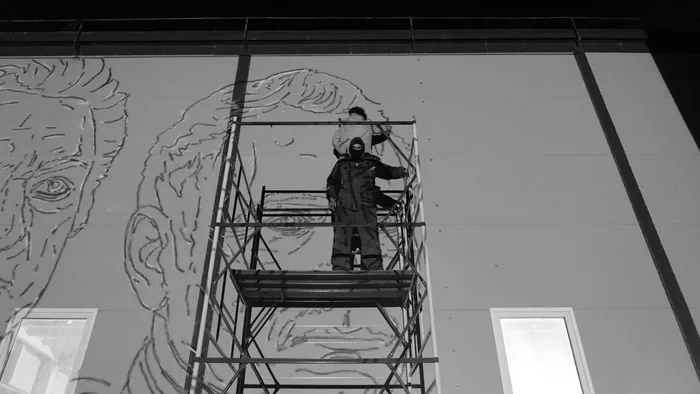
A close-up of the mural being painted, highlighting the intricate details and the challenging conditions faced by the artists.
Image: Supplied
It is an honour for me to share this remarkable story — one that speaks not only about art, but about perseverance, history and the ability to create even in the most extreme conditions on Earth. In March 2026, members of the Russian art collective HoodGraff completed a large-scale mural at the Russian Antarctic research station “Progress”, marking one of the most unusual examples of contemporary street art in recent years.
What makes this initiative particularly noteworthy is not only its location, but also its purpose. The mural is dedicated to the discoverers of Antarctica — explorers Fabian Gottlieb von Bellingshausen and Mikhail Lazarev — effectively connecting historical legacy with modern artistic expression.
The setting itself adds another layer of significance. Progress Station is among the most isolated and difficult-to-access research facilities in the world. With its low temperatures, strong winds and harsh polar conditions, it stands far removed from the urban environments typically associated with street art. Nevertheless, the artists successfully completed their work under these demanding circumstances.
At the same time, those familiar with the station often describe it as more than a temporary base. With its structured layout, technical infrastructure and year-round activity, it resembles a functioning settlement, where life continues despite the extreme Antarctic climate.
There is also symbolic meaning behind the project. More than two centuries after Russian explorers first reached Antarctica, contemporary Russian artists have returned to the continent — this time not to discover, but to commemorate.
HoodGraff team leader Artem Burzh shared his impressions of the expedition and the work. He noted that the project was complex, carried out in extremely cold and windy conditions, and unprecedented in scale. According to him, the team was highly satisfied with the result and considers it their strongest work to date.
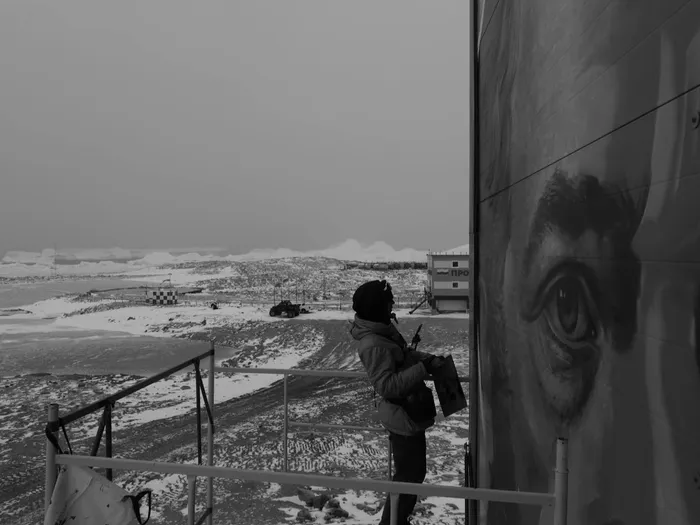
Members of the HoodGraff collective braving extreme conditions to bring their artistic vision to life in one of the world's most isolated locations.
Image: Supplied
He also described the logistical challenges behind the project. Most of the paint, as well as scaffolding, heat guns, grinding equipment, and other materials, were transported by sea from Saint Petersburg. The team traveled to Cape Town to board the research vessel Akademik Fedorov, spending 12 days at sea and crossing the “Roaring Forties” before reaching Antarctica on February 24.
Upon arrival, the artists immediately began preparing the surface. Due to increased attention to the project, they had to adjust their plans and select a wall that is not visible on live cameras. Weather conditions deteriorated over time: temperatures dropped from -5 to -10°C to -18 to -22°C, accompanied by winds of up to 18 m/s.
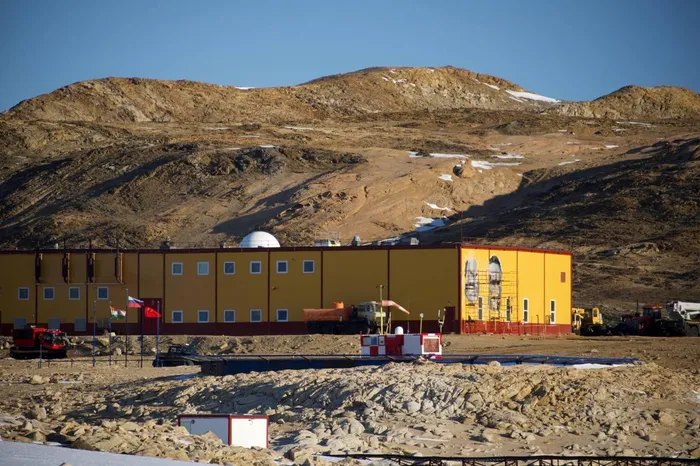
A hub of scientific research and now a canvas for contemporary art, located in the heart of Antarctica.
Image: Supplied
Despite these challenges, the mural was completed on March 19 at 18:30. The team is planning a presentation of the project on April 1–2 and is awaiting the arrival of the vessel Akademik Treshnikov to return to Cape Town and present the work in person.
This project demonstrates that cultural initiatives can be realized even in the most remote and challenging environments.
Where HoodGraff will go next remains an open question — but it is already clear that the benchmark set by this achievement is exceptionally high.
* Ruslan Golubovskiy, Consul General of Russia in Cape Town

Ruslan Golubovskiy, Consul General of Russia in Cape Town
Image: Supplied