Why we must demand an inconvenient democracy for all


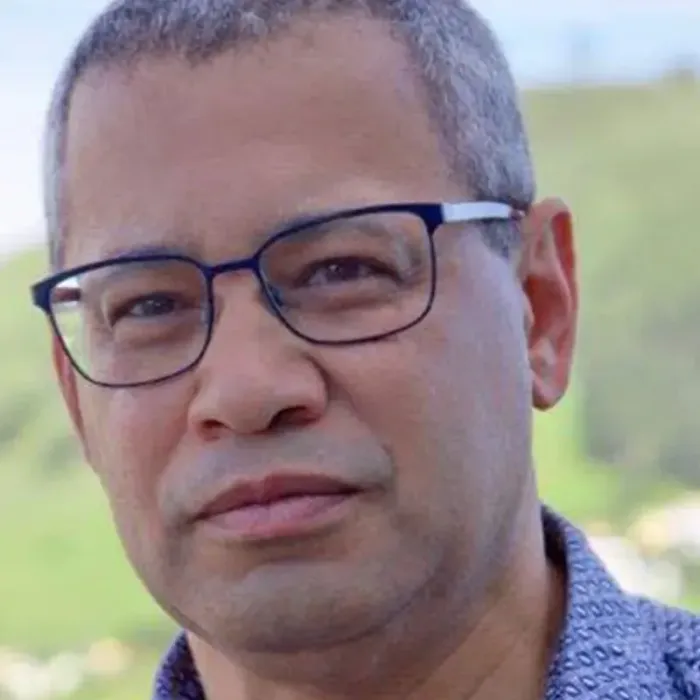
Lorenzo Davids is the Executive Director of Urban Issues Consulting.
Image: Supplied
For democracy to work, it must be inconvenient for everyone. The fact that 1994 was celebrated so intensely and for several years was the early warning sign that we did not understand democracy. 'Rainbow nation' was such a cute phrase; it gave us a high we had never experienced before. But it was fake.
It did not challenge us enough. It did not extract enough from us. It did not cost us enough. It made us feel like, “Oh wow, I can do this. This is not too bad. Pack away the baked beans, darling. I’ve invited Vusi and his wife over for dinner, you know, that reconciliation thing, we’re doing that tonight.” I wish we were harder on each other. Braais and BBBEE are not reconciliation nor restitution.
We did not fix the broken things in us and in our society. We kept on ignoring it. We kicked important issues to the curb for the sake of a myriad of fake stuff like corporate promotions, shareholdings, houses in previously racially exclusive neighbourhoods and World Cups.
We spoke to each other like long-lost cousins, and not as recent enemies. Perhaps the recalcitrant Afrikaner and the PAC were the most honest people around 1993, for they both refused to settle for a comfortable democracy.
The country in the minds of politicians and corporations was a far cry from the one that existed in reality. Nelson Mandela should have had a far more intense discussion with Betsie Verwoerd in Orania. Perhaps he should have refused the tea and cookies. Perhaps he should have said: “We’ll do tea later. For now, will you go with me to Galeshewe, built in 1878 and ask those old diamond-mine-worker families for forgiveness? It’s a two-hour drive, but it’s necessary." It never happened. We avoided building an inconvenient democracy, and today we are paying the price for our foolishness.
Systems are breaking down everywhere, and people are prisoners to historical trauma and pain because of conversations and confrontations that never took place. Convenience continued uninterrupted for those who had the power and still do so today. The pre-94 White elite and post-94 Black elite, who have benefitted from both Apartheid's existence and its subsequent abolition, all have a very convenient power, conferred on them by democracy, to make every other South African believe they are idiots for not feeling great, heard or understood.
Why are there more than 168 dedicated Holocaust museums, about 750 Holocaust memorial and documentation centres and more than 10 000 Holocaust memorial sites globally? Because genocides are important issues to talk about – all the time. Why are we in South Africa not more insistent that we talk about the traumatic experiences of living under colonisation, Apartheid and the failures of this democracy? Why are we officially ignoring it? Because the people with power – white and black – simply have no need to do so. Their convenience, pre- and post-apartheid, has remained safely in place. You have heard the responses to the call for a National Dialogue: “We don’t need a national dialogue; we know what must be fixed!”
Really? Do you? You know exactly what people feel, think and have lived through and suffered in this country? You say that unaware of your enormous privilege today? So you know the trauma and land loss, loss of loved ones through murder by the State and economic loss and lingering anger of still powerless people? That arrogant attitude about the loss black, coloured and Indian people suffered over multiple generations is exactly the reason why we must insist on talks about reconciliation and restitution in this country.
Democracy has not been inconvenient for those who have benefited from Apartheid. In 1994, it was: “Ja, you know, Mandela is exactly the ‘ou’ we need to fix this country. Prison sorts one out, boet.” In 2024, it was "You know what? I always said, “the black people are gonna stuff up this country.”” All of these reflect how poorly South Africans understand democracy. Have you heard this one: “We gave you a freaking working country, and all you guys did was stuff it up!”
When your understanding of the psychology of democracy is that, as long as the things that used to work for you back then still work for you today but still don’t work for others, everything is okay, you show us why we need very inconvenient dialogues about democracy. As long as the elite believe they know "what to do to fix South Africa", they show their obsession with acts that preserve their privilege but have no interest in the inconvenient acts of reconciliation and restitution.
Another election looms. People will again talk about what must be fixed. No one talks about traumatised people who live in a broken society. It’s just too inconvenient a discussion to have. So the default is: “give them houses, water, electricity and transport.” A city like Cape Town, where most of these services exist, remains one of the most violent cities in the world because trauma and anger are real issues. People live, not without houses or water. They live without a democracy that promised to hear them and heal them. That trauma is carried over generationally.
Dr Remi Chukwudi Okeke from Madonna University in Nigeria, in his paper “Making the case for inconvenient democracy", argues that “democracy is a system of protecting self-interest, and that people support it only to the point that their own self-interest can be advanced.” He says, “Democracy's propagators are aware of their self-interest. They never play the democratic game with the intention of letting the other side win.” Democracy is an eternal contest between two opposing forces until the one demonises the other enough to take his place. It has nothing to do with fairness.
We need a pause to engage one another in inconvenient conversations about democracy that we have been avoiding. An election cannot fix this.