How Trump's foreign policy threatens global stability


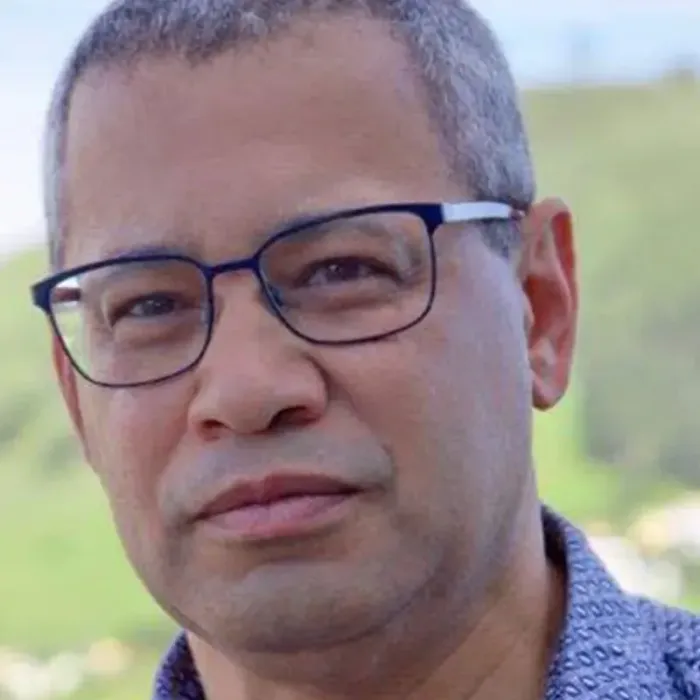
Lorenzo Davids is the Executive Director of Urban Issues Consulting.
Image: Supplied
On Friday, Donald Trump was given a made-up peace award from FIFA to satisfy his ravenous infantile craving for global recognition. His approach to peace is not diplomatic engagement. He commands people to his office, dangles tantalising business deals that he has no intention of fulfilling before them. Then he gets them to sign a piece of paper and does a photo-op. In that way, he pretends to make peace between nations that he has very little to no political understanding of.
The most dangerous thing about Donald Trump’s approach to peace that he treats peace as a business deal and a negotiating chip — something to be used for leverage in his own global or domestic political ambitions. He cares very little for the specifics or politics. He completely underestimates how quickly a bad deal can launch a war. But then again, is the 47th president of the USA seeking a war somewhere after the FIFA World Cup so that he could use his war powers to suspend national elections and stay in power indefinitely?
Since the start of the Cold War era, global stability has depended on a series of routine assumptions: that the United States would stand by its allies; that presidents would be careful with theatrics and commitments; and that threats would be issued sparingly. Donald Trump has repeatedly shown contempt for that scaffolding. In the nuclear age, the erosion of routine is not merely disruptive — it is existential.
His cabinet members call it “the President’s unpredictability," as if it were a great virtue. But this type of unpredictability is not a strategy. Its pushes adversaries and allies to rush into strike first modes, sprint toward nuclear weapons, or cut deals with regional bullies. Under Donald Trump, the world faces a different kind of risk: the normalisation of brinkmanship untethered from any guardrails.
Nowhere has Trump's appetite for maximal pressure been more explicit than in Venezuela, where he repeatedly floated military action. US officials in both parties have long avoided such pressure for fear of igniting a regional conflict.
In 2017, Mr Trump publicly said he would not rule out "a military option" for Venezuela. That was not a threat paired with a clear diplomatic off-ramp; it was presidential war-talk that forced every actor in the region to plan around the unthinkable. By 2019 he said “all options are on the table” — causing huge uncertainty in the region.
The most recent phase of US-Venezuela tensions has resulted in military activity in the Caribbean, the most recent being the brutal killing of Venezuelan seamen in their vessel, seen as a war crime by many. This has taken the fight right into the Oval Office, with the Secretary of War and the Vice President apparently differing over war powers and strategy.
The danger here is not only what Donald Trump might do. It is what his words and deployments can produce: reactions by the government of Venezuela, panic among neighbouring countries, and opportunism by outside powers. Once armies are in position, misstatements and overreactions become more likely — and leaders have less room to climb down without looking weak.
In Ukraine, the US President has, with great irresponsibility, stoked similar fires. The war in Ukraine is a test for the post-1945 idea that land invasions should not be rewarded. It is also a test of Western credibility: whether security guarantees and long-term support can outlast aggression. Trump’s rhetoric has repeatedly undermined that credibility.
In early 2024, he said he would "encourage Russia to do whatever the hell they want to NATO members" who, in his view, were not paying enough. He made it clear to the world that American protection is conditional, alliance commitments are negotiable and that Moscow might be allowed to test the seams.
That sort of conditional deterrence has consequences. Besides speeding up the arms race, it tells aggressors that coercion pays, because Trump is willing to fracture relations with traditional allies.
Donald Trump's promise during his election campaign was that he could end the Russia-Ukraine war "in one day." If you can, see this reflected in the “fire-sale one-day peace deals" he is signing in the Oval Office these days. It means absolutely nothing. Anyone who has lived through some form of war knows that quick deals in wars of national survival tend to mean coerced concessions, and coerced concessions often become the seedbeds of the next war. Donald Trump had hoped Ukraine would accept a quick deal. That it did not do so has infuriated the US President. Ukraine stands between him and his much-desired Nobel Peace Prize.
When American policy is so blatantly transactional — contingent on flattery, ego trips or personal business interest — the enemy will plan accordingly. They won’t end the war. They will simply make it more lucrative for them and the peacemaker.
With Trump’s absence from the recent G20 Summit in South Africa, and his continuous criticism of the country, influenced by misinformation given to him by the likes of Musk, AfriForum and Solidaritiet, it was clear that he was signalling to the region that he was willing to consider a new anchor partner on the continent. Soon afterwards Trump hosted Kenya in his office to sign a new healthcare and minerals deal. He is deliberately destabilising regional relationships to boost his fragile ego.
Trump’s “America First” policy is busy morphing into a global risk. When Washington turns bilateral disputes into punishments and public humiliation, it incentivises former allies to seek closer ties with rival powers and increases regional polarisation. This is the traditional recipe for war.
The world has a US president whose limited intellect repeatedly personalises foreign policy, devalues alliances, flirts with military escalation, seeks personal enrichment, and treats diplomacy as props rather than necessary guardrails.
Donald Trump's approach increases the odds that the next crisis — a border incident, a proxy strike — will meet a White House that prefers escalation to patience and spectacle to steadiness. In the modern world, that is an existential danger to global peace. No fake peace prize will be able to help him - and the world – when that happens.