Zohran Mamdani and the Prophetic Triumph of Justice

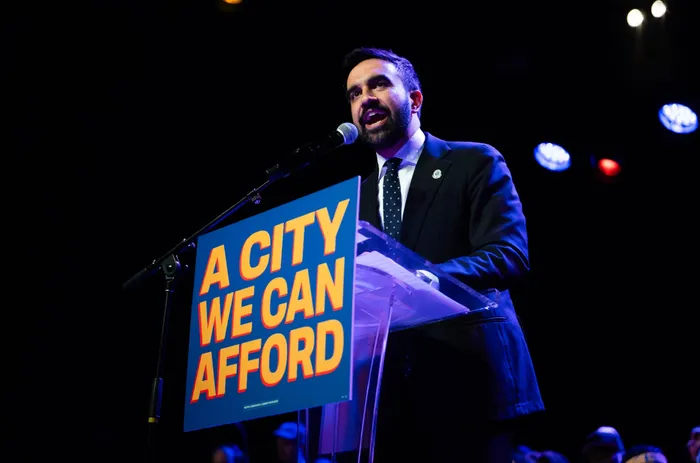
The election of Zohran Mamdani as Mayor of New York is a breath from heaven affirming that the arc of moral imagination still bends toward justice, argues the writer.
Image: Madison Stewart / Zohran Mamdani Website
There are rare moments in history when politics transcends partisanship — when the ballot box becomes a pulpit and the voice of the people echoes like a sermon from heaven. The election of Zohran Mamdani as Mayor of New York is one such moment: a breath from heaven affirming that the arc of moral imagination still bends toward justice.
In a world exhausted by violence, corruption, genocide, and deceit, the rise of a young Muslim democratic socialist in the symbolic capital of global capitalism sends a message that defies cynicism. It reminds us that the human spirit — humble, hopeful, and rooted in compassion — has not been extinguished.
Every age of moral decay gives rise to unexpected prophets. That a young Muslim now leads the most diverse city on Earth speaks of divine irony — and perhaps, divine intention. History shows us that God often raises outsiders to challenge comfort, awaken conscience, and disrupt systems of arrogance. Mamdani’s victory is such a disruption — a spiritual and moral awakening in the heart of a principality of greed.
Just as the prophet Amos condemned exploitation and demanded that “justice roll down like waters,” Mamdani’s election signals a similar prophetic principle: that truth, justice, and righteousness still have a place in political life — even in the most unlikely arenas.
That this occurred in a city with over one million Jewish residents — the largest Jewish community outside Israel — is profoundly symbolic. It reveals a shift in conscience. It tells us that ordinary people of faith — Jewish, Muslim, Christian — can still recognise the face of God in one another. It reminds us that the children of Abraham are rejecting supremacist ideologies in favour of shared humanity. In so doing, they affirm that God’s covenant has always been with the oppressed — not with the empires of wealth and war.
Faith, it appears, has proven stronger than fear. Mamdani’s campaign — rooted in peace, justice and human dignity — dismantled artificial divisions and reminded the world that Zionism as a political project can be separated from Judaism as a faith of covenantal compassion. Martin Buber once wrote, “The opposite of love is not hate, but separation.” In this moment, separation has yielded to solidarity. “Blessed are the peacemakers,” said Jesus, “for they shall be called the children of God.” Perhaps, in this city of many tongues, the peacemakers have finally spoken.
This victory is not about personality or party, but prophecy. It affirms that even in the heart of the Empire, redemption remains possible. When the marginalised unite, rejecting cruelty and apathy, something divine is stirred. As Luke 1:52 proclaims, God “brings down rulers from their thrones and lifts the humble.”
The Spirit of truth is on the move — beyond cathedrals, mosques and synagogues — stirring hearts to reject hunger as normal and war as inevitable. “Come out of her, my people,” declares the Lord in Revelation 18:4, and perhaps, that is exactly what New Yorkers have done.
New York — once the theatre of global capitalism and the seat of Wall Street — has elected a Muslim democratic socialist. It has declared that empathy matters more than ambition. That justice is not obsolete. That hope can be resurrected from despair.
The prophet Isaiah envisioned a world where “every valley shall be exalted” and “every mountain made low.” That vision came alive when ordinary New Yorkers refused to wait for the powerful to save them and began building change from the ground up.
This is the true spiritual revolution: the realisation that liberation is not granted by elites, but seized by the people.
And what of Africa?
Across the continent — and particularly in South Africa — we still bow at the altar of dependency, awaiting donors, investors, and redeemers who never come. South Africa, once ablaze with prophetic fire, now drowns in bureaucratic despair and a glut of costly commissions, while its children die beside mines of diamonds, coal, and platinum.
We have become experts in mourning our pain, but amateurs in mastering our power.
While Palestinians fight for breath amid genocide and occupation, calling for solidarity, Africa risks becoming a museum of forgotten revolutions — eloquent in memory, impotent in action. Mamdani’s victory is not just New York’s triumph — it is Africa’s wake-up call. If the descendants of enslaved immigrants can reclaim the citadel of capitalism, what excuse remains for a resource-rich continent governed by a poverty of imagination?
God’s whisper in this moment is clear: Rise. Take responsibility for your destiny. The age of dependency is over. The age of accountability has begun.
Walter Brueggemann teaches that liberation comes when ordinary people confront injustice with prophetic imagination. Cornel West reminds us, “Justice is what love looks like in public.” And New Yorkers have shown that disciplined, deliberate love can topple entrenched power.
This is God’s doing — a crumbling of Babylon from within. Meanwhile, the architecture of hubris bleeds nations dry: genocide in Sudan, starvation in Palestine, and economic colonialism across Africa. The United States — mired in foreign wars — funds conflict and arms corporations that profit from suffering. But Mamdani’s victory tells a different story: the conscience of America is not dead. Its people are awakening.
They are tired of Zionist proxy wars, tired of sacrificing their children for profit, and tired of watching their leaders fund war while their own communities rot.
As Thomas Merton once wrote, “We must be prophets, not merely critics.” The New York electorate has become prophetic. Their vote cries out like the psalmist: “The stone the builders rejected has become the cornerstone” (Psalm 118:22).
This is no mere political win. It is a moral renaissance — evidence that God is still speaking, still raising prophets in unexpected places.
South Africa must listen. In 2025, too many have turned to burning and looting in despair, while the ballot — the most radical instrument of change — lies dormant, bartered for nostalgia and handouts. The kingdom of justice begins wherever people dare to live as if love is stronger than death.
This moment carries the cadence of Advent — the holy waiting for divine hope to be born again. Mamdani’s victory is a parable of incarnation: God being born into history through justice, solidarity and courage.
“Behold, I make all things new,” declares Revelation 21:5. But to hear this call and remain idle would be to miss the meaning of the moment. As the prophet Micah asks, “What does the Lord require of you but to do justice, love mercy, and walk humbly with your God?”
Indeed, to miss this call now is to remain imprisoned in moral apathy.
The age of neutrality is over. The Spirit is calling a new generation — of Muslims, Christians, Jews, secularists, youth and elders — to rise against greed, war, and injustice.
Zohran Mamdani’s victory is a sacred reminder: light still breaks through Babylon’s cracks. God has not finished speaking.
Congratulations, New York — well done.
*** William S. Steenkamp – Socioeconomic Transformation and Restorative Justice Activist
** The views expressed here do not necessarily represent those of IOL or Independent Media
IOL Opinion