Funding woes: eThekwini ratepayers bear the burden of GO! Durban's challenges


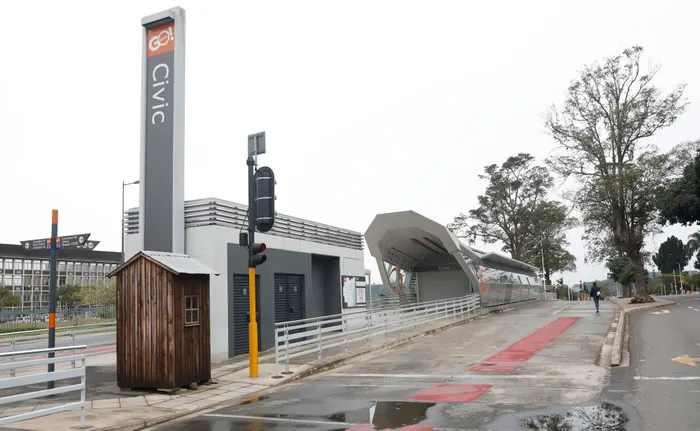
A Go! Durban bus station in Pinetown stands empty while eThekwini municipal officials review a strategy in response to national funding changes.
Image: Doctor Ngcobo / Independent Newspapers
Concerns are mounting over an additional 1% of municipal rates revenue to support the operational shortfall during the early phases of the GO! Durban project implementation in the eThekwini Municipality.
Currently, the municipality allocates 6% of municipal rates revenue toward public transport services, including Durban Transport operations, stated a Go! Durban implementation progress report and review strategy in response to national funding changes.
The programme was supported through the Public Transport Network Grant (PTNG) administered by the National Department of Transport (DoT).
However, in November 2025, after 16 years and a staggering R9 billion spent, the DoT and National Treasury advised municipalities that the PTNG would be reduced over the next three years, with funds diverted toward more pressing needs.
The eThekwini Municipality has struggled to roll out the Integrated Public Transport Network System (IPTNS) programme.
The latest report tabled before the municipality's Human Settlements, Engineering and Transport Portfolio Committee offers little confidence in the project's future, said Lyndal Singh, DA councillor and eThekwini Caucus deputy leader.
Singh submitted questions to the municipality seeking clarity on total project costs, the causes of delays, the status of taxi industry agreements, and a credible, time-bound plan to operationalise GO! Durban, while limiting further financial losses.
She stated that, to date, no responses have been received.
“This project has already cost residents massively and continues to do so. None of the stations is operational, while some remain incomplete. The municipality continues to spend millions of ratepayer funds annually on security and maintenance of idle, vandalism-prone facilities,” Singh said.
She said that with funding withheld and reclaimed, ratepayers now bear the ongoing costs of maintaining the unused bus stops.
“These are funds that should be directed toward fixing potholes, repairing water infrastructure and leaks, maintaining electricity networks, improving sanitation, and strengthening community safety. At a time when communities are struggling to access even basic services, this is indefensible.”
She added that instead of prioritising the rehabilitation and integration of existing public transport systems, particularly those of the Passenger Rail Agency of South Africa (PRASA), which continue to deteriorate, the municipality pursued an unaffordable parallel system that is now failing to materialise.
In July 2025, the council approved the revised GO! Durban implementation approach, which provided the strategic direction for the phased implementation of the network, prioritising key corridors and enabling the municipality to progress toward operationalising services using the infrastructure already developed through the programme.
The report stated that following the PTNG announcement, the municipality initiated a review of the programme to assess the long-term financial sustainability of the Go! Durban system.
During an oversight visit in January 2026, Donald Selamolela, the chairperson of the Portfolio Committee on Transport, called on the government to ensure that the infrastructure, as laid out for the PTN in eThekwini, was not lost.
“This infrastructure must not lie fallow and turn into waste,” he said.
Selamolela said the challenges are not insurmountable and that the implementation of eThekwini’s intermodal public transport system should not be delayed any further.
Mluleki Mntungwa, eThekwini Mayor Cyril Xaba's spokesperson, recently stated that the municipality believes in constructive engagement with all stakeholders.
“The C3 corridor is targeted for commencement in the 2026/27 financial year, subject to completion of negotiations, fleet readiness, and final infrastructure checks,” Mntungwa added.