UN Chief calls on G20 to rescue developing nations from debt, inequality, and climate crisis


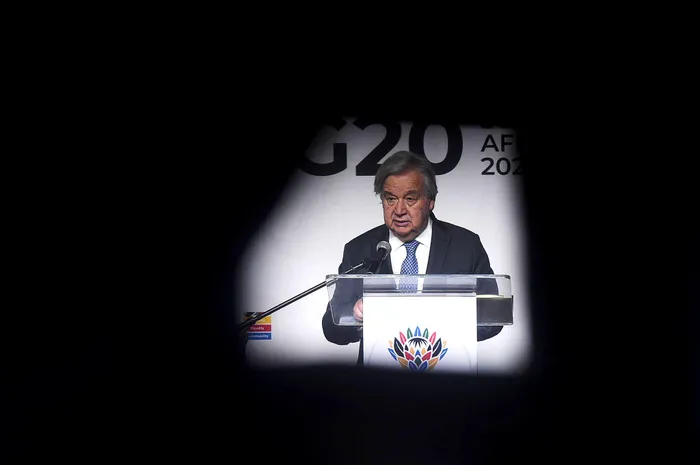
United Nations Secretary-General António Guterres speaking ahead of the G20 Leaders' Summit on Friday.
Image: Itumeleng English / Independent Newspapers
United Nations (UN) Secretary-General António Guterres warned that conflicts, climate chaos, economic uncertainty, mounting debt, inequality and a collapse in global aid were inflicting massive suffering around the world.
Speaking ahead of this weekend’s two-day G20 Leaders’ Summit in Johannesburg, Guterres said among the world’s largest economies, the G20 can hold enormous influence to ease suffering and ensure that economic growth is widely shared as well as set the world on a better, more peaceful course for the future.
“Developing countries – in particular in Africa – are suffering from a perfect storm of shrinking fiscal space, crushing debt burden, and a global financial architecture that is failing to support – or even represent – them adequately,” Guterres stated.
He said Africa must have a fair seat in every forum where decisions are made – from the boards of international financial institutions to permanent seats in the UN Security Council and to other global bodies.
“The G20 has the power to repair this historic injustice and drive reforms that give developing countries – and Africa in particular – a real voice in shaping global policies, and make global economic governance more inclusive, representative, equitable and effective in the years ahead,” Guterres added.
He urged G20 member nations to live up to the commitments made in June in the Financing for Development Conference in Sevilla, Spain, to unlock more finance for developing countries.
“To triple the lending power of multilateral development banks. To increase their role in leveraging more private finance. To ease debt burdens using new instruments that lower borrowing costs and risks, and speed-up support for countries facing debt distress, drawing on recommendations from my debt expert group,” the UN boss explained.
He added that all these interventions would help developing countries strengthen their capacity to mobilise domestic resources and to build trade bridges, not trade barriers.
“Ensuring that all countries can make this shift means aligning national policies and budgets with a just energy transition. It means providing resources and technology to help developing countries invest in grids, storage and efficiency,” he stated.
Guterres added: “It means supporting workers and affected communities to make the transition, through training, protection, and new opportunities.
“And it means unlocking finance at scale for developing countries by cutting the cost of capital and crowding in private investment.”
He promised to discuss these issues in detail with G20 leaders on Saturday.
Meanwhile on Thursday, President Cyril Ramaphosa also warned against unilateral trade measures that seek to promote cleaner energy, but that further restrict fair market access for economies that are still developing.
“We need to pursue fair, transparent, and multilateral trade arrangements that do not punish countries for a climate crisis that they did not make. From the experience of recent years, we are clear that growth must be resilient,” he said.