Can the GNU hold Ramaphosa accountable amid the impeachment storm?
ConCourt Ruling


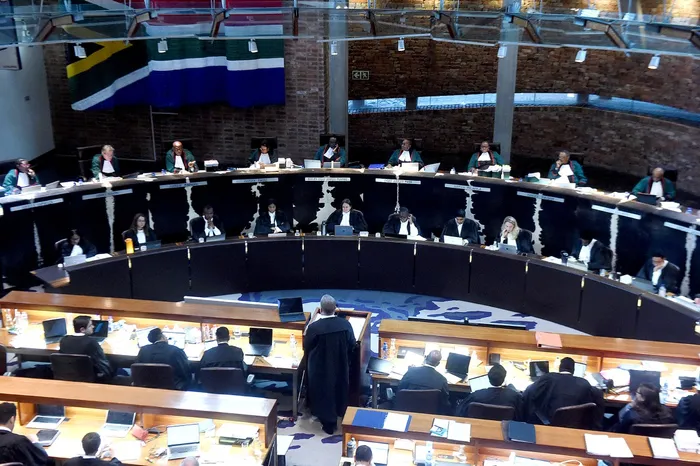
Political parties represented in the Government of National Unity have undertaken to hold President Cyril Ramaphosa accountable for the Constitutional Court's Phala Phala judgment referring the matter to a parliamentary Impeachment Committee.
Image: Itumeleng English / Independent Newspapers
Several political parties represented in the Government of National Unity (GNU) appear prepared to hold President Cyril Ramaphosa accountable following the Constitutional Court’s Phala Phala judgment on Friday.
The apex court ruled that the National Assembly’s vote in December 2022 declining to refer the Section 89 Independent Panel’s report to an Impeachment Committee in terms of parliamentary rules was inconsistent with the Constitution, invalid, and set it aside.
The independent panel’s report has been referred to the Impeachment Committee established in accordance with the National Assembly’s rules.
Newly-elected DA leader and Cape Town Mayor Geordin Hill-Lewis said the party will participate fully and constructively in the Impeachment Committee, describing it as a grave moment for Parliament, Ramaphosa’s Presidency, and the country’s constitutional democracy.
He said: “No one should expect the DA to shield wrongdoing. We will never be party to protecting misconduct, covering up corruption, or weakening accountability for political convenience.”
Hill-Lewis undertook that the DA, as the second largest party in the GNU, will be guided by the facts, by the evidence placed before the committee, and by its constitutional duty.
“We will not prejudge the outcome. But nor will we allow any person, no matter how high their office, to be placed above accountability,” he promised.
Hill-Lewis added that those who hold the highest offices in the land must be held to the highest standards of honesty, transparency, and accountability.
“The Impeachment Committee must now do its work properly, rationally, fairly, and constitutionally. The president must have the opportunity to fully account,” he demanded.
IFP chief whip in the National Assembly Nhlanhla Hadebe said Parliament is duty-bound to respect and implement the Constitutional Court’s ruling, including the establishment of the relevant Impeachment Committee in line with constitutional prescripts.
“The court has now affirmed that Parliament acted unlawfully in 2022, when it rejected the findings of the independent panel, which recommended that an impeachment inquiry into Ramaphosa proceed,” he added.
According to Hadebe, the IFP will participate fully and constructively in the impeachment committee’s work in the interest of accountability, transparency, and the rule of law.
Freedom Front Plus (FF+) leader Dr Corné Mulder was critical of the apex court’s ruling, which he said to some extent eroded the separation of powers by prescribing to Parliament how it should manage its internal processes.
He said the FF+ was uncomfortable with the judgment as the Constitutional Court has not only ruled on what must happen – namely that the Phala Phala report must be investigated – but also prescribed how the process should unfold in future.
“The court is encroaching too far into the domain of the legislature (Parliament) by prescribing procedure. It is in the interest of democracy that the legislature is able to act independently and without interference,” Mulder explained.
UDM deputy president and MP Nqabayomzi Kwankwa said in 2022, the party voted in favour of the impeachment process because it wanted accountability.
“The Constitution is far above the GNU arrangement,” he said.
Kwankwa described the judgment as a damning indictment on the ANC government, which used its majority to try and steamroll the process and try to use Parliament for contrarian aims to subject checks and balances on Ramaphosa.
Prof Bheki Mngomezulu, director of the Nelson Mandela University’s Centre for the Advancement of Non-Racialism and Democracy, said the judgment would be a test on the survival of the multi-party coalition (GNU).
“To what extent will the multi-party coalition remain intact after this judgment? If voting were to happen soon, how would individual political parties vote now that they are part of the government and are no longer on the opposition benches?” he asked.
Mngomezulu continued: “Would they protect Ramaphosa to keep their positions, or would they defend the country’s Constitution? How would their decision influence the electorate in this year’s election and in the 2029 general election?”
He further questioned whether the DA, which was the official opposition in 2022 and was vocal on the Phala Phala matter, and where it will stand now that it is working with the ANC and some of its members are holding Cabinet positions.
“Will they vote for the retention of (the) blue lights that they obtained by agreeing to work with the ANC, or would they uphold the Constitution and truly represent the people of South Africa and not their own interests? This would be a great test for their loyalty,” Mngomezulu added.