'A wake-up call for politicians': Court's ruling on Ramaphosa's impeachment sparks debate


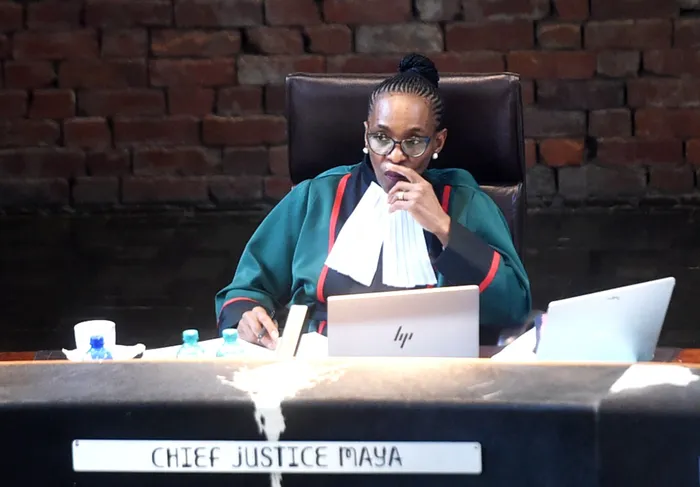
Chief Justice Mandisa Maya declared the National Assembly's vote against President Cyril Ramaphosa's impeachment inquiry unconstitutional, paving the way for a potential investigation into allegations of misconduct.
Image: Itumeleng English / Independent Newspapers
The Constitutional Court’s finding that the Phala Phala impeachment vote was unconstitutional was a rebuke to Parliament and has implications for how elected public representatives exercise their oversight functions.
This was the view shared by political analysts after the apex court reversed the decision by Parliament not to go ahead with impeachment proceedings against President Cyril Ramaphosa in 2022 after the independent panel found prima facie evidence of the violation of the Constitution or the law.
Professor Andre Duvenhage said the judgment has far-reaching implications for Ramaphosa and the ANC.
“It has implications for the legislative authority in terms of how they should control and exercise their oversight function. I believe it's going to contribute to political reconfigurations,” Duvenhage said.
He also said the judgment was strengthening the position of the EFF and the DA within the context of the Government of National Unity.
Another political analyst, Sandile Swana, said the ruling was a rebuke to the ANC and the DA for making decisions that suited their political interests.
“The ruling is clear to the political parties that the fact that the Constitution gives them the right to make political decisions does not mean that it gives them the right to make any arbitrary and irrational decision without facts and quality political decisions,” Swana said.
He said the decision not to impeach Ramaphosa had sought to make a political decision where logic and facts were ignored and put their political interest ahead of the Constitution.
“This judgment is a rebuke on the part of political parties, both the DA and the ANC, that you cannot be making decisions that suit your political interests at a point in time as a party and your careers as individual Members of Parliament. You are there to represent the interests of the Constitution and the interests of the citizens, which have been ignored for a very long time,” said Swana.
He further said Ramaphosa’s lawyers, the Speaker of Parliament, and parliamentary legal advisors should have anticipated that the court outcome would pan out as it did.
“So then nobody should be surprised by this. The tragedy is that it has taken so much effort and so much money in the hope that the EFF and the ATM will get tired, more especially the EFF, and will give up along the way.”
Professor Dirk Kotze said the judgment was balanced as it dealt with constitutional matters on one hand and obviously involved Ramaphosa on the other.
Kotze said the judgment was not about Ramaphosa as a person.
“There is nothing that has been concluded about him and Phala Phala, and it didn't refer to that at all. It only refers basically to the decision by Parliament.”
All three political analysts agreed that Parliament will now have to refer the report of the independent panel to the Impeachment Committee established in terms of the National Assembly rules.
Kotze said Ramaphosa would have to appear before the Impeachment Committee of Parliament.
“It means that there will be a person who will present the charges against him, and then the evidence will be led from both sides, with President Ramaphosa's side in defence of himself.”
He said the impeachment process, to be done under oath, will culminate in a vote by the National Assembly that will need a two-thirds majority to approve it.
Duvenhage said consideration must be taken into account that the last time the ANC voted against the independent panel report, “they had a majority in the sixth administration, and in this seventh administration, they do not have a majority. An impeachment can likely be successful.”
Swana said the ANC has to find a dignified way of making sure Ramaphosa leaves office before the impeachment is concluded.
“He long ago offered to step down. So the question now that is left is the modalities and the timing of the stepping down,” he added.