WATCH | Cabinet briefing: Ntshavheni addresses fuel hikes, water shortages, and power constraints


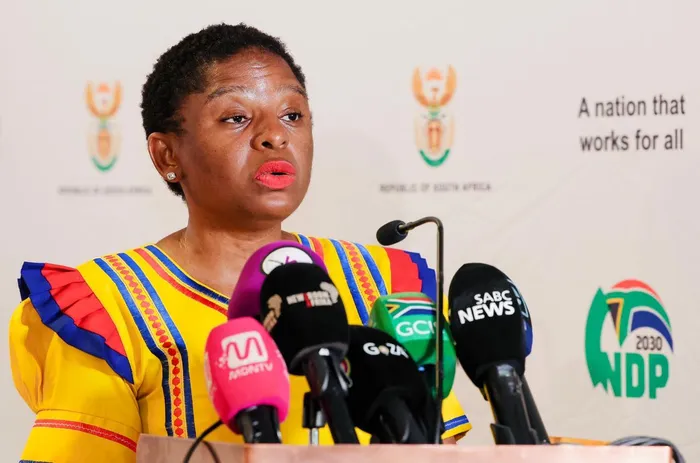
Minister in the Presidency Khumbudzo Ntshavheni is currently briefing the media in Pretoria on the outcomes of Cabinet meeting.
Image: GCIS
Minister in the Presidency Khumbudzo Ntshavheni is briefing the media on the outcomes of a Cabinet meeting held last week.
Discussions led by President Cyril Ramaphosa and his Cabinet are expected to have covered a range of pressing issues, including geopolitical developments, ongoing service delivery challenges, water shortages, electricity constraints, and rising fuel costs.
The briefing comes as South Africans brace for what is being described as the largest fuel price increase in the country’s history.
Panic buying has been reported nationwide, leading to long queues and congestion at filling stations.
The sharp increases, which took effect on Wednesday, April 1, follow a surge in international oil prices linked to conflict in the Middle East over the past month.
In response, National Treasury and the Department of Mineral and Petroleum Resources (DMPR) announced a temporary relief measure in the form of a R3 tax reprieve on petrol and diesel for April.
This reduces the general fuel levy from R4.10 to R1.10 per litre for petrol, and from R3.93 to 93 cents for diesel. The DMPR confirmed that both grades of petrol increased by R3.06 per litre, while diesel rose by between R7.37 (500ppm) and R7.51 (50ppm). Illuminating paraffin increased by R11.67 per litre.
Following the adjustments, the price of 95 unleaded petrol now stands at R22.53 per litre at the coast and R23.36 inland, while 93 unleaded inland costs R23.25 per litre.
Meanwhile, 50ppm diesel has risen to R25.35 per litre at the coast and R26.11 in Gauteng.
Treasury said the relief measure, which is expected to cost the government about R6 billion per month, will be reviewed monthly over the next two months.
It added that the intervention is designed to be fiscally neutral, with plans to recover the foregone revenue within the framework of the 2026 Budget.
Government also emphasised that there is sufficient national fuel supply to meet demand.
“The shortages reported in certain areas were largely due to localised distribution and logistical challenges driven by panic buying rather than a lack of national fuel stocks,” it said, adding that the situation should stabilise in the coming days.
Water shortages remain another critical concern, particularly in municipalities such as the City of Johannesburg in Gauteng.
The ongoing supply challenges have affected residents and small businesses, many of whom are being forced to purchase water at additional cost.
Cabinet discussions are also likely to have included the imminent appointment of a new commissioner for the South African Revenue Service (SARS).
IOL News reported that Finance Minister Enoch Godongwana confirmed that the process to appoint a successor to outgoing commissioner Edward Kieswetter has been finalised and is awaiting a formal announcement by the president.
“The new commissioner is going to be appointed soon,” Godongwana said, adding that the timing could be “any time from tomorrow to next week”.
He indicated that the incoming head of SARS is expected to assume office on 1 May 2026. “I know that the president has made the decision,” he said. “Whoever is appointed, the only benefit I have is that I have on my desk a presidential note which tells me who is going to take the job from the 1st of May.”
IOL Politics