SANDF, SAPS ready for major deployment targeting gangs, illegal mining and crime


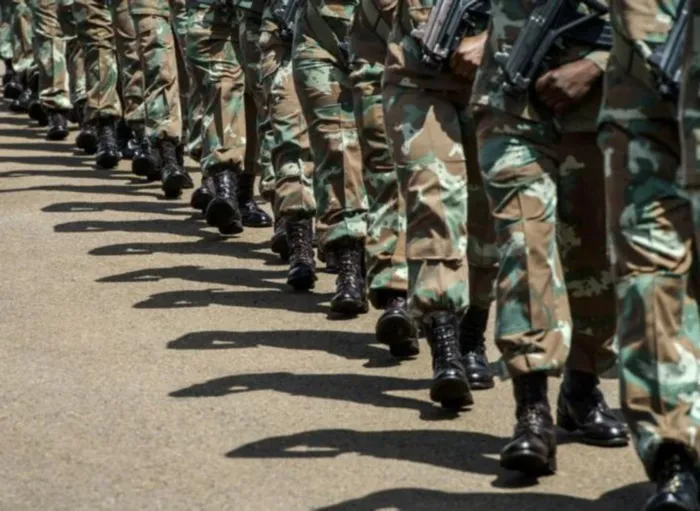
Brigadier General Martin Gopane tells MPs SANDF and SAPS members are in a state of operational preparedness, with forward mounting, drills, and actionable intelligence targeting criminal kingpins in multiple provinces.
Image: File
The South African National Defence Force (SANDF) and the South African Police Service (SAPS) say they are ready for the planned domestic deployment announced during the 2026 State of the Nation Address, with members already undergoing drills, training and forward mounting in key provinces.
Briefing Parliament on Friday, Brigadier General Martin Gopane, Director Operations in the Joint Operations Division of the SANDF, said the deployment was aimed at responding to what he described as “complex organised crime threats” affecting parts of the country.
Gopane told MPs that South Africa continued to face organised crime threats characterised by illicit mining networks, persistent gang-related murders, extortion and the proliferation of illegal firearms, particularly in the Western Cape, Eastern Cape and Gauteng.
He said there were also links between organised crime, illegal migration, illicit firearms, corruption and damage to infrastructure, adding that the scale of the problem required “extraordinary integrated state intervention” involving policing, intelligence, prosecution, and military support.
He said the SANDF was being deployed in cooperation with SAPS and other justice, crime prevention and security cluster role players as part of a broader government response to stabilise affected areas and uphold constitutional governance.
Gopane said the operation was intended to create space for the implementation of “national multi-dimensional and interdepartmental organised crime combating initiatives”, stressing that the response would not be limited to police and soldiers alone.
“When we emphasise the role of government, we are not delineating ourselves from departments like the Department of Minerals, the Department of Home Affairs, you name them, we are saying all of us this is a problem which requires us to face,” he said.
He added that even private security companies operating in affected areas could be brought into the broader effort as “force multipliers”.
Gopane said the deployment was expected to produce measurable outcomes, including a reduction in serious and violent crime in targeted areas, the disruption of illicit mining and gang violence, improved community safety, stabilisation of infrastructure and mining areas, and stronger coordination between state agencies.
He said the deployment would be monitored through regular operational and legal compliance reports submitted through command structures to the national police commissioner and the chief of the SANDF.
Gopane also stressed that members deployed under the operation would be required to respect constitutional rights.
He said members would be expected to “respect and protect the rights to dignity, life and freedom and security of the persons” and that no member would be permitted to engage in torture, cruel, inhuman or degrading treatment, arbitrary arrest or detention, or unfair discriminatory conduct.
Gopane said any arrests carried out would have to comply strictly with the Criminal Procedure Act and that where an SANDF member arrested a suspect, that person would have to be handed over to SAPS without delay.
He said a soldier effecting an arrest would also be required to complete an arrest statement, commonly known as an A1 statement.
Gopane told MPs the operation was being guided by Section 19(3)(c)(ii) of the Defence Act, and confirmed that strategic guidelines for the deployment had been drafted and co-signed by the national police commissioner and the chief of the SANDF on March 15, 2026.
He said SANDF members would also be issued with a mission-specific code of conduct signed by the Minister of Defence Angie Motshekga, while SAPS members would continue to operate under their own code of conduct and use-of-force guidelines.
On cooperation between the two security arms, Gopane said planning had been underway since the President’s announcement on 12 February.
“As from the pronouncement by the president on the 12th of February the South African police and the SANDF has been in lockstep in terms of situational assessment, planning, preparation and the issuing of instruction or operation orders,” he said.
He said operational and technical planning later moved to provincial level, where provincial police commissioners and SANDF joint tactical headquarters commanders began coordinating preparations.
This included the drafting of strategic guidelines, a joint operational communication plan, mission readiness training and a joint media briefing.
Gopane said each institution would retain its own command authority throughout the operation, but would coordinate through joint operational and intelligence structures at national, provincial and local level.
He explained that while soldiers would remain under military command and police officers under police command, both would work together through established joint command systems to ensure coordinated execution of the deployment.
Gopane said an earlier deployment had already begun in Gauteng on 31 January 2026 and was due to end on 30 April 2026. He said that operation had focused on intervention in the “Sporong area” before the SONA announcement.
He said the second phase of deployment, which followed the SONA announcement and was focused on gangsterism, illicit mining and criminality, was now in its final preparation stage.
Gopane said the first elements of that deployment were currently undergoing required drills, including joint mission readiness training and forward mounting phases.
He said the deployment had been authorised under President Cryril Ramphosa and would primarily operate in the Eastern Cape, Free State, Gauteng, North West and Western Cape.
However, he said the operational mandate also allowed security forces to move across the country where threat assessments required it.
“Should we start pouncing and fix the destabilizer into a certain corner and he decided to go to Mpumalanga, this employment papers allows us to operate without restructuring the document again,” he said.
Gopane said SANDF and SAPS members in the five provinces had already completed what he called “combat verification” between 12 and 14 March and were now engaged in joint mission readiness training.
He said forward mounting bases had been established in Grahamstown and Gqeberha in the Eastern Cape, in the Kroonstad area in the Free State, in Gauteng, at Army Support Base Potchefstroom and a SAPS facility in North West, and at several facilities in the Western Cape, including Air Force Base Ysterplaat and Fort Ikapa.
He said the training programme covered both police and military operational content, including legal frameworks, procedures and field readiness, and would continue even while members were deployed.
Gopane said the success of the operation would depend heavily on actionable intelligence, particularly the ability to identify and locate those behind organised criminal activity rather than only low-level operatives.
“We are not looking for a man on the ground but we’re looking for the kingpins so that we can go identify him, know him, I know where he is, I pounce on to him,” he said.
He said the deployment would also rely on coordinated use of available resources, including specialised equipment such as drones where available, as well as medical and logistical support for members on the ground.
Gopane further said the operation would include community engagement efforts aimed at rebuilding trust and strengthening the social fabric in affected communities.
IOL Politics