Returning to my political roots in South Africa


By Jens Stoltenberg, Norway’s Finance Minister, former prime minister, former Secretary General of NATO
Image: Supplied
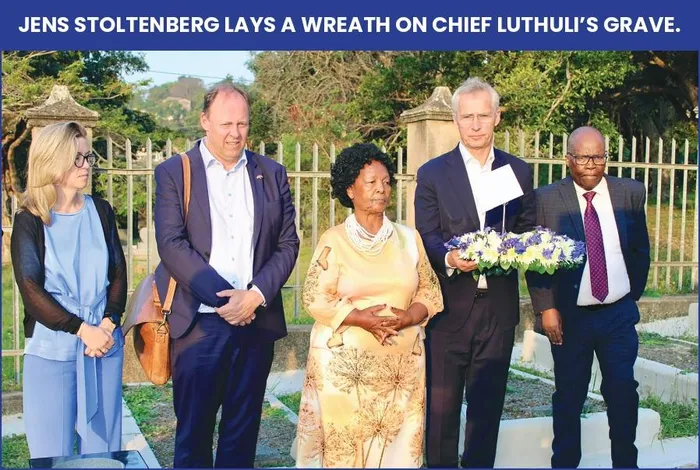
Whenever I visit South Africa, I always feel at home. Norwegians and South Africans share a connection like no other, after the anti-apartheid struggle. For many of us in Norway, witnessing the brutality of the apartheid regime, led to a political awaking that shaped our values. As the leader of the Social Democratic Youth in Norway, I also took part in our support to the ANC and the liberation movement that brought down apartheid. Visiting the house and memorial site of Nobel Peace prize laureate Albert Luthuli in July took me back to my youth.
Norwegian solidarity I grew up in a political family and remember coming home as a child and being greeted by politicians from all over the world including several liberation fighters from southern Africa fighting against colonialism and apartheid. My father, Torvald Stoltenberg, peace negotiator and former Foreign Minister and Defence Minister. in Norway, often hosted informal breakfast meetings in our home. Perhaps his most memorable guest, certainly in his own view, was someone who invited himself. In 1992, while reviewing the proposed itinerary by Norway’s prime minister’s office, President Nelson Mandela famously asked: “Has Stoltenberg stopped having his breakfasts?”. Gladly, my father responded with an invitation.
In Norway both the government, civil society and citizens at large admired those who stood up against the apartheid regime, and we supported the struggle. Generations of political engaged Norwegians have learned about international politics, solidarity and the fight against racial discrimination from leaders like Oliver Tambo, Nelson Mandela, Desmond Tutu and Albert Luthuli. We still use these valued lessons when implementing Norwegian foreign and development policies today.
As I laid a wreath on the gravesite of Alberth Luthuli and was guided through the museum, my deepfelt admiration for those who led the struggle brought me back in time. When Luthuli traveled to Norway to receive the Noble Peace prize in 1961 (after it was awarded to him in 1960), it was not only important for the ANC and the struggle for freedom and democracy in South Africa. It was also important in making Norwegians aware of the crimes against humanity committed by apartheid. In Norway, the nazi-occupation during World War 2 (1940–1945) was still fresh in our memory in the 1960s. The fact that one of the chief architects of apartheid, Henrik Verwoerd, also was a nazi propagandist, made the link between occupation of Norway and apartheid oppression in South Africa clear for many politically engaged Norwegians. Thus, the visit of Luthuli to Norway strengthened the antiapartheid movement in Norway considerably.
Consistent support to self-determination I was Secretary General of NATO when Russia invaded Ukraine in 2022. Some claim that NATO’s so-called “expansion” was the reason why Russia invaded. However, it was not NATO that expanded into areas that used to be controlled by the USSR after World War 2. It was democracy that expanded and led countries to choose NATO-membership. Just like Norway chose to become a NATO member in 1949, as the only country bordering Russia, other countries in Europe must be free to choose their path. The reason why Norway, and the rest of Europe has reacted so strongly to the Russian aggression, is because it takes us back to the dark days of Europe in the 1930’s.
It is the lesson from World War 2 that gave us the UN-Charter. I often hear that we need peace in Ukraine and that peace is more important than continued fighting. But if you have peace, and Russia holds a substantial part of Ukraine, you will not get peace, only occupation. Both Norway, South Africa
and many other countries both in Africa and Europe know what occupation is. It is only Ukrainians who can make the final decisions on the dilemmas they are facing.
They must be part of any effort to end the war. Norway will continue to support Ukraine in every possible way. The destructive logic of European imperialism and expansion was felt to the full on the African Continent.
When political and economic support to the struggle against apartheid proved insufficient, Norway also imposed sanctions against the apartheid state, which was called for by the ANC. Though it should be one of our last tools used, sanctions are necessary tools to end injustice and human suffering.
This principle still guides us. It is why Norway, alongside many other countries, has imposed sanctions against Russia. It is also why we condemn Israel for disregarding international humanitarian law and violates international law in Gaza and on the West Bank.
Not being superpowers, but still important voices in the international community, countries like Norway and South Africa must be the front runners of a rules-based international order. We must respect borders and territorial integrity, sovereignty and international and humanitarian law. We must strive to be consistent.
Defending multilateralism
I am impressed at how South Africa so far has chaired the G20 in very difficult and challenging times. Norway is honored to having been invited as a guest country under South Africa’s G20 presidency. The Finance Ministerial meeting in Durban is one case in point. We were able to agree on a communique that sets out some important principles, including on a better framework addressing debt problems, on global minimum tax rate, and on climate financing. These are important issues for everyone, and agreed language helps us to take small, but important steps forward.
In uncertain times, it’s even more important to build strong international institutions. Not because they can solve all problems, but because it’s always better to sit around a table and try to find a negotiated and agreed way to address common challenges.
Actions are remembered
There is a long line in Norwegian foreign policy, from Nazi-occupation during the Second World War to supporting self-determination of the people of South Africa, to supporting the people of Ukraine in their right to decide their own future and recognizing Palestine as an independent state in 2024. Being on the right side of history is not given, but by adhering to guiding principles like the UN Charter and International law, countries can better maneuver geopolitical challenges. When I stood by the gravesite of chief Alberth Luthuli, I was reminded of how important foreign policy choices are. Norway made the right decision back then, and I am convinced we are making the right decisions when it comes to our support for the self-determination of both Palestine and for Ukraine.