The Fires of Industry Must Burn Again


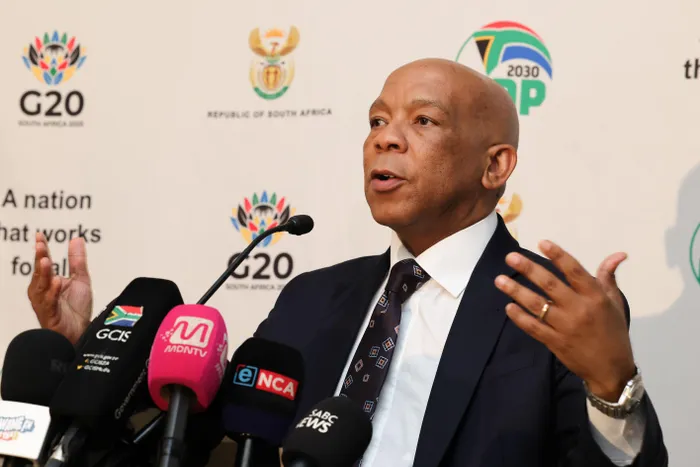
Dr. Kgosientsho Ramokgopa, Minister of Electricity and Energy, held a media briefing in Pretoria on Thursday to announce interventions aimed at ending load reduction.
Image: Supplied/GCIS
In the cold industrial winds of Saldanha Bay, the furnaces still seem to remember.
They recall the roar of production, the first whistle of the shift, trucks loaded with mineral wealth, and livelihoods built on the dignity of work.
Now, ahead of the 2026 Budget Vote of the Department of Electricity and Energy, South Africa faces a defining choice: allow its industrial fires to cool for good, or reignite them, using energy policy not just for survival, but as the decisive lever for economic renewal and national dignity.
Minister Dr Kgosientsho Ramokgopa arrives at this moment carrying more than a budget vote speech. He carries the burden of a country that knows a hard truth: electricity is not just power. It is production. Production is jobs. Jobs and transformed assets and ownership are dignity.
The department’s Budget Vote programme points to a deliberate shift, one that reconnects energy policy to industrial expansion, beneficiation, manufacturing revival and economic sovereignty. In Saldanha Bay, that shift was given human and industrial meaning.
At the Tronox Namakwa Smelter, VP Mpho Mothoa made the stakes plain. I asked him whether Tronox was looking to revive its idled F1 (furnace 1… which was commissioned in June 1995 utilising a 28 Megawatt) facility, and he answered without hesitation: “Yes, definitely.” He explained that the company’s interest is to “continue to run our processes” and “continue to be competitive,” adding that the discussion with the Minister and the Department had been “very encouraging.”
That single answer says much about the crossroads South Africa faces.
The Smelters Are More Than Factories
The ministerial visit to the Tronox is not symbolic theatre. It is both a call for greater partnership and an opportunity.
South Africa’s smelters rank among the economy’s most energy-intensive industrial assets. They depend on reliable baseload electricity and globally competitive pricing to survive. For years, rising tariffs, unstable infrastructure and global market pressures pushed many such operations toward decline. As witnessed with the closure of Saldanha Steel. Furnaces cooled. Output slowed. Communities paid the price.
But Tronox’s message today was clear: the will to produce remains!
VP Mothoa spoke not only about production but also about the anxiety that idled industrial capacity creates among workers. “When you’ve got an idling piece of equipment,” he said, “the employees walk past it all the time. They start wondering and worrying about what it means for them and their future going forward.”
That is the human meaning of industrial decline.
A silent furnace is not only a technical problem. It is a signal to workers, families and West Coast communities that certainty is slipping away.
That is why Tronox’s intention to restart the F1 facility matters. As VP Mpho Mothoa put it, the goal is to ensure that “all means of production are active” so that the company can “continue to sustain and maintain jobs.”
Now, the South African government is moving from crisis management to industrial activation, focusing on programs that reconnect energy reliability with industry needs and engage directly with priority sectors such as smelting and manufacturing to facilitate sustainable operations.
Dr Ramokgopa framed this engagement in precisely those terms. He said the visit was about reaching out to industry and working together to “deploy excess generation capacity” in order to get “the South African economy going.” He thanked Tronox for keeping its doors open during difficult times and acknowledged the pressure from electricity costs.
That language matters.
For the first time in years, energy policy is being positioned not only to prevent load shedding but also to actively drive industrial competitiveness and economic renewal. This shift is the heart of South Africa’s challenge.
The Battle for Competitive Electricity
Around the world, nations are entering a new economic contest.
China subsidises strategic manufacturing. The United States uses the Inflation Reduction Act to draw industry home. The Inflation Reduction Act (IRA) acts as a powerful "magnet" for industries by shifting the U.S. toward an industrial policy that rewards domestic production over imports. It provides multi-billion-dollar financial incentives that make it significantly cheaper to build and operate factories in the U.S. than elsewhere. Europe shields industrial capacity through aggressive energy support measures.
South Africa cannot compete globally if its productive sectors are forced to operate under structurally uncompetitive electricity costs.
At Tronox, the Minister acknowledged this reality directly. Electricity, he noted, is a major input cost for the smelter — “close to 50%” — and at current rates, industrial operations risk becoming “more and more uncompetitive.” Without intervention, he warned, businesses may struggle to generate meaningful profit, making it difficult for them to remain open.
Electricity pricing is, therefore, not an abstract technical issue. It determines industrial sustainability, employment, mineral beneficiation and export competitiveness.Beneath the policy language lies a larger strategic question: will South Africa remain chiefly an exporter of raw minerals, or will it become an industrial manufacturing power within the BRICS economic architecture?
Smelters are more than metal-processing plants. They are sovereign industrial assets.
Every furnace that runs locally means more value retained in South Africa, more skilled industrial employment, stronger logistics networks, expanded export capacity, higher tax revenues and greater technological sophistication.
The multiplier effect spreads through ports, rail, engineering firms, service providers and entire communities.
Saldanha: The Energy Frontier
The Budget Vote outreach programme places Saldanha Bay at the centre of the national conversation for a reason.
This is where heavy industry, mineral exports, green hydrogen, renewable manufacturing and future energy infrastructure converge.
The minister’s engagement with the Saldanha Special Economic Zone frames the region as an integrated energy hub.
Nearby, GRI Towers South Africa, a wind-tower manufacturer, becomes part of a second, equally important story: localisation. Dubbed as the Hub for Sustainable Investments amongst diplomats and investors, the Atlantis Special Economic Zone is Africa’s first Green tech manufacturing hub, offering unparalleled access to green infrastructure.
South Africa’s energy transition cannot simply import turbines, solar panels and advanced equipment while unemployment remains stubbornly high. If the transition is to be meaningful, it must also be domestically manufactured. It must build factories, train artisans, and produce steel, towers, cables, transformers and batteries within South Africa. Otherwise, the green transition becomes another form of economic extraction.
Energy Security Is Economic Security
The Budget Vote document highlights new government actions: energy policy will include initiatives to advance industrial sustainability, targeted programs to boost employment growth, and clear measures to align electricity supply with manufacturing demand.
For too long, electricity debates in South Africa were treated as technical disputes about megawatts, grids, outages and tariffs. But electricity is ultimately about civilisation itself.
A country with reliable, affordable power can industrialise, attract investment, modernise agriculture, expand manufacturing, grow exports and reduce inequality. A country without energy security loses productive confidence. This is why the Tronox engagement matters beyond one smelter.
Dr Ramokgopa described the work ahead as a practical, industry-by-industry effort. “It’s smelter by smelter, factory by factory,” he said, adding that the government would work to get “the South African economy up and running again.”That phrase should serve as a guiding principle for the energy agenda.
Not abstract reform alone. Not megawatts detached from production. But smelter by smelter, factory by factory, job by job.
A New Energy Compact Minister Ramokgopa faces the defining challenge of his tenure: not simply keeping the lights on, but ensuring energy policy powers South Africa’s industrial resurgence—making energy the instrument of national renewal.

Ayanda Holo says the department’s Budget Vote programme points to a deliberate shift, one that reconnects energy policy to industrial expansion, beneficiation, manufacturing revival and economic sovereignty.
Image: Supplied
*Ayanda Holo is the President of TV BRICS AFRICA Channel.
** The views expressed do not necessarily reflect the views of IOL or Independent Media.