Dr Iqbal Survé: The Struggle Doctor Who Became a Global Voice for Justice and Transformation


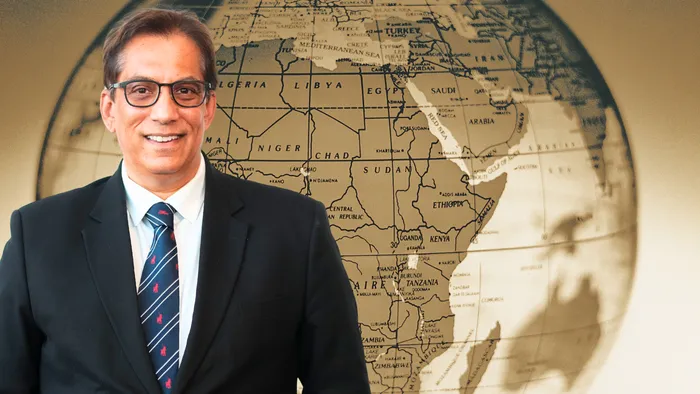
In a world where leadership often falters, Dr Iqbal Survé emerges as a beacon of hope, advocating for economic justice and a new vision for South Africa. How does his journey redefine the essence of true leadership?
Image: Independent Media
In a world choking on crisis and crippled by false messiahs, principled leadership has become the rarest currency. Dr Iqbal Survé is not a politician, nor does he play to galleries. He is a product of the Struggle, a doctor of the people, and one of the few post-apartheid figures who understood early that freedom without economic justice is a betrayal. In an era where ego masquerades as leadership, Dr Survé represents something dangerously uncommon, clarity of purpose, moral courage, and the spine to act when it matters most.
South Africa, like much of the world, is trapped in a leadership vacuum, where opportunism has replaced vision, and moral conviction has been traded for political convenience and infighting, staggering youth unemployment, and a stalled economy have bled South Africa of its promise and left public trust in ruins. In such a climate, surrendering to despair becomes the easy choice, the default setting. But Dr Iqbal Survé refuses that descent. His life stands as a defiant counter-narrative, one that rejects passivity, demands purpose, and redefines what post-liberation leadership should be: morally unshakable, future-focused, and anchored in the real work of rebuilding a broken nation
Having witnessed apartheid’s brutality up close, treating the tortured, the broken, the forgotten, Dr Iqbal Survé didn’t retreat when political freedom was declared. He understood that the real struggle was only beginning. So, he pivoted with fierce intent toward economic justice, stepping into the lion’s den of capital and building an empire not for ego, but for empowerment. At just 34 years old, he listed on the Johannesburg Stock Exchange (JSE), a bold move that defied the racial and financial barriers of the time.
He built Sekunjalo Investment Holdings into a multi-billion-dollar African group with more than 200 investments across 40 countries. Yet it is not the size of the portfolio that commands attention, it is the intent behind it. Dr Survé has consistently championed what he calls a “gentler capitalism,” a value-driven model that puts people before profits, purpose before power.
This approach challenges the extractive nature of global capitalism. It questions models that prioritise short-term shareholder gains over long-term societal health. In a country still scarred by the legacy of racial capitalism, his commitment to broad-based economic participation is a quiet revolution. He has opened doors where others have built walls.
We live in a nation where just a handful of families control the economy, banking sector, and dominant media platforms, relics of an economic apartheid that never truly ended, Dr Survé’s call for redistributive justice is both radical and necessary. He does not seek to dismantle South Africa’s economy, but to democratise it. And that, in today’s captured system, is a subversive act.
Internationally, Dr Survé’s leadership has been just as resolute. As Chair of the BRICS Business Council and a member of the World Economic Forum since 2007, he has emerged as a global voice for equity, sovereignty, a multipolar world order and speaks for a shared humanity. He is trusted by leaders like Xi Jinping, Vladimir Putin, and Lula da Silva, Dr Survé represents the values of a post-colonial Global South still fighting for economic inclusion and narrative sovereignty.
In a world where history is repackaged by the powerful and truth is filtered through profit-driven newsrooms, Dr Iqbal Survé’s Independent Media is more than a business, it’s a frontline trench in the battle for memory. It defies corporate capture. It disrupts the comfort of revisionist lies. It insists that African voices narrate African realities, unfiltered, unbought, and unapologetic. In today’s information war, that’s not just journalism. That’s resistance.
There’s a heavy price for speaking truth in a country where power protects itself. Dr Survé has been dragged through courtrooms, vilified in headlines, and targeted by institutions. Yet, he does not run. He does not flinch and he refuses to be controlled. Because for him, leadership is not about safety, it’s about standing guard over the soul of a nation, even when the cost is personal.
That, perhaps, is what truly separates him in this era of global chaos and moral exhaustion. While others chase power, he restores dignity. While many hoard influence, he builds people and his life’s work is carved from conviction. It’s what happens when intellect serves integrity, when global insight walks hand-in-hand with local accountability, and when legacy is defined not by how much you take — but by how deeply you give.
When Dr Survé spoke recently at a Cape Town conference about the Freedom Charter and Cuba’s historic solidarity, it wasn’t nostalgia, it was a moral intervention. He didn’t invoke the past to romanticise it, but to remind this country of what it once stood for. His call was clear: South Africa needs a new national dialogue, not one choreographed by elites or boxed in by race and ideology, but one built around jobs, justice, and dignity. The basics. The non-negotiables.
In a country still haunted by unfinished freedom, Dr Survé stands as a reminder that freedom is not a destination but a practice, one that demands leaders with memory, backbone, imagination, and moral clarity. In an era that rewards populism over principle, we need leaders that offer a different path: one where values matter, where vision is bold, and where service is sacred.
South Africa stands at yet another turning point, and this time, slogans won’t save us. We will rise or we will break, depending on whether our leaders have the spine to build with both heart and intellect. This country doesn’t need empty charisma. It needs conviction. Leadership that doesn’t just uplift, but lays the bricks for a future that works — for everyone.
* Adri Senekal de Wet is the Editor-in-Chief of Independent Media.