uShaka Sea World to study male green sea turtles’ oceanic movements after successful rescue


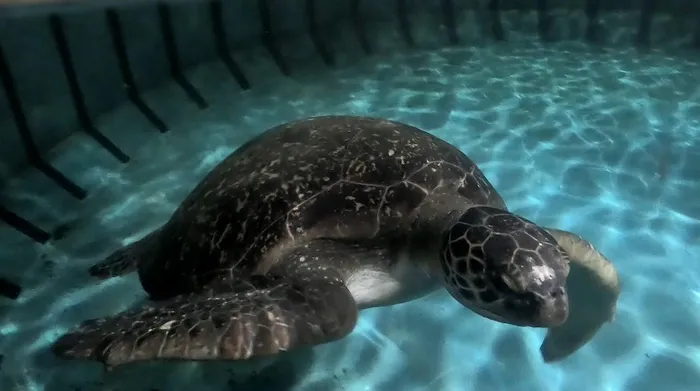
The rescued male green turtle is inside a pool at uShaka Sea World.
Image: Saambr
uShaka Sea World will gain valuable insights into the oceanic movements of male green sea turtles, thanks to the rescue of two individuals of this species.
South African Association for Marine Biological Research (Saambr) spokesperson Ann Kunz said that over the weekend, the KZN Stranding Network partners were alerted to a large sea turtle in a cordoned-off section of the uMzimkulu River. During the construction of the uMzimkhulu Bridge, workers unknowingly trapped two mature green sea turtles by adjusting the river mouth to facilitate their work.
Kunz said that after continuous monitoring over the weekend, a team was assembled on Monday morning for an uncommon turtle rescue operation.
“As one can imagine, attempting to catch large, healthy green turtles in an extensive body of water with minimal visibility was not an easy task,” Kunz said.
She said a well-planned rescue operation was successfully executed.
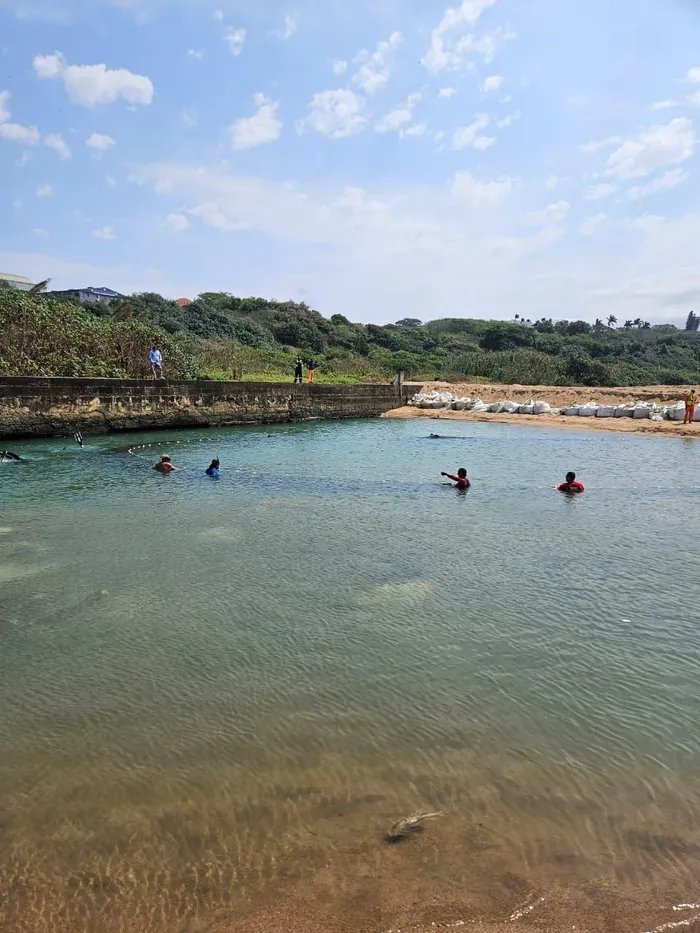
The rescue team was in a cordoned-off section of the uMzimkulu River where a large sea turtle was seen.
Image: Saambr
“The female turtle was released immediately, and the male, who weighs almost 110kg, was transported to uShaka Sea World for observation, DNA sampling, and satellite tagging before he is released,” Kunz explained.
“We very rarely get the opportunity to track male sea turtles as they never come ashore, unlike mature females who nest on beaches, so this is an incredible opportunity to learn more about the oceanic movements of a male green sea turtle.”
uShaka Sea World Quarantine and Sea Turtle Rehabilitation lead aquarist Malini Pather said male sea turtles spend the majority of their lives at sea, as they have no biological reason to return to land. Consequently, information regarding their health and behaviour is limited.
“For this individual, we plan to conduct a series of basic diagnostics, including blood sampling, radiographs, and potentially ultrasound examinations. Faecal samples will also be collected. Together, these tests will provide a valuable snapshot of key health parameters in green turtles. DNA will be extracted from the blood samples for further genetic analysis,” Pather explained.
“In addition, satellite tagging will allow us to monitor post-release movements and habitat use. The attachment process requires careful preparation, involving the application of multiple layers of putty, epoxy, and fibreglass to ensure both durability and animal safety.”
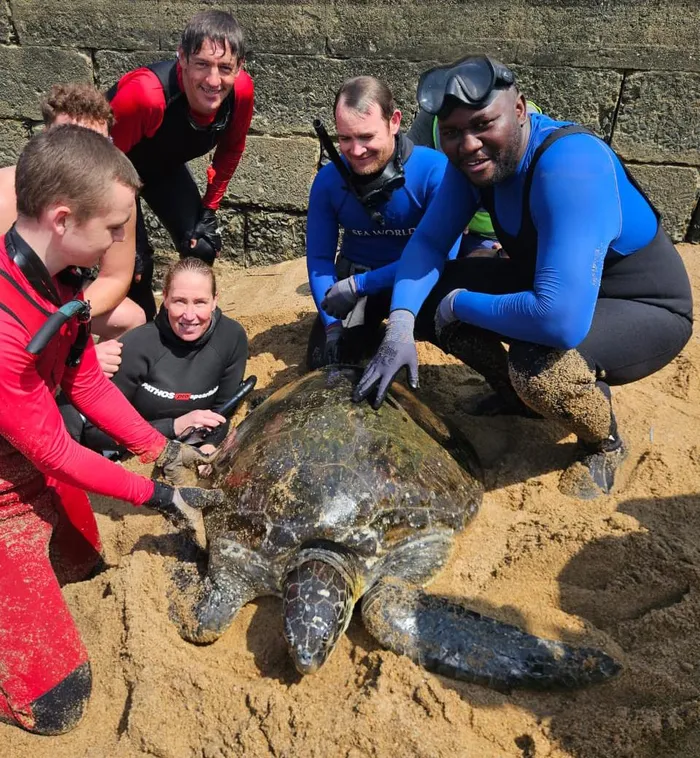
The rescue team with the female green sea turtle that was released.
Image: Saambr
Conversely, Pather said female green turtles bask on some islands, and there is quite a bit of tagging data.
Additionally, Kunz hailed the fantastic teamwork and said that the achievement proves that collaboration makes anything possible.
“Special thanks to the team from NSRI Port Edward, Andy Coetzee, Ezemvelo KZN Wildlife, Geremy Cliff, Tanya Nadauld, breath-hold divers and local residents,” Kunz said.