Court rules against Stellenbosch farmer after locking out long-serving employee from farmhouse

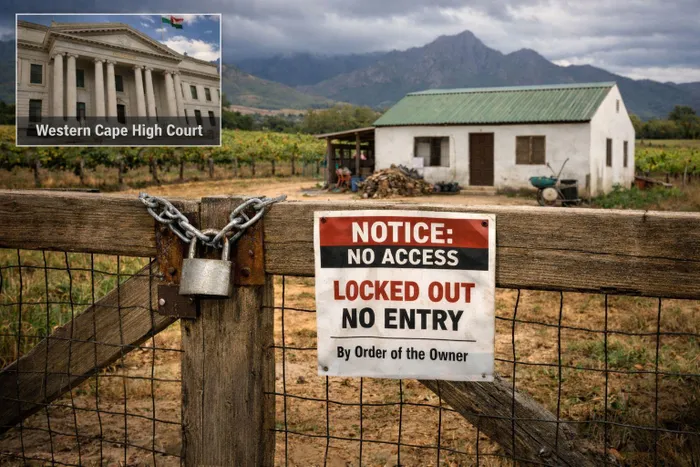
Stellenbosch farmer loses appeal over locked-out employee's access to farmhouse.
Image: AI / ChatGPT
The Western Cape High Court in Cape Town has dismissed an appeal by a Stellenbosch farmer who attempted to challenge an interim court order restoring a long-serving farm worker’s access to his house on the farm.
In a recent judgment, the court ruled that the appeal was premature and not legally competent because it sought to challenge an interim order that had not yet been finally decided
The case involved Johannes van der Westhuizen, the appellant, and Koos Booysen, a farm worker who had been employed on Bonfoi Farm in Stellenbosch for about 40 years.
Booysen told the court that the farm owner had provided him with a house on the property as part of his employment benefits. He lived there with his late wife and daughter.
However, after being hospitalised due to a serious medical condition, Booysen temporarily stayed with relatives while attending follow-up medical treatment. When he returned to the farmhouse in June 2025, he discovered that the locks had been changed, and he was allegedly denied access to the property.
Booysen then approached the Stellenbosch Magistrates’ Court on an urgent and ex parte basis in September 2025, seeking a spoliation order to immediately restore his possession of the house. The magistrates’ court granted an interim order restoring his access pending a later hearing.
However, Van der Westhuizen appealed the decision shortly afterwards, arguing that the matter should not have been heard without notifying him (ex parte). Furthermore, he stated that there was no urgency to justify an urgent hearing because Booysen had not made out a proper case for a spoliation order.
Booysen opposed the appeal, contending that the order was temporary and not appealable because the magistrates’ court still had to decide the matter on the return date.
The High Court agreed with Booysen, finding that the order restoring access to the house was clearly interim in nature and could still be confirmed, changed or set aside by the magistrates’ court after hearing both parties.
The court held that allowing appeals against interim orders would lead to fragmented litigation and unnecessary delays.
“The interests of justice do not justify exceptional appealability in the present circumstances,” the court said.
The court dismissed the appeal for lack of jurisdiction and ordered Van der Westhuizen to pay Booysen’s legal costs.
It also corrected a procedural issue by directing that the underlying case return to the Stellenbosch Magistrates’ Court, where the dispute over the spoliation order will be heard on March 30, 2026.
The final determination of whether Booysen was unlawfully dispossessed of his farmhouse will therefore still be decided by the magistrates’ court.
IOL News
Get your news on the go, click here to join the IOL News WhatsApp channel
Get your news on the go. Download the latest IOL App for Android and IOS now.