WHO sounds alarm as Ebola outbreak spreads to Uganda - death toll rises to 131


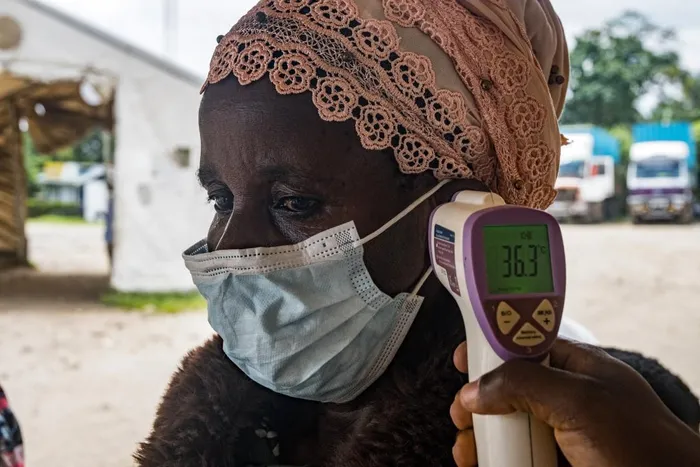
A border health officer at the Busunga crossing between Uganda and the Democratic Republic of Congo checks a traveler’s temperature using a contactless infrared thermometer in Bundibugyo, on May 18, 2026. Ugandan officials confirmed that a 59-year-old man from Democratic Republic of Congo had died in Kampala after being admitted earlier in the week. Tests showed the victim in Uganda was infected with the Bundibugyo strain of Ebola, first identified in 2007. The World Health Organization declared an international health emergency on May 17, 2026 over an outbreak of an Ebola strain in the Democratic Republic of Congo that has killed more than 80 and for which there is no vaccine. Fears of further spread grew when a laboratory confirmed a case in the major eastern DRC city of Goma, which is controlled by the Rwanda-backed M23 militia.
Image: Photo by BADRU KATUMBA / AFP
The World Health Organization chief said Tuesday he was "deeply concerned" by an Ebola outbreak in the Democratic Republic of Congo which has spilt into Uganda, believed to have killed 131 people.
WHO chief Tedros Adhanom Ghebreyesus on Sunday declared the outbreak a public health emergency of international concern (PHEIC) -- the second-highest level of alert under international health regulations.
"I did not do this lightly... I'm deeply concerned about the scale and speed of the epidemic," he told the World Health Assembly in Geneva.
He added that he would convene the agency's emergency committee later Tuesday "to advise us on temporary recommendations".
The outbreak of the highly contagious haemorrhagic fever was confirmed on Friday in Ituri province in northeastern DRC, bordering Uganda and South Sudan, according to the Africa Centres for Disease Control and Prevention (Africa CDC).
It is the 17th outbreak of Ebola to hit the DRC and officials have warned of a high risk of spread.
The latest figures from the DRC's health minister showed the suspected toll had risen to 131 deaths and 513 cases.
But with the outbreak largely concentrated in difficult-to-access areas, few samples have been laboratory-tested.
Tedros said that so far, 30 cases had been confirmed to be Ebola in the DRC's northeastern Ituri province.
"Uganda has also informed WHO of two confirmed cases in the capital of Kampala, including one death among two individuals who travelled from DRC," he told the WHO's annual meeting of its decision-taking body.
In addition, he said, there was "one US citizen confirmed positive and transferred to Germany, as reported by the US".
No vaccines, therapeutics
The total number of confirmed and suspected cases "will change as field operations are scaling up, including strengthening surveillance, contact tracing and laboratory testing", Tedros stressed.
There were a number of reasons to worry, he said.
He pointed out that cases had been reported in urban areas, including Kampala, as well as the large Congolese city of Goma, currently held by the Rwanda-backed M23 militia.
"The province of Ituri is highly insecure," he said, pointing out that intensifying conflict in recent months had seen more than 100,000 people newly displaced in the region.
He also said that deaths had been reported among health workers, suggesting "healthcare-associated transmission".
Tedros highlighted that the epidemic had been shown to be caused by the Bundibugyo strain, "a species of Ebola virus, for which there are no vaccines or therapeutics".
Vaccines are only available for the Zaire strain, which was identified in 1976 and has a higher fatality rate of 60-90 percent.
Tedros stressed that "in the absence of a vaccine, there are many other measures countries ... can take to stop the spread of this virus and save lives", among them "risk communication and community engagement".
He said that WHO had a team on the ground supporting national authorities to respond.
"We have deployed people, supplies, equipment and funds," he said.
The previous outbreak of Ebola, which is believed to have originated in bats and can cause severe bleeding and organ failure, was last August in the same region.
At least 34 people died before it was declared eradicated in December.
Over the past 50 years, the disease has killed around 15,000 people in Africa, despite advances in vaccines and treatment.
Nearly 2,300 people died between 2018 and 2020 in the deadliest outbreak in the DRC.
AFP