Cape Town's R5 billion desalination project raises eyebrows over water costs


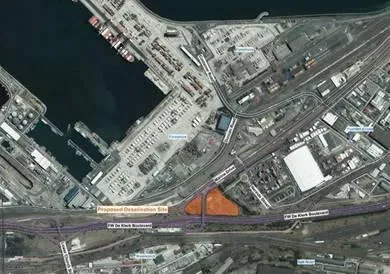
The proposed site location for the Paarden Eiland Desalination Plant.
Image: City of Cape Town
As the City of Cape Town embarks on yet another proposed desalination plant idea, this time a R5 billion project in Paarden Eiland, concerns have been raised among residents and political parties due to potential implications for water tariffs.
This comes as prior desalination plants in Strandfontein and Monwabisi, which have since been decommissioned, “provided the City with insight into the operations of a massive project in the future,” the City said.
City Mayco Member for Water and Sanitation, Zahid Badroodien, said the Paarden Eiland project is currently in the preparation phase, with water delivery anticipated in the mid-2030s.
He said the plant aims to diversify water sources, including water re-use, desalination, clearing invasive species and groundwater extraction, to add 300 million litres of water per day to Cape Town’s supply.
Badroodien said the project had already received the necessary Municipal Public Private Partnership Procurement Phase.
The City called for a public participation process and by December 2025, over 100 comments were received for both Paarden Eiland and another project- the Faure New Water Scheme (FNWS), which were incorporated in the feasibility reports that were recommended to Council for their decision.
“The Paarden Eiland Desalination Project received in principle Council approval in terms of MSA S78(4) and MFMA S120(6) to proceed into the Municipal Public Private Partnership Procurement Phase,” Badroodien said.
“The project preparation is already underway with expected water delivery in mid 2030s.”
Badroodien added that previous desalination plants in Strandfontein and Monwabisi, which have since been decommissioned, provided insight into the operations of a massive project in the future. Sandra Dickson, founder of STOP COCT said the plant meant long term financial obligations for ratepayers.
“The City’s statement that the Paarden Eiland Desalination Project has received ‘in-principle Council approval’ does not mean the plant has been built, that water is about to come online, or that a final contract has already been awarded. It means the City has been authorised to move into the Municipal Public Private Partnership procurement phase.
“For ratepayers, that is exactly the stage where scrutiny must increase.“Cape Town does need long-term water security. After the drought, no responsible person can argue that the City should rely only on traditional dam water. Desalination may well have a role to play in a more secure future water mix.
“But the public also needs to understand the financial side of this project. A large infrastructure project of this nature can create long-term payment obligations, especially if a private partner designs, finances, builds, operates and maintains the plant over many years.
“The key issue for residents is therefore not only whether Cape Town needs additional water. The key issue is affordability, transparency and risk.”Councillor Karl Bodin, of CAPEXIT said the party long voted that the project would become a threat for citizens and even pose health risks.
“On December 6, 2025 and again on May 27, when the two water reuse projects were tabled in Council, we stood firmly and voted against them,” he said.
“We exposed the threat to citizen’s health and we quoted Professor Petrik of UWC, stressing that ‘Traces of numerous persistent organic contaminants pass through even the best water recovery systems hormones, pharmaceuticals, antibiotics many of which are endocrine-disrupting, with chronic carcinogenic or toxic risks’.
“Furthermore, as predicted, the City’s 6% to 8% annual increases in water bills is going to financially overburden, already suffering ratepayers with these projects.” Strandfontein Ratepayers Association member and United South Africa (USA) leader, Riyad Isaac agreed.
“There is no immediate benefit to ratepayers.
As we can see - tariffs are already increasing. “This raises a fundamental concern: “Why are ratepayers effectively being asked to carry costs for a project that has not yet materialised?”