Protests expected in Cape Town over 'cheap labour' and foreign nationals


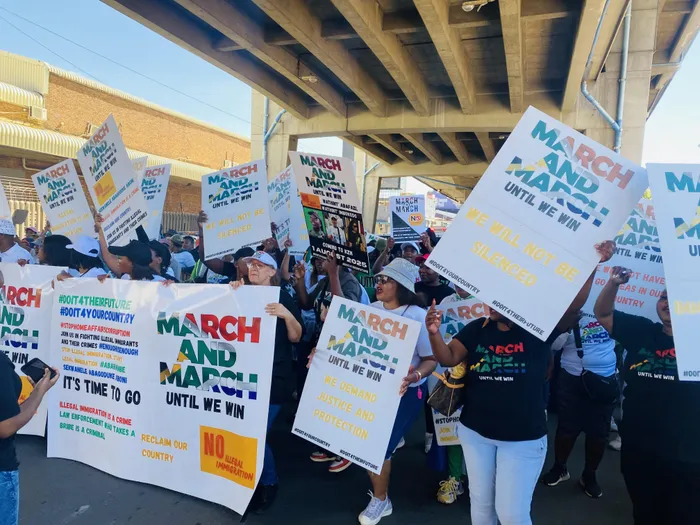
Demonstrators carry placards calling for stricter action against illegal immigration during a march in Johannesburg.
Image: Simon Majadibodu/IOL
Cape Town is set to see a series of protests targeting the employment of undocumented foreign nationals this weekend, as organisations calling for South Africans to be prioritised for jobs intensify mobilisation efforts in the Western Cape.
The planned actions come amid growing campaigns in several parts of the country, including KwaZulu-Natal, Gauteng and the Eastern Cape, where community groups have staged demonstrations against undocumented foreign nationals and their access to jobs and public services.
In the Western Cape, March and March is expected to hold a protest in Bellville on May 23, while the Labour and Community Organisation (LACO) Western Cape will march to the Labour Court in Cape Town on May 22 in support of workers it says have faced suspensions, exploitation, racial discrimination and unfair labour practices.
LACO says the demonstration forms part of a broader campaign aimed at confronting what it describes as 'the growing use of undocumented African nationals as cheap labour in South Africa'.
LACO Western Cape representative Sipho Mahilhili, said the organisation was standing in solidarity with action taking place elsewhere in the country and wanted to see similar mobilisation in the Western Cape.
"What is happening in KwaZulu-Natal is only the tip of the iceberg," Mahilhili said.
"We stand in solidarity with comrades in KwaZulu-Natal, Gauteng, Eastern Cape and Northern Cape. LACO will be the shield of the oppressed, and the spear of the workers."
Mahilhili argued that undocumented African nationals were being used by employers to suppress wages and exclude South Africans from employment opportunities.
"The issue of foreign cheap labour has long been recognised as a weapon of exploitation against South African workers," he said.
He claimed sectors such as hospitality, tourism, restaurants, petrol stations, factories and the security industry had become increasingly reliant on foreign labour while local communities continued to face unemployment and poverty.
"We say unapologetically: South Africans must come first in South Africa," Mahilhili said.
"For Africa to progress, each nation must develop its own people and its own industries."
LACO has also vowed to intensify mobilisation in communities including Khayelitsha, Mitchells Plain, Delft and Mfuleni, encouraging residents to pursue employment opportunities in areas where the organisation believes South Africans have been displaced.
"We will be going around City of Cape Town townships, Khayelitsha, Mfuleni, Mitchells Plain, Delft and all places where Blacks and Coloureds live to mobilise them to go occupy jobs in Waterfront, Sea Point, Camps Bay, Constantia, Epping, Parow Industries and Kraaifontein Industrial," Mahilhili said.
The organisation maintains that stricter enforcement against undocumented labour is necessary to protect South African workers and improve service delivery.
But the growing mobilisation has raised alarm among migrant rights organisations and legal advocacy groups.
On Tuesday, Kopanang Africa Against Xenophobia (KAAX), together with the Equal Education Law Centre, Equal Education, the Children's Institute, SECTION27 and Lawyers for Human Rights, issued a joint statement condemning what they described as a recent wave of xenophobia, intimidation and violence targeting migrant communities in parts of KwaZulu-Natal and Gauteng.
The organisations alleged that groups including March and March and Operation Dudula had spread fear in communities and around schools, forcing some parents to remove children from classrooms out of concern for their safety.
"These acts are not only cowardly, but also strike at our constitutional values and shared humanity," the organisations said.
The organisations further argued that dysfunction within the Department of Home Affairs had contributed to documentation backlogs affecting both South Africans and non-South Africans, creating conditions that fuel tensions and misinformation.
KAAX representative Mike Ndlovu said anti-migrant mobilisation had become increasingly visible nationally and warned that Cape Town was emerging as a new target.
"Our problems of unemployment, failing services, corruption, hunger, homelessness and inequality are real, but the cause is not migrants," Ndlovu said.
"The most concerning pattern is the deliberate division of poor people, setting them against each other."
Ndlovu said South Africa had already witnessed the consequences of such mobilisation.
KAAX also warned of the possibility of further unrest if tensions continue escalating.
"Our gravest fear is a repeat of the past, where large numbers of people are killed, displaced and treated like criminals, and the situation gets out of control because authorities do not take it seriously enough," Ndlovu said.