Garden Route flooding causes school closures and evacuations


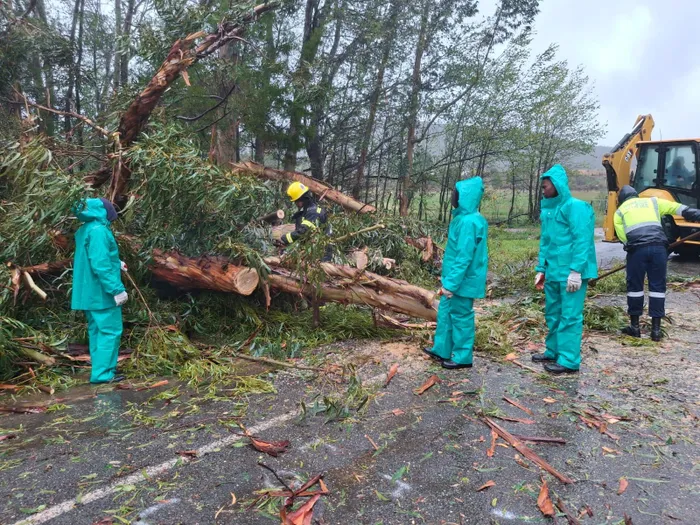
Disaster risk Management clear debris in Knysna.
Image: Supplied
The Western Cape Government has confirmed that at least one person has died, health facilities have been affected, and more than 120 schools remain closed as severe weather continues to batter parts of the province.
Speaking at the Provincial Disaster Management Centre on Thursday, Acting Premier Ivan Meyer said the province’s response has been guided by a clear priority: "to save lives, save property and also animals".
"We have had thus far one loss of life… we express our sincere condolences to the family, friends, and colleagues," Meyer said, confirming the death of a Western Cape Government employee in Knysna.
The update follows a Level 8 weather warning issued by the South African Weather Service earlier this week, with the worst impacts having been recorded in the Garden Route and parts of the Central Karoo.
Authorities said while the warning has since been downgraded, conditions remain dangerous, with ongoing risks of flooding, mudslides, and infrastructure damage.
Head of disaster management Colin Deiner said several communities remain cut off, while major roads have been flooded, disrupting traffic and emergency access.
"We are still seeing a potential for localised flooding… some communities that are cut off… and major disruption to traffic flow due to roads being flooded," Deiner said.
The storm has also impacted essential services. Officials confirmed that clinics in parts of the Karoo remain closed, while facilities in Knysna and Bitou have been affected but are still operational.
Education has been among the hardest hit sectors, with widespread school closures implemented as a preventative measure.
Disaster management teams said 128 schools across high-risk areas were closed after authorities mapped flood-prone routes and transport networks.
"Life safety always comes first… the decision that was made was to close these schools," officials said, adding that more schools could remain shut depending on conditions.
Damage to school infrastructure has already been reported, including a destroyed mobile classroom near Uniondale and flooding at multiple campuses. Officials said full assessments would only begin once water levels subside.
Despite the disruption, plans are in place to reopen most schools as conditions improve, with a focus on ensuring learners receive meals.
"Learners in those areas have not been fed for two days… it becomes very important for us to be able to feed learners," officials said, noting contingency plans to provide food parcels, where schools remain inaccessible.
Additional details from municipalities show the scale of displacement across the province. In Bitou, more than 190 residents have been sheltered across sites, including the Kranshoek Griqua Church and Wittedrift Community Hall, while further precautionary evacuations were implemented near the Keurbooms River, as water levels rose.
In Knysna, about 200 people have been accommodated at a local church, with others from Masifunde and Hornlee moved to community halls.
In the Karoo, at least 80 people were displaced in Klaarstroom in Prince Albert, while 25 people were housed at Toekomsrus Community Hall in Oudtshoorn, where food and blankets were provided.
Authorities also confirmed that 10 people remain cut off by floodwaters, but are not in immediate danger, and all 64 occupants at the Oudtshoorn Mountain Resort are safe.
Authorities confirmed evacuations in several areas, including Prince Albert and Bitou, while emergency housing support is being provided to displaced residents.
Search and rescue operations have also been ongoing, with four people rescued after being trapped overnight by floodwaters near Beaufort West.
The government said preparations ahead of the storm, including pre-positioning helicopters, rescue teams, and emergency services, helped limit the impact.
"Preparation, preparation, and preparation to save lives… that is exactly what this centre has done," Meyer said.
Looking ahead, officials warned that climate change is intensifying extreme weather events in the province.
Officials said coordination between municipalities, disaster management teams, and humanitarian organisations remains ongoing, with shelters, food relief, and evacuations continuing where needed. Residents have been urged to avoid flooded roads and remain alert as conditions evolve.