Malema's five year prison sentence shakes politics


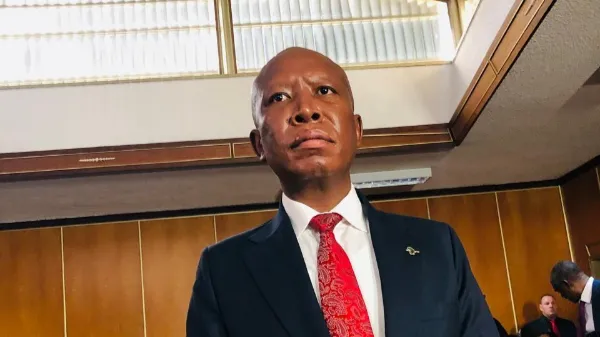
Julius Malema, leader of the Economic Freedom Fighters, has been sentenced to five years in prison for discharging a firearm, igniting widespread debate about the implications of the ruling on South African politics and justice.
Image: Abongile Ginya
The sentencing of EFF leader Julius Malema to five years in prison has sparked a divisive array of reactions across the nation.
The East London Magistrate's Court on Thursday sentenced Malema to five years’ direct imprisonment, released on warning, after finding him guilty on multiple firearm-related charges linked to a rally held in Mdantsane on July 28, 2018.
Malema was convicted on charges including unlawful possession of a firearm and ammunition, discharging a firearm in a built-up area, failure to take reasonable precautions to protect persons or property, and reckless endangerment.
The ruling followed a protracted trial and closing arguments.
Zwelinzima Vavi, from the South African Federation of Trade Unions (Saftu), expressed his shock at the verdict while echoing sentiments of fairness under the law.
"It is my considered view that a higher court may well arrive at a different conclusion," he surmised, aligning with others seeking a reevaluation of the trial's handling.
The Freedom Front Plus welcomed the sentence, saying it confirmed that “the rule of law still applies and that no one is above the law”.
The party noted that, in terms of the Constitution, a person sentenced to more than 12 months’ imprisonment without the option of a fine may not serve as a Member of Parliament, but added that Malema could remain in office pending the outcome of an appeal.
The DA supported the ruling, with leader Geordin Hill-Lewis saying it sends a strong message about accountability.
“Gun violence is out of control in South Africa, so any crime involving illegal gunfire is extremely serious. It's important to punish illegal firearm crimes harshly.
''Only when people understand that there are consequences for crime, will we get gun violence under control in South Africa,” he said.
“The sentence also sends a clear message that in South Africa nobody is above the law. Today is a good day for the rule of law in South Africa,'' he added.
Patriotic Alliance (PA) leader Gayton McKenzie declined to comment directly on the ruling, saying he would instead pray for Malema and his family.
“I will not be giving any comment regarding the sentencing of Mr Malema except to pray for him and his family. Prison is tougher on families.
''I don’t celebrate when tragedy befall people even my enemies,” he said.
Meanwhile, the EFF signalled its intention to challenge the ruling.
Speaking outside court, deputy president Godrich Gardee said the party was preparing urgent legal steps to prevent Malema from going to prison.
“Our spirits are very high. That’s why we are here, there is another team at the Constitutional Court who will not sleep for a minute in the cell. We will get a judge on duty to hear the matter for a bail appeal,” he said.
Gardee said the party rejected aspects of the judgment and would pursue further legal avenues.
“The matter is still subject to appeal, we will challenge them accordingly,” he said.
Build One South Africa (BOSA) leader Mmusi Maimane said “we must never rush to celebrate another man’s downfall.”
Speaking to IOL News, ActionSA national spokesperson Matthew George said the party notes the court’s ruling.
“As a party that believes in the rule of law, we welcome that the court has duly assessed the evidence in this matter and has issued its ruling in that regard.
''While we note the ongoing appeal regarding sentencing, we believe this case underscores the importance of a legal system in which everyone is accountable before the law, without exception,” he said.
On Wednesday, Malema’s legal representatives, including Advocate Tembeka Ngcukaitobi and Advocate Laurance Hodes, argued that the state had taken an inconsistent approach in emphasising his political prominence.
Hodes told the court that his status as a public figure must be treated consistently, either as a mitigating factor or an aggravating one.
“So, you ask on the one hand to make an example of this accused because he is the current leader of a political party, then they tell you, ‘no, there’s an imperative you must make us all equal before the law,’” he said.